
hi great to be here and fantastic day
really enjoyed the entire session how
are you enjoy so I had a good time right
it’s so amazing I hope I can end it
little like you know at least something
I can do at the end of it right so so
yeah I’m actually you’re gonna speak
about something which is about garbage I
think the last topic also the body I am
going to really get into garbage right
now and how many of you heard about
waste management right so I’ve been at
this in this space for last 7 years
surely by mistake after my graduation I
accidentally chanced upon to work with a
nonprofit called X Nora in Chennai just
because I had an idea so it’s not
because I could not know a thing I had
an idea for a chance to work over there
and also a year of working there I
really this it’s really opened up the
space to me and I was seeing like lot of
news in the paper every day about
garbage being piled their garbage issues
happening yeah but it was only problems
that kept coming in the papers there was
never solutions that were coming in and
that really got me to start Paperman
seven years back so today I am gonna
actually I’m gonna go with a simpler
topic it’s gonna say that I actually ate
my toothbrush last week and I want to
check weather with you people do you
guys eat your toothbrush anytime you
know and you’re fusing that’s what I’m
gonna check out here so this is the
story so you are you should wish anyone
who doesn’t know it everybody uses
toothbrush right great so you know how
it is made it made with plastic right so
you know how many toothbrushes are made
in a year so there’s 15 million ton in
1964 3311 tons in 2014 and 612 million
tons by 2036 this is the king of
toothbrushes I’m talking about a single
item disposable plastic that we use in
our life a single disposable item a
toothbrush right
so bill get the pressure thrown away
obviously we all don’t use the same
toothbrush how many of you have used to
do this for 10 years
hey for the max you use three months six
months right max but less than 14
percent of this is recycled globally all
the tooth beside you use 14 percent less
than 14 personal recycling globally so
this is what happens
one truck full of plastic one truck full
of things get dumped in the ocean every
minute
this is stat we’re talking about a world
with 7 billion people that’s quite a
number right every time we throw a
toothbrush away do we think about this
think about 7 billion people throwing in
this away right and more than five
trillion pieces of plastic ends of an
ocean and that’s the size of 3585 blue
whales that’s the kind of plastic that’s
there in this thing and by 2050 there’ll
be more plastic in the ocean than fish
at the rate that we are going this is
the situation right the spastic is a
very I think it breaks down it breaks
down to small micro plastics right in
the oceans make down small micro
plastics and what happens fish eat them
right so I come prevailing I come from
very coastal town in Kerala and in
Chennai also ice in the coastal so fish
is a big part of our diet so this what
happens to me most Sundays so okay so
for the last how many years and imagine
as it goes on it keeps happening and in
the coastal region in especially in
Tamil Nadu and in Kerala there is not a
single family today that has does not
have one
cancer patient in the family it’s quite
an alarming thing right most families
have at least one person who’s with
domestic cancer and this next time you
throw a toothbrush away imagine how it
bites us back right so I just want to
bring some light to the topic that we
want to discuss further so I don’t want
to come up with solutions today I’m
going to actually
go deeper into this problem and I’m
going to leave it to you like I think
sukima did in the talk right to like
think of audits because we need more
problem solvers in the space right I’m
going to throw a light more on this
problem today right so let’s get let’s
take it to the larger picture of things
we’re thinking only at toothbrush when I
was taken to a larger picture right
India dumps of a 62 million tons of
trash every every or annually the thing
look it’s across cities if you go indoor
I’m sure that outside of the landfill
where all this trash is being dumped
right all the plastic bottles that we
used today right doing this session
where is gonna be dumped we all think
about it when we use it but what happens
we do after we throw it away right is
there in a way the cyclic world rap
speaking and child labor all this all
this plastic bottles that we throw away
today is encouraging rock quickly
trafficking and child labor so in
indirectly we are engaging in the same
process today right it’s going to get
dumped in a landfill where their kids
are going to come in they’re going to
don’t want to pick up these things from
home they’re gonna get hurt the
hospital-based lying in ass right second
thing is a rapid urbanization and
growing disposable income sorry for that
tonight rapid urbanization and growing
disposable income right India is that
you have two billion people put into
that right 2030 now how are you going to
meet this world is going to move 10
billion people
India is gonna be the most populous
country in the world right and everybody
is this possible income is higher
getting an increase and we all want
consumption right we all want to have
what our neighbor has right so we are
all buying and where is it all going to
end
viral decisions to water and air
pollution this is a case in fact in in
Taiwan last year they reported 16 deaths
because of its dump yard and it’s going
to happen in China in India last year we
had Mumbai fire burns that happen in the
land dump sites right the air pollution
the water pollution is just getting out
of proportion right and it all starts
with us throwing the toothbrush away it
all starts with us through that
Shammi so how are you gonna stop this
I’m gonna I’m gonna I’m gonna basically
introduce you to a few people a few
friends I made in the last seven years
you might know the manager but these are
friends who were actually do something
about this issue I have seen I’ve seen
so many people I’ve spoken to so many
people about waste management but I
actually found these are the people who
actually do something about this problem
in this country right let me introduce
to them let me introduce you to friends
from this one is lecture Minh having
seen somebody like lecture Minh and her
carriage ever seen some real a knight
like him yes selection election is
basically lived near Kanyakumari he runs
a small little waste shop right he has
got three girls children I think this
picture was taken right after his third
child was born and he’s a very happy man
it could clearly see and he runs a small
shop on the side there’s not only
covering it’s a side shop explain for
you this is Abdul here in Chennai and
you can see his shop a small cookie it’s
a fifty spice shop right within which he
works right
he is collected or I can see behind him
all that cardboard places plastic little
bit all the stuff that is accumulated in
the shop so that’s a bill for you he’s
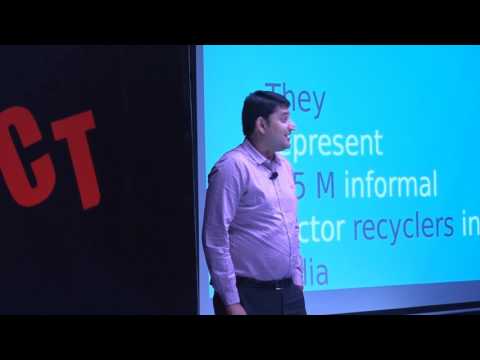
he’s a thing together they represent the
1.5 million informal sector in this
country
it’s a 1.5 million strong informal
sector in this country and these are the
people who actually go out and make a
difference every single day right for
that every toothbrush that we throw away
they find a way to collect it and send
it to the factories where it gets
recycle at 14 person that happens today
of recycling right in India they are the
primary reason for doing that nobody
else but what would they get in return
they are discriminate they don’t get
quality of life you know and it’s not a
good life that they live right
and together and this is the most
amazing thing together
the refax is 20 billion worth of
materials in India so Indian informal
sector of recycling in the 20 billion
dollar industry it’s a come 20 billion
dollar industry which is which is God
these guys who come and pick up from
your homes then you have the what do you
say the the wholesalers who accumulate
from them then there is the next leg of
recyclers who buy these materials the
factories the paper recycling Factory
the plastic recycling factories and they
produce twenty billion dollar worth of
second-hand materials right and they are
the pillars of the India’s trash economy
we call this a trash economy which is
hidden which is not shown it is it is
that there’s a very very evident trash
economy in this country and which is yet
to be discovered completely now if this
economy is supported at the government
it comes into light right and we all
play a role in this it does not form at
just one organization doing something
you all play a role in this this flash
economy can be a hundred billion dollar
industry so I’m talking about the trash
being an opportunity not a problem right
and that’s how you should see the trash
and there is a big opportunity in it it
can be a hundred billion dollar industry
if it is rightly channelize if the
government looks at it like this way and
government starts supporting the
informal sector and you know and also we
all as people start working together
with our informal sector to recycle more
it can be a hundred billion dollar
industry so how can these be done so I’m
gonna here only share a few examples of
what can be done because these are few
things that we are experimenting at
Paperman but I’m sure there’s lot more
done right so in fact my presentation
ends here right this is where my
presentation ends and I want you to
think about the solutions that you guys
can come up with but from here on I’m
going to give you four things that we
are doing currently that where we are
taking a few solution so you can have
some ideas on thinking about these
things one we work with these guys to
improve their business practices so we
we provide you can see that electronic
waste scale it was something like your
uber for trash so we map these kabadi on
us and like I said we connect them to
the households where they
go and they weigh the materials and they
pay for it or people can donate to
charity if they want so that’s what we
do we improve their business practice
I think we start seeing them as
franchisee owners we start seeing them
as entrepreneurs not as Pickers or
trashing we we start seeing that they
they need to have a better quality of
life
second thing we do is we incentivize
people to recycle that’s very important
right if you don’t see value in your
trash
you will not treat it right so we
created a platform called trash funding
where your monthly trash is going to
educate a child now that you see more
value in that right when you know one
child is going to school because of your
trash you see more value in it right so
it’s a platform so today the platform is
raised from 25 lakhs worth of trash we
have around 4,000 users who use it in
Chennai who give their donate their
monthly trash to various NGOs your 40
NGOs it’s like a Kickstarter for trash
yeah it’s like a Kickstarter for trash
third promote material recovery right
that is we engage with companies which
are into resource manufacturing and like
say Tamil Nadu newsprint limited or a
few other companies where we make sure
that material recovery is taken optimum
levels so that’s critical because once
you collect this to the system you need
to have a market for these materials
right now I’ll give an example
tie off we all have ties right we are so
then what only two persons of car tires
get recycle in India but you know in
Tata is recycles the after products are
one carbon black furnace oil and then
you get steel this is what the research
of Java no recycling tires so it’s a
it’s a it’s a it’s a big opportunity in
itself but today what happens there’s no
market connectivity over there right so
we work with vendors we work with
partners to ensure that there is a
better material recovery for these
products so we take one product at a
time and build a product stream around
it first thing that we do is we acute
the informal sectors to execute EPR EPR
is nothing but n per excellent producer
responsibility
right now that’s like something like a
Pepsi right a Pepsi produces a bottle
right back in your coke comes a Pepsi
comes in a bottle right now imagine
Pepsi has the responsibility to make
sure that bottle goes back and recycle
right so we work with Pepsi to give them
stats in in the China market like say
how many of your bottles today actually
got recycled right to work backwards
integration which also creates more
economic opportunities for these people
from the traditional income generation
of weighing your trash and getting money
for it right so we’re trying to create
an whole model around that where brands
engage with your local kabadi on us big
brands engage of the local kabadi with
us to actually build an entire circular
system of products which means less goes
to waste and more comes into this thing
so these are a few things that we are
trying at Paperman but there’s a lot
more that’s to happen and I think what
we are doing is only going to have one
person of this problem like sir I was
saying today in his eco village the
things that he is doing right and we
need each of you to come up with your
own ideas your own solutions your own
imaginings you had to come up with large
because this problem is a problem of 1.3
billion people today right and it cannot
be solved by one organizations cannot be
solved by one individual it has to be a
multiplier impact it has to come by
building a trash economy we need to
build a trash economy in this country we
need to build as an opportunity and more
entrepreneurs more problems always has
to come into this thing so you can
decide whether you want to start
continuing to eat your toothbrush right
or you want to actually move forward and
make a solution out of it thank you so
much
[Applause]
Please follow and like us: