
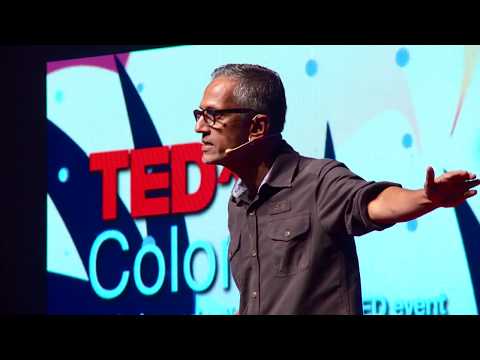
[Music]
good evening quite unknown to me when my
friend and colleague at work near Ubben
had nominated me to speak at TEDx I was
wondering what would be an idea worth
sharing and I thought if I connect the
dots so to speak in my life and think of
the most important moments I quickly
realized that it had very little to do
with technology or the business that
I’ve been involved in you see when I was
15 years old I was introduced to Marxism
by my brother Francis who guys see over
there he took me to see this veteran
trade union is called ballot humble and
Ambala top was an extraordinary man and
it was a life-changing moment for me
because you see Bala was a great
socialist in the true sense of the word
and he was a humanist he was a brilliant
lawyer probably one of the best his
country has produced and yet he chose
not to amass wealth for himself but
dedicated his entire life for the
upliftment of the working people of this
country in particular and also the other
oppressed people now it is my
relationship with Bala
that I became socially conscious but my
Marxism in practice I learned from my
mother when I was about 5 years old
now my mother was 20 when she married my
father who was 40 a staunch Catholic and
he took to heart the biblical saying go
forth and multiply
and and and so he did he in a period of
twenty years he gave my mother eleven
children and in a moment of absolute
selfishness he dropped dead when he was
64 I was four don’t make calculations
please so and and and my mother was left
in an utterly hopeless situation she had
what Frances we had like 15 people in
the house my grandmother cousins 15
people and she has to sustain this
family with a media income of my
father’s pension how did she do it
some years later I asked her now weren’t
you terrified when this happened and and
she said no and I said why not because I
knew that God will provide simple as
that faith but I think it is a ingenuity
that held and sustained this family I
remember an incident when soon after we
had my father that we moved to a new
house and there was a neighbor and for
some strange reason that I can’t
remember he took a dislike into us and
one night he said he was going to attack
a house my mother being a good captain
him caught the children together we all
knelt down and prayed and then she
realized that prayer alone might not
save the day we better prepared and so
we organized ourselves there was a front
door barricaded my brothers were in
front with whatever they could lay their
hands on I remember three-pound garden
fork and and and some in a crowbar
deadly equipment but behind where my
sisters with pots of chili water chili
powder dissolved in water and the game
plan was if the intruders broke through
the boys will duck the girls we threw
the chili water and then we brought them
with atmos ferocity but but you see
nobody came and and it was alright but
you see in this one instance is when I
realized the marxist maxim an ounce of
action is worth a ton of theory and and
there are two important lessons for me
really one is that the power of
organizing how to organize the limited
resources with creativity and
and an innovation and secondly very
importantly any successful action can
only start with a clear consciousness of
the issues at hand and in this case it
was a mother wanting to protect a family
but today sadly a lot of us are
completely indifferent and and
disengaged from from any of the larger
issues that face the people of this
country we think that we involved in any
collective action is to be political and
oh my god that’s a bad word isn’t it you
go to a party and you talk about any of
the larger issues and people say hey
please don’t start a political
discussion here are you a no politics
please and then we leave it to the
politicians to address the issues that
affect our lives in the lives of the
people in this country how foolish is
that do you think that this cake
institution called a parliament can
really bring about any meaningful change
to our lives and for this country and
the people who be elected are they truly
representative of us and interests of
our community and yet me show up at
elections hold the pencil in our hand
and the ballot paper and think my god
they’re good exercise a great democratic
freedom for change and then we can
disappoint it like what you hear these
days on I say these fellows are just the
same no better than the other lot and
this goes on but nothing has changed in
this world without the participation of
the masses of the people nothing and yet
we are afraid to get involved in any
kind of collective action because we
think that to be involved in action is a
frightening prospect you know we created
the demonstration teargas broken limbs
death but you know what in my life
organizing was not such a daunting task
really because in 1976 when I was near
advanced level class for the first time
in Sri Lanka the police had entered the
university in parody Nia and shot dead a
student but is the first time does that
happen and so we quickly got together
and we said to you should we do
something about this and then all my
friends and some of absolutely mission
so on the day that the trade unions
called for a direction mind you this is
one life in 1976 I don’t want to talk
about the thousands of death that we
have had later and we have been
completely indifferent to this one death
when the trade union stopped work we
boycotted classes and no more no mobile
phones no Facebook no nothing
there was a soccer match the previous
day we sent the word out the next
morning I went to the cantina hid and
looked at the when the bell rang the
director came no one except a few
stragglers who hadn’t got the message
obviously but you know so what did you
achieve a collective consciousness that
even a killing of one student is
completely deplorable and then much
later we had good fun doing these things
much later when I was at State Bank of
India my first job I was 22 as elected
president of the cylinder of the bank
Employees Union on the branch there was
some dispute I can’t remember what it
was we thought we’ll keep a strike
action as action of last resort and we
said can we do something creative and
you know what we did we decided we are
going to come to work in our sarongs
and the ladies will come in the house
courts now the ladies will wear in the
house courts over what they were wearing
we didn’t have much under a sarong and
and this was not one of those fancy hand
loom sarong huh these are these a clock
that you tie and you know just like you
know you’ll come out via blue jeans on a
Sunday morning and and there we were and
you have no idea what this was unless
you know having been inside State Bank
of India
it’s a majestic building in four massive
columns high ceilings fans with
beautiful windows and this emblem of the
old name of the old Bank Imperial Bank
of India and there you were running
around but our customs were sold but the
banks image was not and very quickly
they settled it and we had great fun but
anyone asked yourself okay fine you had
some success but isn’t this a very local
issue it really addressed a larger
issues facing the people in this country
by non-confrontational protest action
and I want to share with you probably
the most important struggle that I have
been a part of and that was to save the
phosphate deposit in a parallel now a
parallel as you know is a you may not
know is there is a village 240 kilo me
in the north-central province of this
country in 1970 a substantial deposit of
phosphate was found
now phosphate as you know is a
non-renewable natural resource and the
National Science Foundation at that time
had said if we mind this sustainably we
can make it last 200 years I’ve read
some articles that said you can make it
last a thousand years
now meanwhile in other parts of the
world phosphate was depleting and frost
rate is very important for the
production of aggregate eliezer but the
government of the day 1990 decided to
hand over these these deposits to a
international consortium that included a
notorious mining company called
freeport-mcmoran and they were going to
strip mined this and deplete this very
rare resource in 30 years and in the
process they’re they’re devastated and
destroyed one of the most agricultural
in archaeologically rich parts of this
country ravaged and ruin very much like
what they did to an island called Nauru
in the South Pacific
seven square kilometers second richest
in the world per capita income today
destitute and Island looks like a crater
created moon now one single man decided
he must do something about it a lonely
monk Mohammed a pirate and terror from
the ancient temple purana vhari of
golconda he decided we can’t let this
happen and he mobilized the people now
that caught the attention of the trade
union led by Bharat on boom I spoke
about he was terribly inspired by this
man and we went to a parallel and found
the courage and determination with which
these people were ready to even lay down
their lives and the monk was threatened
but the trade union got involved the
peasants in the in the in the village
the trade unions in the city and we
started a campaign very soon
environmentalist actors writers
journalists juries scientists Academy
everyone got involved in this and in one
day of collective action while the
people of our power came down and worked
on the streets of their village we
walked out of our jobs in the afternoon
and picketed in the fort railway station
the most
the crowd of people I’ve ever seen in a
picket line and the groundswell of
public opinion the Supreme Court decided
is a violation or the fundamental rights
of the people in this country and the
project was stopped now what we saved
was not just the phosphate deposit now
powerless it’s in the middle of an
extraordinary man-made ancient elaborate
soil and water conservation system that
fed water to the tanks from ancient
times to today in anuradhapura and
irrigated thousands of acres of land in
this country the Nobel physicist nobel
laureate physicist Philip Anderson of
Princeton no less said a parallel is one
of the most one of the most
scientifically important and unreported
stories in this world how did we stop
this just by the collective
consciousness of a cross-section of the
people in this country who decided we
must do something to protect a part of a
heritage or culture or people and our
land and that brings me to the precision
is it all right for us to be indifferent
to the massive problems his country
faces today you have heard the blaster
of the politicians grand vision of 2025
wonder of Asia now you are laughing
but you are not laughing then but look
at what this country is going to face
debt when our current creditors come
calling in two years from now 2019 our
debt will be three point nine billion
dollars our reserves today are four
billion by to talk about 2019 we need
seven billion to pay our debt and to
bridge the the budget deficit that the
financial deficit now you don’t need to
be the head of IMF to figure out we are
not going to make it four point five we
are not going to have the growth because
we are facing the worst drought this
country has seen in 40 years corruption
we are slipped from whatever we were to
the 95th position in the transparent
international corruption index and the
country we like to aspire to be
Singapore is number eight water massive
crisis only 40 percent of the people in
this country I am drinking water and the
rest of them depend on Wells rivers
they’re running dry and that and and
recently you saw the umayyah project
take sucking in water from the
underground and releasing a two hundred
thousand liters or something per second
and they’re sending water by browsers to
these people but two important things I
want to talk about before my tongue
hangs per time runs out health and
education health is a frightening
situation we face you have heard about
the kidney disease problem there has
been ravaging this country for the last
thirty years still they don’t know the
cause because most of it happens in the
Unruh the poor among the poor farmers we
need a thousand Alice’s machine beer 180
there’s no chance in hell that we’re
going to deal address this problem
meaningfully now compound this with
diabetes one out of five Sweden consent
diabetes one out of nine Singaporeans
have diabetes and the prime minister of
Singapore has declared war three things
he spoke about as important things for
him
in his in his National Day speech
preschool education smart nation
diabetes now diabetes contributes to
kidney failure now you see the problem
compounding by twenty thirty thirty
percent of this country will be the
aging population over 65 look at their
health problems these three deadly
developments are going to come biting
and cripple our health system completely
you saw what happened when the dengue
outbreak three people to a bed in a
hospital and the doctors and nurses are
at breaking point
education isn’t it terrible what we put
our children through and I talked about
this ridiculous scholarship exam grade
five they take these children what 10
years old 11 years old and put them to a
nationally competitive examination to
get the race to the top so that they can
get to better funded schools for the
secondary and an higher education and
what we do we send them for classes when
they are 1 grade 1 5 years old every day
tuition classes what are we doing they
are taking the joy out of our children’s
childhood and in the process they’re
killing the human spirit and this brings
me to the talk that Ken Robinson gave a
famous TED talk you must listen to this
do schools kill creativity and he makes
a very compelling case that as we face
an uncertain future what we would need
is creativity and the teaching of the
Arts in the schools and I completely
subscribe to his view in fact that’s one
of the few talks that has inspired me so
much that I talk about it at every given
opportunity like I’m doing today but I’m
now asking myself it’s creativity alone
enough creativity for what shouldn’t
creativity serve to create a purpose of
humanity take the example of Google
Amazon Facebook and Apple my god these
are great innovative companies aren’t
they and they absorb the best creative
talent in the world and what are they
doing for the betterment of humanity
very little in fact all these companies
hold billions of dollars of money that
should be paid in fair share
taxes money that can go for critically
absolutely urgently needed public
spending and they contribute to the
greatest income inequality in the world
and you want to send the best and
brightest to work for them
that is their consciousness and what do
they do look at the income inequality I
mean today six people in the world
all males four of them from Silicon
Valley owned as much wealth as 50% of
the world’s population 3.6 billion is
that all right and so I come to my
conclusion Lenin Balaton Poe said told
give me ten professional revolutionaries
and I will overturn Russia and he was
referring to the most oppressive Czarist
regime that the world had seen millions
of people in poverty and starvation and
all that but I’m looking at this room
today if everyone water ticket came
there are 1,100 people and some of you
extremely talented
we were access to technology that I
could never have dreamed of when I was
your age and you have some wealth as
well now suppose you had used a little
bit of your consciousness to address one
of the large issues that face us that
would have been very meaningful and
that’s why I say an ounce of
consciousness is worth a ton of
creativity and suppose you had 30
seconds to reflect on your life what
will you think of okay
I had a wonderful career had a great job
and one good eye you know provided for
my family they’re all looked out of
great I had a great carefree life
fun-filled life wonderful but what if
you have used the talent that you have
the knowledge the resources and your
creativity to have raised consciousness
about one of the many inequities that
face this country today and in
had to be a part of a movement look at
the possibilities only then can you
truly say my life was well lived and a
life was worth it
thank you
Please follow and like us: