
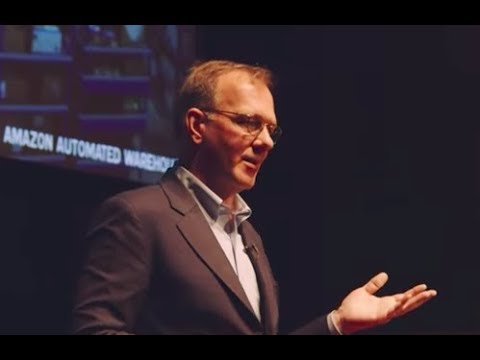
I’m here to wake you up because it’s
Sunday morning and I’m going to speak
about AI and robots and all that sort of
stuff and I I would suggest that you
will be awake by the end of that talk at
the very very least now knowledge is
power
that’s what Francis Bacon famously said
more than 400 years ago and I was
thinking how is this actually today so
let me start with a question who here
knows what an exabyte is other than the
fact is a very large number 10 to the
power of 18 you see I couldn’t picture
this so the image you see behind the
number that’s the Library of Congress in
Washington DC which is the largest
library in the world unless you listen
to the people from British Library who
think they have about five volumes more
but some that doesn’t matter so much so
the entire printed content of the
Library of Congress can be stored on an
exabyte one hundred thousand times so
last year there you go last year we
exchanged information over the Internet
to the tune of 1,100 exabyte that’s 110
million times the library the content of
the Library of Congress in one year and
each and every one of you in here has
access to that via your smartphones that
is doubtlessly in your pocket and
hopefully on silent so in front of that
background the question is is knowledge
actually still power today now we only
live we live in the edge of the computer
the one you see here was one of the most
powerful mainframes of its day it’s an
IBM machine it was so powerful actually
that it this was the machine used in
ground control used for the Apollo 11
mission to put a man on the moon they
ran the most sophisticated programs the
most complex stuff in its day and the
program size was 6 mega
which is actually less than 10% of candy
crush saga on your phone now all this
goes back to this man Gordon Moore one
of the founders of Intel who is the
author of Mohs law which of course isn’t
really a law but he basically said that
roughly every 18 to 24 months the number
of transistors on a chip will double and
therefore it’s not a straight line but
it will basically mean that the
computing power will double the when you
when you look at the graph you would see
this as an exponential one and you know
it’s sad to say but Moore’s law is dying
or internals getting slower but we’re
still waiting for the new chip
generation we are almost three years in
fear not though because there is new
stuff on the horizon and that’s quantum
computing and I have absolutely no idea
what that’s supposed to do other than
justin theroux who can actually explain
it to you however we have a son who
thankfully is a physicist he just filed
his thesis on practical quantum
computing things cross dude wherever you
are and so he said look it’s actually
very simple um what is on here is
accurate in other words if a really fast
modern computer can read in inverted
commas every book in a library a quantum
computer can read every book in the
library at once so we’re looking at
several orders of magnitude and
computing power that we will be adding
god knows when in ten years time in 50
years time student and all that rise in
computing power allows us to to look at
a lot more complex problems of computing
and that is what is now known as
artificial intelligence way I when I
grew up this thing existed only in
science fiction movies but it’s very
much with us today and I’m going to show
you a little bit about this now if
you’ve been reading the papers in
particular over the last year or so you
will also have come across the term
machine learning
if you are in that space you know
exactly what it means if not it actually
means what it says on the 10 namely the
machines are coming now it starts really
really harmless when you look you know
this is a factory worker and you think
come on you know we’ve had industrial
robots in car factories for decades and
that is true there’s nothing you last
summer however I stumbled across this
this headline company called Foxconn was
the largest manufacturer of consumer
electronics in the world they build
about a third of the entire consumer
electronics and one including the iPhone
now they announced that they would
replace 60,000 workers with robots and
what that is in itself a really scary
big number what really really I thought
was shocking was that this means that
someone who makes $5 a day is now too
expensive and therefore will be replaced
by technology the same thing you find
for instance warehouse logistics those
little orange things there are robots
that that drive shelves towards the poor
guy who still has to pack them in an
Amazon warehouse Amazon acquired that
company they want to put 50,000 of those
in the into their various warehouses it
also works it also works for for very
large packages port of LA they those
things drive themselves and if you want
to take it a notch darker this guy might
be your next policeman he’s faster than
Usain Bolt and he lasts longer than only
100 meters you don’t outrun him
meanwhile in the parking lot of uber
this friendly Dalek here is doing the
parameter control and make sure that
putting the virtue shame now yet a notch
darker if you need a you know sniper if
you’re not the government you probably
need to go to the dark web but you can
buy this thing today I mean this is this
is commercial grade killer drones
there’s also your thing well you know
there’s this other thing but this
builder can build you a house for brick
and mortar in two days never draws a
sickie never needs a needs needs needs a
day of vacation never gets ill and never
has a bad back from all those bricks um
but there’s also like like red really
fun stuff hello Tech there we go so this
is a pizza delivery guy and you think
hey dude this is awesome right says I’m
just diving up Domino’s and and and
order it now if you live in Auckland New
Zealand if someone is listening you can
do this today because Domino’s and and
flirty which is a drone maker and they
actually started trialing pizza delivery
via drone in November of last year so
you know if you think I’m talking to you
about a far-flung future no these things
were happening today and then you think
well but you know in in dense urban
environments you cannot fly a drone and
fear not clicker there you go
you can also get it on wheels and it
will just roll along nicely on the
pavement and deliver the deliver your
pizza to the front or leo end live two
weeks ago in Washington DC and and and
Redwood City in California and if you
think Pizza Pizza Pizza is is all too
boring you know there is of course also
a robot that can cook up to two thousand
meals and you can buy these things now
uber takes it or not hire not only
parameter control with friendly Daleks
but they actually started trialing
self-driving cars to pick up real
passengers in and not only in some some
odd little place where no one lives but
in Pittsburgh which is fairly densely
anslee populated and if you don’t want
to ship around people but things this
truck has been trialing on the roads of
Nevada for the last four years now the
backdrop to this is worldwide about 400
million people earn their living by
shipping people or things from A to B
and they’re all in the process of being
potentially displaced this is Sunday
right we should do a bit of culture meet
Emily Howell you can look everyone
Spotify it’s very very gentle nice piano
music the thing however is Emily Howell
is an algorithm sign to a label for the
time being so admit and honestly listen
to it because it’s amazing
and then last last autumn I stumbled
across this headline the good folks from
google deepmind deepmind his company
based out of London that was acquired by
Google and they they published this
really complex scientific article about
about wavenet which is which generates
audio and that means that the next Emily
Howell will actually also be able to
sing and you wouldn’t be able to tell
the difference if that’s a human being
or not and you know you might have one
of those since last Christmas in your in
your kitchen hey Alexa play me a very
nice song now
the background to voice recognition and
voice output is you know that’s a really
complex computing problem and it is
there let’s go one further this is the
dead funny robots called Dexter and
here’s a very nice nice nice face but
it’s also here’s camera so he will watch
you doing things and then you will learn
from that so if you fold a shirt Dexter
will from you doing it learnt how to
fold a shirt now that’s pretty cool in
itself but last summer then there were
there were some guys from I think it was
Carnegie Mellon who said well you know
wouldn’t it be cool if robots of
different makes and kinds and could
actually teach each other so this isn’t
live yet but they’re in there in beta
stage and they actually start to
developing languages so that you know
you have some robot in somewhere in
Japan is that hey guys you know I don’t
really don’t know how to fold a shirt
can you help me out
Dexter said I got you when I was little
I trained as a lawyer and my dad said
look you know I mean this is this is son
become a lawyer an accountant or a
doctor right it’s you safe
Oh guess what I’m not well I am because
I fled the profession quickly enough but
again last time last summer was a good
good summer for a I Clifford Chan’s one
of the largest law firms in the world
one of the big magic circle firms in
London and Baker Hofstadter is a large
law firm the u.s. they both deployed
different AI lawyers in their practice
in their bankruptcy practice in the u.s.
the guys and and Clifford chances for
one of the most lucrative parts of
corporate law which is corporate due
diligence so this is today now the end
result of all this is is that you know
we need two jobs will automation will
take every job it can take the number of
people working in agriculture in the
u.s. dropped from from about 90% in the
in the around 1800 to about I think
about 2% by 2010 and what you can see
from that is it’s not the immigrants
guys it’s it’s automation and yes I am
an MBA so you might want to ask you what
is it you do how many repetitive tasks
are in your world to review an
accountant start looking if you’re in
radiologists I suggest you might want to
retrain it’s very very you know anything
that has repetition in there the Machine
could in theory and I’m not saying this
is going to happen tomorrow but a
machine can in theory do this better
faster cheaper and without without any
any vacation leave now however we are
being told right is not only doom and
there is new jobs for you and when I
read through this list I know like what
the heck even is this what is a memory
augmentation therapist and what on earth
do you learn if you want to become a
diffractive optics modeler as funny
isn’t it but you know this is an actual
job ad from 2015 where someone was
looking for a diffractive optics mullah
who knows what TLDR means everyone else
needs to speak more with the kids guys
it’s too long didn’t read in other words
if something is so long that you
couldn’t be bothered to read you look at
the short summary so Ray Kurzweil is um
as a future religious tour whatever you
call those beeping he’s a scary record
and being very very accurate in his
predictions I’ve summarized this for you
so he basically says all this malarkey
about faster computing that I spoke to
you about will lead to a faster
innovation because we can deploy all
that power that will effectively then
means that we should be faster and
better to finding solutions to like
really hard problems things like
diseases and hunger and energy crisis it
said will all be solved which eventually
will lead to immortality unless you’re
really Catholic them probably not bodies
will eventually become obsolete and then
the last step is that we will be one
interconnected hive mind
I got knows what he was smoking then but
but you know when you think it through
that there is actually possibility and
no matter what you think about this it
means that change is coming and change
is accelerating you are very likely
living in an age today where this is
slowest it will arguably accelerate
through now this is nothing new right
change alone is eternal perpetual in a
mortal there’s a Schopenhauer like
hundreds of years back what I do what I
can tell you however is to just sit here
and hope it won’t happen is a bad idea
is a really bad idea now where do we go
from here
I think there is a big case to be made
to rebuild society because the whole
demarcation line between capital and
labor might be a bit unhinged but that’s
an entirely different talk there’s a
couple of tactical steps that can take
away a little bit of you of your fear
the big one is education now as a
stopgap should human machine
collaboration you know there’s certain
things that machine’s are actually
struggling with things that that aren’t
standardized things that you know
tactility and dexterity etc so you know
you can do that but it’s not only in in
in manufacturing it’s also you may have
may recall last spring or so there was
an AI alphago that beat the world’s best
ever like the Roger Federer of go and
with an amazing array of neural networks
however those were all trained on humans
so he could arguably not have done it
without humans and when you speak to
scientists every day they use massive
computers and data sets to actually do
that and then and then and then go with
it so there is that collaborative side
however longer-term let’s have a look at
what is specifically human because we
can find that and define it and then
nurture it then we can arguably find a
way to inoculate ourselves against that
machine revolution and not end up like
the poor folks in the matrix so there
are things that are made with love there
are things that carry emotional value
now this is the pattern my wife cut
who’s a tailor to make me this jacket
and despite the fact that she’s bi
beloved wife but if you are going
through that process of a bespoke jacket
and you know that this to the last
buttonhole this was handmade by highly
skilled craftsperson who do this not
only for the money but because they
actually love this this is something
that a machine will struggle to
replicate empathy is another one
machines can actually recognize that but
they but they don’t of course feel it so
any any any any job any action
everything that requires empathy that’s
a good place to be
creativity’s is one you know there’s a
hundred thousand monkeys they’d hack on
keyboard and eventually Ulysses will
come out that is not creativity that’s
brute force computing and again genuine
creativity is a hard one to mimic for a
machine and the last one is critical
thought now all of these things all of
those four things that have just shown
you cannot be found on a curriculum in
school they are however arguably the
cornerstones that we will need in order
to to provide a meaningful education to
our kids so that we can also educate
them for jobs that we have actually no
idea what they will be but those those
are the cornerstones that that you know
give us a little bit of hope in order to
do that however we need to ride that
train rather than jump in front of it
and with that I bid you farewell thank you very much