
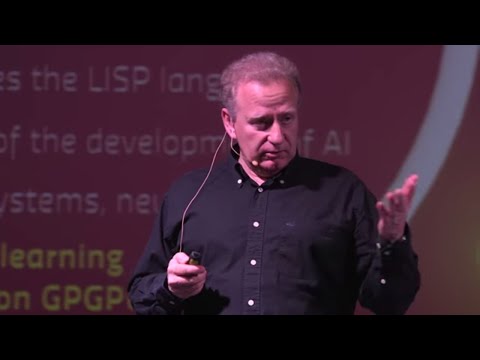
shape the future and because I’m a
computer scientist so something that we
are working on on our research team
right now in Strasbourg University is to
think on how it is possible to make
computers to make them autonomous to
have some creative autonomous computers
so in order to understand how this can
happen it can happen through the mix of
two things which is ai ai is artificial
intelligence but also artificial
evolution most people don’t know that in
parallel with the development of AI
artificial evolution has also developed
so if you look at a timeline on how
computers have and research on these
domains have been now going on
well 1953 is more or less the first
business computer the IBM 650 okay and
you see that artificial intelligence
developed in 1955 1960 56 and so on so
it was what some of the very very first
algorithms that have been developed on
computers were of artificial
intelligence but of course the very same
thing that has been puzzling people is
about evolution so if in 1953 you’ve got
first trials in Australia USA in Europe
in 1957 chains of bits have been evolved
by Frazer and you go on like this
and those two technologies have come up
come of age and interestingly enough it
has been sooner in artificial revolution
than in artificial intelligence
ever since the year 2000 now we have
human competitive computers algorithms
that are capable of creating of
innovating creating get imagining new
solutions that had never been thought
about before by human beings
and since 2009 there’s a there has been
another revolution which is the advent
of graphic processing units these are
massively parallel chips on which you
have several thousands of course that
can work in parallel all right but the
only problem is that you need to have
the right algorithms in order to be able
to exploit them and artificial
revolution is one of them and in
parallel artificial intelligence is also
one of the type of algorithms that can
exploit these GPUs with in 2012 the the
the advent of deep learning so for those
of you who not who don’t know about deep
learning yet and who don’t know what
deep learning is capable of doing here
are a couple of examples so the
state-of-the-art here is deep learning
has been developed by young account and
here is typically what comes up if the
video is coming yeah so this is what a
computer is capable of doing right now
yes what is the man doing typing is the
baby sitting on his lap yes are they
smiling yes is there a baby in the photo
yes where is the baby standing bathroom
what game is being played
soccer is someone kicking the ball yes
what color is the ball yellow what game
is the dog playing frisbee what color is
the dog black is the dog wearing the
color yes
what is the cat sniffing banana where is
the cat
I’m bed what color is the cat black and
white what color are the bananas green
okay all this is being done in real-time
it is that’s the current state of the
art of deep learning as it is called
which is what has been developed by
Facebook through Yemen account this is
one of his achievements but also the
problem is that you can have some big
problems too because now you have Google
photos that is using same technology
with sometimes some bad labeling on some
photos but then so not only is it is
this working on photos but it’s also
working on videos here you’re just
looking for people all right the
computer is automatically detecting the
people but not only it is is it capable
of detecting people it’s also capable of
detecting any kind of other things so
you can take a computer for a walk you
know in town and so this is the analysis
of the computer a man in a suit and a
tie
hold standing in front of the building
of course it’s not a tie so computer
makes some mistakes but you can see that
the zip could really be mistaken for a
time here a sign on the wall that says
it’s trying to read the sign a man is
walking down the street with a cell
phone in front of a building of course
the thing makes mistakes but roughly you
know it
it gets an idea on what is happening and
this is again current technology so this
is what AI is currently capable of doing
and not only does it happen to don’t
does it apply to images does it apply to
videos but also it applies to
text-to-speech and roughly everything
that is around here so for those of you
who have been looking old movies here is
a movie that was considered as being
science fiction complete science fiction
back in the 90s
some of you will recognize it that’s the
time Terminator
okay just arrived on earth and he’s
looking for some things to some clothing
so he’s trying he’s analyzing all the
people that he sees because he you know
needs to find someone who that matches
his gait and apparently this guy is
matching it you know so probably this
this guy has clothes that he could put
on I need your clothes your boots and
your motorcycle so that’s the
you forgot to say please you forgot to
say please that was a wrong answer from
a human because if you look at what
happens to him next this is exactly is
not what he should vegetative sunset so
here
the Terminator was a autonomous computer
and what made it autonomous first of all
it was capable of analyzing what was
around it understanding what was
happening and what you see is that what
was total science fiction at this time
in the domain of recognizing what is
happening around it this is exactly what
we have right now all right now what is
missing in order to get an autonomous
computer it is the ability for a
computer to be able to find solutions on
so what is autonomy one of the
definitions autonomy is could be the
ability to solve a problem on your own
and it’s here that artificial evolution
comes in before speaking of artificial
evolution what is evolution first we
could define it in the following way in
a dynamic environment where multiple
coexisting species and individuals
evolve thanks to random mutations the
selection of the best creates some new
species that are emergent and that are
able to solve the problem of surviving
adapting to the current conditions so if
you look at what is happening in nature
nature is extremely inventive you have
some very improvable animals around here
one of those that I really like is the
opposite or proxy day it’s a fish that
is a deep-sea fish and what you may
think are its eyes are not its eyes is
the gills this is where it breathes is
two black spots in front and in fact its
eyes this is not a drawing by the way
it’s a picture
okay so living anymore it’s taken from a
video the eyes are the semi spheres the
green semiosphere
that are looking up okay and the fish is
looking up through its transparent skull
because it’s a deep-sea fish that is
hunting for other for for other fish and
typically it looks up it keeps looking
up in order to find through to see if
there’s a shadow of another fish that is
swimming just over it and if there’s a
shadow the fish would swim up the ice
swivel in front in order to be able to
catch its prey so you see that nature
can be extremely inventive in order to
find ways to adapt and and and for for
these animals to survive so the question
is can we use evolution for our own
purposes and if can could be could we be
implementing evolution into computers in
order to create artificial evolution so
this is what has been happening ever
since the 1950s the second timeline that
I described you start with a population
that you initialize and as soon as you
have a population of potential solutions
to the problem you just evaluate them
and this is what we call parents parents
are solutions that have been evaluated
you know whether they are good or not
now once you have this population of
parents well first of all you have a you
you try to see if one of them is solving
the problem if it’s the case then you
stop there and you pick up the best of
the population – that would be the best
solution to your problem but if not then
you select n parents and you have these
different parents which are potential
solutions to your problem you cross them
over you mutate them you have variation
operators and through those variation
operators you create a population of
children and once you have this
population of children you’ll evaluate
them then you get parents and children
that you reduce through a replacement
phase and well here you are you have a
tip you have evolution inside a computer
and once you get this well you get
creative computers this is these are
creatures that have been evolved by
calcium’s back in 1994 and the idea was
to find creatures that could
swim so the computer has blocks you can
assemble the blocks can move the blocks
around and the idea is is to have a
computer find a way to swim as
efficiently as possible now some of them
you see some some gates that that you
can find in nature that the computer had
been able to find on its own like these
you know looking like sperm or and then
this would be how to how you would run
on a surface that would not be on the
fluid anymore but on a solid surface but
then of course you these are very old
works you can see how the evolution
creates for instance a marching cube so
you start with a cube which has muscles
which has bones which has fat cells and
this is the result one of the resulting
gates that’s another way for a cube to
walk that has been evolved here again
the programmer didn’t program any of
these behavior it is the computer that
came up with the behavior but through
evolving steps so these are type protein
problems but what could how could we be
using them for real this is an example
with the st5 project at nasa by jason
long the idea now is that you have
satellites that are micro satellites
really small but because they’re really
small they don’t have much batteries
they are very they’re not powerful at
all and they have to transmit back their
data to the earth so either you have an
antenna that is a single wire in which
case you have an omni omnidirectional
antenna that emits through the whole
universe and just you catch a very small
part of the signal from the earth or
you’re trying to focus the signal
towards a radio telescope and if you’re
trying to focus the signal to a radio
telescope you you had rather focus it so
that you’ve got the exact surface of the
radio telescope that is listening to the
satellite so that you don’t waste any
part of the signal typically have such
little energy to transmit with the
problem is that if you use
the antennas hoody you gay models to
model this well you could need an
antenna that would be several meters
long or if you were using a parabola the
parabola would be much too large for the
very tiny satellites that you’re
creating so at some point a way to do is
to give artificial revolution the
Maxwell equations to give a an antenna
simulator to the computer and say okay
please can you evolve an antenna that
would be small enough to be compatible
the size of satellite but in that valid
nevertheless would be able to focus
enough the data towards the radio
telescope and after I think it was three
weeks of massively power computing using
artificial evolution this is the result
that was obtained by computer scientists
not antenna engineers all right
because we can’t see anything that was
what was found by the computer and
what’s very interesting is that it is
the computer that found this shape very
odd very strange shape very complex
shape and when this was shown to the
antenna engineers they said what is this
computer scientists that well we don’t
know the computer found this with your
equations with your simulators right and
what they did there then this of course
tests the antenna into an anechoic
chamber it worked perfectly and now they
constraints and the computer came up
with another antenna that was different
or maybe a third antenna and the
computer keeps coming up with antennas
that are totally improbable and when you
just plug them on they’re working
perfectly well in the end so NASA had
made a very small movie to deploy the
est five mission and I think that they
had at some point they said it was the
first time a nonhuman technology was
sent into space why is it non-human
hasn’t been designed by a human has been
designed by a computer and you’re not
able to reproduce it it’s only computers
that can do it
so the idea now is that if you imagine
that artificial intelligence allows
computers to spot out problems because
it knows what is happening around it
then if it spots out a problem has to
solve in order to complete this mission
then computers could use artificial
evolution to find a way to complete the
mission to be inventive to find a new
solution and so the the next revolution
to come in computer science could be to
a couple artificial intelligence and
artificial evolution in order to have
computers that are autonomous now of
course there could be unexpected
problems and that was one expected
problem it should have been zooming on
the on the bottom part of it and because
now we need to think of a bit of
philosophy and I have three sentences
that were supposed to be printing just
on the bottom of the screen the first
sentence sentence comes from a French
writer who said that scientists who
should really rethink about what they’re
doing and the real sentence I just
forgot it because it was just written
there well I’m not going to be
remembering it it is possibly a French
writer who said that science is but the
rim of the soul if you’re not looking at
what you’re doing now the second
sentence was a very interesting one
because it came from a very renowned
scientist who said well if we knew what
we were doing we wouldn’t be we wouldn’t
be calling this research would we and so
who has been saying this sentence if we
knew what we were doing we wouldn’t be
calling it research it’s just
Einstein who said that and finally there
is another philosopher lavished horse
who said that scientist is not here to
give answers the scientist is here to
ask the right questions so finally we
are now in a stage where we can create
autonomous computers this is what we are
doing in my team in Strasbourg
University but it is we need to be very
wary of what we are doing because these
computers can make mistakes and if they
do make you make mistakes then they they
are autonomous they can
think of new solutions in order to
circumvent the problems and they will do
it and the the last there was a very
small video which was taken from 2001
Space Odyssey where you had Hal the
computer that was flying the ship who
computed that the in order to fulfill
its mission there would be more
probability for the computer to fulfill
its mission without the human crew than
with the human crew so at some point in
the movie the computer decides to do
away with the human crew because it
computed that the probability for its to
completes mission would be better
without the humans so it proceeds into
eliminating the humans so you see that
computers can become very inventive and
so now the very last sentence by a great
philosopher who is sharpen our is that
the task is not so much to see what not
what no one has yet seen but to conceive
what no one has yet imagined but that
everyone sees so I let you ponder on
this thank
[Applause]
[Music] merci beaucoup ejaculate