
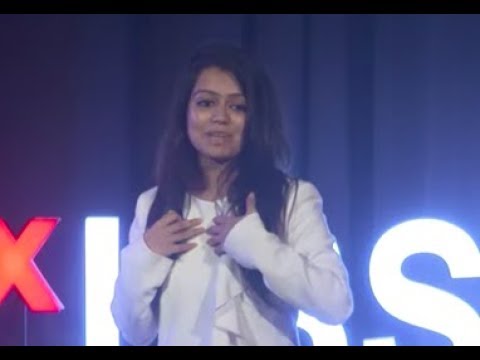
before I tell you why I’m here let me
tell you a bit about my journey when I
was nine years old girls and boys of my
age had incredible dreams full of hopes
and dreams and visions they said they
want to be astronauts and writers
musicians and dancers I said I want to
be an entrepreneur a few years later in
life when Indian students start deciding
what they want to become I heard their
dreams changing now they mostly said
bankers and engineers and doctors and
lawyers I still said I want to be an
entrepreneur and over the years my
conviction only grew stronger and my
decision turned into a lifetime
commitment but when I went to law school
nobody from my entire community
understood what I did or who I wanted to
become and contrary to their choices I
began to work with startups in a wide
range of services from legal services
blogging and ethical hacking but somehow
I was still not contented with life I
was constantly torn between what the
world wanted me to become and what came
naturally to myself it was one of those
nights when I woke up and I asked myself
what would you do if you are one percent
more courageous who would you be if you
are one percent more courageous and I
woke up that night and I told myself
that I want to be the bestest highest
and the truest version of myself and
every time I would say that I could feel
the anxiety in me but I would never let
that control me a few months later I got
chosen for a fellowship program for
social entrepreneurs in Washington DC
and that was for the first time in my
life I finally
found the people who understood my
journey and even though my peers were
nearly elder by a decade that last room
of entrepreneurs became my home so when
I came back I realize that many Indian
students are unable to pursue exactly
what they want to pursue not because of
lack of resources in the country but
because of less awareness about how to
pursue a profession there is opportunity
in every profession there are jobs
degrees diplomas scholarships available
in every profession whether you want to
be an environmentalist or a
photographer’s a scientist or a
historian but we just need to be aware
of it so I began interviewing people
from all kinds of profession beginning
from car races of the amount of
challenge filmmakers winning green Oscar
Awards artists inventors musicians
entrepreneurs not just to entertain my
readers but to educate them about how to
pursue a profession it was then when I
started to understand the various
opportunity that is present in every
profession and over time I interviewed
more than 300 professionals to form my
brainchild martini and more and that is
what brings me here in early 2016 my
team ran a campaign to understand the
hurdles that Indian students face while
pursuing a career that is when we
understood that nearly seventy percent
of the students are unable to post you
what they want to pursue not because of
lack of resources but because they
either didn’t know how to pursue a
career or their parents weren’t
convinced our research also show that
after three to four years of work
experience professionals who were not
satisfied with their jobs either like
change their jobs frequently lost their
zeal for work or even became insecure to
their successful counterparts so let me
give you some numbers in 1929 during the
Great Depression of us the rate of
unemployment in
raised from three percent to twenty-five
percent for those who still had a job
their wages decreased by forty two
percent that’s nearly a half later in
two thousand during the Great Recession
8.7 million jobs were shared in u.s.
besides many other things like fall of
house’ll income massive burn out of
investment money etc the reason why I
say so is because India looks very
similar to what us look during these
periods we call it the white collar
unemployment India produces 1.5 million
engineers every year out of which eighty
percent is not employed that is a
massive number and one of the major
reason why this is happening because of
wrong recruitments we are placing a
person in for the wrong profession I
believe that we are all good at some
things and we are all bad at some things
if you put an artist on a corporate seat
he is bound to be lost if you tell a
scientist to become a bureaucrat I’m not
sure how far he will learn I believe
that we are all good at something but we
can be better at many other things
equality of professions is not a
movement it is not a slogan it is a plea
and so this conversation in India is
very very crucial our professions are an
expression of our personality my
self-confidence and inhibitions and
bruises is intertwined with everything
that I build we need to start molding
minds for the future and not for the
past I understand that there is an
inherent fear towards every unknown
career but believe me when I tell the
youth that there is opportunity in
everything that you want to become but
that is a historian or a sign
or an inventor so before i close let me
share a story with you when i went to
washington for my fellowship my mornings
were generally begin hustling between
books and breakfast and sorting out my
things and one morning in the cafeteria
I met a lady about 80 85 years old while
having a conversation with her she tells
me that she was an international
entrepreneur back in the 1940s and
before I left for the day she told me
that i usually don’t give free advice is
but i’m going to give you one and that
everything in life happens for a reason
your life might not be easy but
eventually you learn how to find fun in
it that stays with me because i live it
every day so my takeaway for every youth
in this room is you must begin begin at
the beginning begin in the middle begin
at the ending it doesn’t matter but the
most important thing for you is to get
started never dismiss your dream without
knowing the pathway to your vision and
when you step out of this room today i
want you to ask yourself what would you
do if you are one person more courageous thank you