
well I’ll be talking about doesn’t
anyway a pathway to healthy societies
and I have taken mitochondrial
perspective as a biologist which I’ll
come to in a due course of time what I
put over there you all will agree with
me that the fast pace of economic
development has not made us immune to
disease burden and this disease burden
has been rising along with this disease
burden has been the stress level which
has been rising and then what has
happened we asked a question to
ourselves why is it due to what have we
done to ourselves that this disease
burden keeps on rising in India the
cancer rate wasn’t as high as it is
today as compared to Western Europe
today it’s matching with that particular
rate and what have we done we have acted
as our own enemies how we have acted as
our own enemies in the process of
evolution what has happened the
evolution equipped us in our genomic
material the blueprint all of us have it
equipped us with variations in our
genome which are favorable to sustenance
survival withstanding diseases and yet
with all this they stowed upon us by
Nature we abused it and we abuse it to
the extent that today we are suffering
and I’ll give you a glimpse of that so
how have we
when all of us in this audience have 100
trillion cells in our body
can I go back all of this all of us in
this audience have 100 trillion cells in
our body and in these hundred trillion
cells we have two kinds of genomic
materials one is there in the nucleus
which is contributed by our parents and
in case of males obviously father
contributes Y chromosome so it’s father
to some transmission and the mother
contributes mitochondria to both
daughters and sons mother does not
discriminate fathers do so mother is
always fair so daughters and sons both
get mitochondria that’s why I have
picked up this mitochondrial perspective
and how it operates and what I have
shown over here for engineering students
it’s like a factory the whole body is
like a factory with number of machines
operational were there so to a
mechanical engineer I would say well you
use machine language to understand this
and a mathematician along with this
mechanical engineering student would be
saying well let me use nonlinear
mathematics to understand it so you put
together non linear mathematics with
machine language and you understand it
well somebody in the electronics would
say sir what do I do in this situation
I’ll say well think about grids and how
the transmission takes place so there’s
communication of information from one
grid to end of the grid and computer
engineer says well you didn’t talk about
me I’ll say don’t worry talk about hubs
and edges in those hair hubs and how the
communication is transmitted through
these hubs that’s how biology has to be
understood today by you youngsters in
future understanding the complex systems
so we try to understand this complex
system as a whole and what all goes on
over there in terms of biochemical
reactions in terms of synthesis which is
going on in terms of information
transfer from cell to cell from
generation to generation that’s what we
deal with
I’m not good at this
give me the other one I’m sorry for this
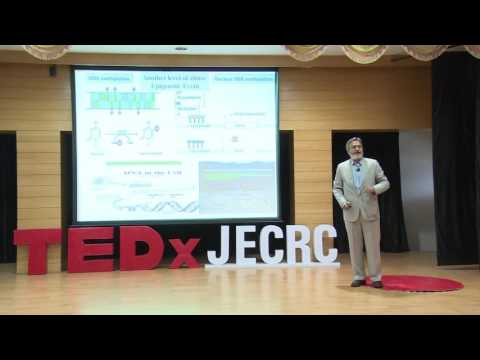
so there are two levels at which we
understand genomics one level is that at
the genome level which I said is being
contributed by both parents and the
other level is of some modifications
which are happening in the genome and
these modifications are called
methylations so you have in the
double-stranded DNA like this you have
bases over there these are letters so
all of us have a three billion letter
long DNA coming from mother and three
billion letter long DNA coming from
father and there are these four
alphabets in the DNA four nucleotides
and they are the ones which determine
the language of DNA and they are
organized in a manner along the length
of this 3 billion letter long DNA that
you create landscape ik features in the
genome and all is about those landscape
features like you have natural landscape
outside you have diverse element or
there
you can’t overlap them with each other
they have their own distinct identities
similarly in the genome also these four
bases organize in a randomized manner
they create their own landscaping
features and scientist I’ve given some
names to them micro satellites mini
satellites snips single nucleotide
polymorphism you don’t have to bother
about that you just remember like a
natural landscaping features you have
features over there now this word
cytosine this label gets modified and
all this modification happens in
randomly but it also can be this is
called epigenetic regulation this can
also happen this methylation one of the
epigenetic regulators it can also happen
by dietary habits bad dietary habits
irregular dietary habits or exposure to
chemicals carcinogens mutagens so it can
happen by all this that’s what is why
cancer rate is increasing today so there
is a regulation at our blueprint level
the DA
a one regulation is genomic structural
so there are some changes happening over
there and another level of regulation is
epigenetic and I’ll just use these words
maybe in between so you need to
understand them this is what we are
doing so our poor lifestyle we have also
the seed entry kind of lifestyle we have
syndrome of Plenty and high stress and
this it’s like rich and poor both are
suffering so you have plenty in one case
and you have stress in another case to
become rich and there is this unbalanced
ecosystem in this ecosystem not only
outside which influences us but also
inside us what does it result into so we
asked the question as a researcher we
asked the question is too complex
because you can have different levels at
the genome level 3 billion later long
DNA may have hundreds and thousands of
changes happening over there which we
call mutations and then you can’t be
looking at a drug for each one of them
then on top of that you can have a PG
Natick kind of modulations these because
of these methylations and other other
levels of modifications which can happen
which are epigenetic in character then
you can’t be looking for drugs for each
one of them so is there a possibility
that it does it converge at some
metabolic at some biochemical level if
this convergence can happen over there
then you can target this with a
particular drug that’s the story I’m
going to give you that quickly how this
convergence in a normal cell when we eat
and the carbohydrates break down they
generate sugar and the sugar is
processed by a biochemical machinery and
this mitochondria plays a good role over
there in balancing itself with the
nuclear material and the biochemical
reactions which are going on here which
are glycol like you know glycolysis over
here which is happening
I won’t don’t want to use these complex
first for you
and this pyruvate enters in the
mitochondria and the mitochondria is the
hub for creating power creating energy
and you can see here 36 ATP molecules
being generated
whereas in cancer situation you have
this happening glycolysis happening
processing of glucose taking place some
biochemical reactions going on yet you
do not have adequate energy being
generated over there it does not require
that it’s an abnormal situation which
has happening over there and the energy
generated is through this process and
the cell gets geared towards this
bioessence of nucleotides so what is
happening basically the cell is geared
to produce energy through this process
of using sugars whatever food we eat so
all the glucose which is generated were
there the cell uses it very quickly and
when cell uses it very quickly it
generates a phenomenon which is called
Warburg hypothesis so Warburg had
suggested that more of glucose will be
taken by the cancer cell and more of
lactate will be produced this is kind of
a feature of a cancer cell
now mitochondria comes into picture
because mitochondria works this tiny
molecule within the cell has its own
genome as I said mother passes onto both
daughters and sons and it maintains this
balance the homeostasis we in technical
term will call homeostasis but I will
use balance as the word so it balances
were there it the homeostasis is that
mitochondria will replicate divide we
call it by Genesis and then it will see
see to it that the cell is restored back
it survives because survival is one of
the features of the cell to sustain
itself for future and all those
reactions are going there information
transfer is there and this mitochondria
you will be surprised to know is an
outsider in billions of years which has
come inside the cell
and we allowed at that time the cell
allowed it to sustain itself to live
there peacefully and it lived peacefully
all these millions and billions of years
in the cell that in humans also you have
this mitochondria and they are the power
house they’re energy producers
they also synthesize they also signal so
there is a communication between this
mighty neo organelle within the cell
communication between mitochondria and
the nucleus and the nucleus and the
mitochondria so this communication this
balance is maintaining the homeostasis
in the cell and this homelessness in the
cell obviously make homeostasis in the
body the physiological homeostasis if
this is disturbed as would happen in
cancers cases so mitochondria plays an
important role in maintaining this
balance and as an outsider I would say
mitochondria has taken us for a ride
because now it came as an outsider lived
all through the revolution and has taken
control of so today people are thinking
that I put good mitochondria in a bad
cell is it going to recover yes it
happens that despite the bad genomic
background the epigenomic background if
you put good mitochondria were there
it’s so important it communicates so
well it tries to maintain the
homeostatic balance in the cell and cell
has some normalcy restored back but
sometimes like in cancer situation it
feels helpless under abnormal conditions
so this is how mitochondria feels it has
a balance between life and death in the
cell so it undergoes survival and at the
same time it has it leads to the death
which is called in technical terms that
we say apoptosis so mitochondrial
behavior if abnormal can lead to cell
death and obviously if cell does not die
and has a baggage of damaged DNA inside
it and it survives and the immune
response which we have cannot fight it
out cannot kill these cells so what
would happen cancer arises so
mitochondria definitely is a very
important organ so it came as an
outsider in the cell so it it’s at the
crossroads of the life and death and it
plays an important role and what are we
doing with this the mitochondrial DNA
mutations the mitochondrial methylations
as I mentioned and introduce to you that
the two levels of regulations which
happen at the genome level one is the
structural part there will be changes in
this genome which may accumulate or the
evolution which were good for us
evolution gave rise to them and asked us
to well these are good changes in you
you survive you and we abuse them today
those changes have failed us those
changes have acted against us the
changes which we acquired in the
evolution which were good for us by our
bad habits and lifestyles these very
changes which we call polymorphisms in
promoters they have started behaving
which were favorable in evolution they
have started behaving erratically and
that has created a normal situation and
in mitochondria again the mutations
which happen that means genetic changes
and the methylation which happens which
is epigenetic changes we did not know
much about the epigenetic changes in
mitochondria in fact this was proposed
long long ago we were the one of those
first ones who have established it that
well mitochondrial methylation takes
place and this mitochondrial methylation
which is happening in the mitochondrial
genome it retains the homeostasis of a
cell by increasing its mass which is
called by Genesis by increasing its
mitochondrial potential which is very
important and when I use the word
potential and mas definitely it should
tingle a bell in your head and you
should say well there’s something going
on this complex structure and this
complex structure need to be understood
in nonlinear with some kind of a
language which is very different and
that’s machine language so because it’s
not so simple what does it do I’ll just
highlight some mechanism over here not
going in scientific details if by these
habits right from sedentary lifestyle to
irregular dietary habits and I had given
you this background that the genomic
background which was favorable in
relation for us has turned bad now and
on top of that you have now mutations
introduced in cancer only few days back
again it was published that what was bad
luck what was called it’s bad luck if
somebody is suffering from cancer has
mutations now they say well it’s
randomized so most of the mutations
which are happening in cancer in the
cells are happening in the tumor and
they don’t have the presents their
presence in normal cells that means out
of five hundred odd genes there are 500
which are somatic mutations and only few
of them are germline which are passing
from generation to generation which
means that we are abusing our system in
such a way that these mutations are
getting introduced and they may take a
shape where they are turning into a
cancerous cell or a tumorigenic cell now
here is a situation that the
mitochondria how it behaves and how it
regulates it generates these free
radicals whatever food we eat we
generate free radicals and these free
radicals in our body we have a system
which will scavenge it which will mop it
and if the machinery of ours of the
mopping machinery is not good then
obviously these free radicals are going
to be accumulated over there they are
very short half-life or that they don’t
sustain there for too long but then
within that period they are able to
damage DNA they are able to damage might
other things lipids carbohydrates in the
body now all this system abusing system
through insulin signaling and other
signaling they make this mess
bah lism turn into one of the enzymes
which we have researched on which is
called pyruvate kinase one of the
isotonic forms which is a tetra mer this
tetra Mar 4 molecules always becomes
stable dimers and this stable dimer
turns into the cell into anabolic state
and I’ll just you give you a glimpse
over here the mitochondria even one base
change just one base change generates
reactive oxygen species or these free
radicals they go inside the nucleus this
signal and then signaling is this
methylation happening this methylation
in the nuclear genes makes
anti-apoptotic which means survival
genes they give the signal for survival
that goes very high
this gives signal in the metabolism the
dimers are high as compared to normal in
Zion Tet remember in the pathway the
biochemical pathway you will have more
towards the PPP shunt and that means the
anabolic character anabolic character is
required for the cancer cell to sustain
itself and it does not happen only in
mitochondrial situation even the pathway
in the nuclear genes whether apoptosis
is there or immune response they fail or
DNA damage fails then or epigenomic
signal thing they generate the same
phenomenon up whether it kinase
dimerization we have looked into that
now finally we have looked into how do
we tackle with this so we have tried to
have signatures of metabolism now these
are groups where highly vascularized
tissue is the tumor tissue is there or
cells are there there are poorly
vascularized cells there are some which
will make metastasis that means they
will spread in the body or they will be
chemo resistant for drugs for all these
we have generated certain metabolic
feature signatures and we are attacking
these signatures through these molecules
which are molecules from within making
inhibitors for them and they have worked
they kill the cancer cell and that’s
what in the society it is going to be
beneficial in future and I hope it’s
takes that practical shape of
transforming itself in terms of certain
drugs which are simple which achieved
because they are based on very cheap
methodology ultimately or genomic
epigenomic events are converging on that
event in the metabolism and if you
target that metabolism for cancer cell
the cancer cell is going to die and all
these forms of cancer are going to be
contained thank you very much
[Applause]
Please follow and like us: