
Translator: Amanda Longoni Reviewer: Claudia Sander
Who of you have pedaled?
Enough people.
So you must remember
Wind sensation in the face.
Perhaps the first round on the court.
That walk in the park
that walk on the beach,
that race wagered on the street.
There are people who think the bike
It is an individual activity.
In fact, many people practice the bike group.
And she allowed me to meet
many cool places,
many interesting people.
very different people,
from different social and cultural backgrounds.
And all sharing the same pleasure of pedaling.
Some more actively,
in search of bike paths and means of transport,
other for leisure
and some for physical activity and health.
But certainly very interesting people.
But let’s leave the bike a little hand
and let’s talk about exclusion.
Who has not had an experience of exclusion?
Who does not remember the feeling
to be the last guest of a team
by bad play a sport?
Who does not remember the feeling
not having been invited to a party
not knowing very well the organizer?
The feeling of not being able to go in a restaurant
for not having money?
I have not made that trip,
It is excluded from a group
at school, at work …
To be different …
Now imagine if every day life
we woke up and could not see the light because we’re blind?
If every day we wanted to pick up an object,
a simple action to pick up an object,
and could not by having the paralyzed arms.
If we needed to climb a ladder
and could not to be stuck in a wheelchair.
That is the reality of many people, and when you think and is empathetic,
putting in place of these people,
perhaps our feelings of exclusion
become smaller,
become a little more insignificant.
But you start to think:
“Cool, this is a situation that exists,
a problem that exists.
But what can I do?”
It is a political, social problem,
is society as a whole?
What can I do?
When I wondered,
I invariably came a point where I asked myself:
“In that moment I ceased to be part of society as a whole?”
If it is a problem of society,
I have to help treat.
And looking for ways, thinking of ways,
We came to the conclusion that each has a different way to help.
I can help according to my financial level,
according to my experience of life,
according to my profession …
I have different ways to help
people who have needs.
And, along with some friends who cycle,
we were in the mood
to take this experience pedal
to people who could not afford.
Some of them ever pedaled,
by being born blind,
and others who have become blind later in life
and they thought it could never ride.
But every deficiency has its particularity.
I can not treat a person in a wheelchair the same way …
a person who only has paralysis,
with a person who has quadriplegia;
a person who is blind to a person who has no ability to balance …
And through the different ways we try different ways to help.
In early 2016,
we find a chance to take the visually impaired pro pedal.
Look, we found a way to take
visually impaired
to the pedal.
Our goal was not to take the pedal to people with visual impairments.
It is very simple I get cycling
and lead to a group of blind pedaling.
It was not what we wanted.
What we wanted was to bring the blind pro cycling.
It was effectively do an inclusion.
And what it is not greatness,
that when you begin to do this work,
the inclusion occurs on both sides.
It gives the blind, cycling,
and cyclists, with this deficiency.
So we find the tandem bike
and through it, we saw the possibility
pedaling with visually impaired.
Found in the Blind Association of Rio Grande do Sul,
a partner to do this project,
and in June last year,
We did the first event of Inclusion pedal.
At that time were 100 cyclists,
and 20 of them were blind.
And the reactions were varied,
the person who came and wanted to see the bike,
touch the bike, feel every piece of the bicycle,
people who laughed endlessly
the anxiety of having that pleasure
for the first time.
And one of the people …
The tour was elapsing,
We stopped at some traffic lights
and in those moments,
one of the blind answers the phone and says,
“Mom, I can not talk now, I’m riding.”
Off and begins to laugh without stopping.
He says: “The mother did not understand anything.
I never rode. “
This feeling is spectacular;
the feeling of being providing this
to a person who never rode
it’s spectacular.
Just as he, who had never cycled,
another girl, who had pedaled,
He described as:
“A broken wings bird flying around.”
That was the feeling that she was having at the time.
And the project has grown,
and we went looking for
other ways of working,
but, as everyone knows, it is difficult to raise money,
It is difficult to get partnerships
to work with this type of action.
And we seek,
through other forms of cycling,
through other forms of inclusion,
bring a lot of people in this process.
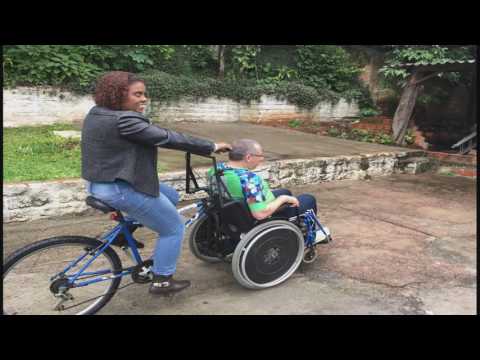
Here’s another example of bicycle,
an example that we are working on this year.
The purpose of this bike, of course,
It is to work with people with physical disabilities.
Here in the picture, another wonderful time.
There terrified, sat me.
Really scared.
The experience of sitting on a bike without having control
It is something indescribable.
Who’s riding is Babs, she is an educator,
teacher at a municipal school of Viamão,
a group of children 3 years of age.
And she was guiding a bicycle for the first time.
I was her eyes.
I was too scared.
But her smile says it all,
She says she was feeling at that time.
And as we search …
There is another part of the Inclusion pedal,
that is, in a way,
when we talk about social inclusion, somewhat irrelevant,
that is how we seek to buy these bikes.
These are expensive bikes.
This is a prototype that was built.
The other tandem bike is also very expensive.
We found, in the collection of bottle caps,
a way to collect money.
Then, through the cap, we work another way, another bias,
What is sustainability and solidarity.
Through the collection of bottle caps,
these caps are resold,
aimed pro track,
destined for recycling,
and people, in a very simple way,
They can help in a certain way.
Last year, we donated 11 bicycles
for the Blind Association.
These bikes today are with the Association,
pedals are made with a frequency
bimonthly, quarterly, they organize and out.
And this year we have consolidated the Inclusion pedal as an association.
We are trying to buy our own bikes,
so we can take the Inclusion of Pedal to other cities.
And it’s already happening.
We already have in São Paulo people who have contacted us
and they want to take the Inclusion pedal go.
Received last week,
Para one of Bethlehem bond,
people wondering how they could help,
sending caps.
It is the power of good,
things are happening
in a way without you even knowing how.
This was the first pedal,
when we made the donation of bicycles to the Association.
And the next day I get a call from a parent
who saw the report,
claiming to be the father of an autistic child,
that did not have the opportunity to offer his son pro
bike experience.
“How can I do, Leandro, to help you,
to that autistics can ride a bike? “
And in that connection we started to understand that it is much more than blind,
It is much more than autistic …
We have to work with all types of disabilities.
We must seek all forms
to bring different types of disabled pro pedal.
And that’s what we have been seeking.
Last year were the blind,
this year we are working with wheelchair users,
and we do not have the weather to stop.
By collecting a capful,
a simple cap,
I ressignifiquei this cap.
For me this here, that goes to waste in the home of many people
and many restaurants,
It is a piece of a bicycle.
And you, what are you doing to help the inclusion?
Thank you.
(Applause)
Please follow and like us: