
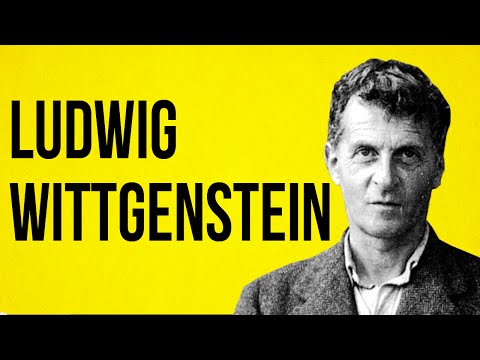
Much misery occupies a place in this world
Because we can not let others know
What we mean clearly enough.
One of the philosophers who can help us
In our problems with communication
Is Ludwig Wittgenstein.
He was someone who loved isolation.
He stammered, pausing for a while in the middle of his words
He used to leave
If you do not like people’s conversations.
This was strangely unusual
For a person to study
How can communication between people fail.
Ludwig Wittgenstein was born
In Vienna in 1889.
The youngest son of a rich family,
High culture
But despotic and powerful.
Three of Ludwig’s four brothers committed suicide,
Ludwig himself has suffered repeatedly
Of suicidal thoughts.
When he was young, he was interested in engineering.
After studying in Cambridge,
His father died and he inherited a lot of money
He gave up all of it
Mainly for his already wealthy relatives
To live in strict isolation
in Norway.
He then began writing a book published in 1921
Entitled A logical and philosophical message.
It was a nice little thing
Puzzling.
The important question asked by Wittgenstein
In this book was:
How can humans
Share ideas with each other?
His answer,
Which carried a revolutionary feeling,
The language works to stir images
Inside us
About what things are in this world
Wittgenstein thought about this
When he was reading a newspaper article
On a case before a Paris court,
Which in order to explain the details of an accident
At a crossroads more effectively,
The Court was organized to re-represent the crime
Using models of cars and pedestrians.
It was the moment of inspiration.
In Wittgenstein’s words we were able to
Making images of facts.
When you say: Palm near the beach,
This paints a quick picture
Which is similar to the model that allows other people
Seeing the state in their minds and understanding.
We are constantly
We move images between us.
But the Parisian court needed to resort to a real model
For a very important reason.
Because we generally,
Very bad in organization
To create good images in our minds about others.
Communication usually fails
Because others carry, the way we put them
The wrong picture of what we mean.
It may take time to realize two people
The differences about things are quite intuitive.
Communication problems usually occur because we
We do not carry a clear and accurate picture
About what we mean in our heads.
We generally say things that are meaningless or overlapping
Or not explained
Which for this reason is not understood by others.
There is another risk:
We read in the words of others many meanings
They never intended it or even unjustified.
You tell your wife about a conversation between you and someone
Interesting in the hotel reception.
The image you carry in your mind
innocent.
But your wife is quickly forming
Another picture altogether.
The message is an appeal
From an Austrian philosopher who speaks little, many are silent in his words
To speak more gently and with less impulse.
From his famous sayings:
“Wherever one can not speak,
He should be silent. “
When you post this,
Fingenstein thought very much
This message is the last philosophical work
Which you need to write.
So he searched for how he could fill the rest of his life.
He turned into architecture and spent some years
In designing a house for his sister in Vienna.
He spent a lifetime
In properly configuring door handles and air coolers.
Very late during his project, he was very upset
From the ceiling in one of the rooms
He concluded it
very low.
With tremendous inconvenience to all,
He insisted on lifting it
Three centimeters.
Where I think this is the perfect solution.
Then, in 1929
Vittgenstein suddenly returned to Cambridge
And to philosophy
I realized there was still a lot
To say about language and communication.
So he began to write another book
Published after his death,
Which we now know is entitled
Philosophical Investigations.
Instead of believing that
The language relates only to pictures,
He developed an idea
Language is like a tool
Which used to practice different games,
Which does not literally mean games
But the types of purposes.
So if a father said
For his frightened son:
“Do not worry, everything will be fine”
They do not really know that things will be good.
They do not play a game
Logical prediction based on available facts.
But they play another game:
Game words as a tool for tranquility and peace of mind.
Vittgenstein’s view is that
All kinds of misunderstandings occur
When not see
What kind of games are being played by someone?
If a father says to his son:
“You never helped me, you can never depend on you”
It may be a natural inclination
To hear that as part of
Game Show facts;
As saying:
War of Waterloo was in 1815.
Thus, the person may quote the facts about
How he insured the car yesterday,
Some vegetables were bought at lunch time, too.
but in fact,
This person is playing a completely different game.
They use words
Not to express facts.
They play a game of help and reassurance.
So in their language game,
“You never helped”
“I want you to be more supportive”
To develop the game in question,
He, as Wittgenstein realized,
The key to good communication.
In philosophical investigations
Wittgenstein wanted to attract attention
To what extent our understanding of ourselves is related
In the words of others,
In which languages
Developed openly and on the tongues of peoples
Over many centuries
Long before we were born.
For example, on Sunday afternoon
I may fall prey to a bad mood
I’m thinking about next week
Everything is something I have to do.
My ability to know this part is very subjective within me
And helping others to know me
It will multiply significantly if you find a word
She was lost for a while:
Anxiety.
Word which is purposefully formulated
By the philosopher
Kirkgard in the 19th century, in Copenhagen.
Words like anxiety
Nostalgia
Disgrace or
confused
And many others
Help us to name confusing feelings in our personal experiences.
Language is a general tool
To understand private life.
The richness of the language we discovered
It is undoubtedly important to know ourselves.
Read many books
Give us the tools that help us to know
who are we.
Yet much of Wittgenstein’s philosophy
Very complex,
Based on a desire to always be useful.
The task of philosophy, according to Wittgenstein,
That indicates the fly on the way out of the bottle.
The bottle concerned, which he was interested in,
Is the language.
Before dying of cancer in 1951,
Care for us to take out
Lots of word flies
Useful to us all.
Please follow and like us: