
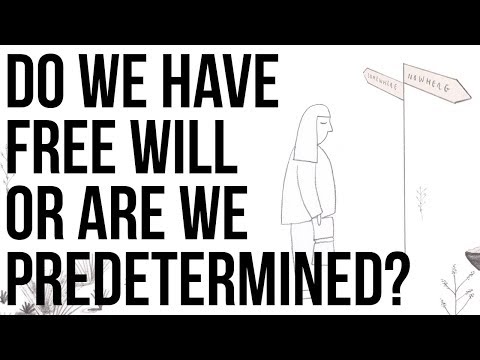
The history of philosophy dominated competing debates about ideas
On freedom of will and determinism. The issue simply revolves around whether it should
The issue simply revolves around whether humans should be seen as basically free to choose their actions and shape their lives
Or are they considered leaders of forces beyond their control,
Whether fate, biology, politics or social class. The debate has been fierce for so long.
Where he appeared in ancient Greece and then moved to the Romans and tainted the Christian philosophy
And remains until today among philosophers, psychologists and nerves.
Part of the reason for the difficulty of finding a definitive answer to this question is that it is
It is often put in abstract terms as if we will discover that one
These two (free will and determinism) is a better interpretation of human beings in general
But in fact, the debate becomes more interesting and relevant to us if we change the factors of the question
We simply asked whether the idea of freedom of will or inevitability is more appropriate or
More or less me? We all have different needs in this area depending on two psychological qualities
They are contradictory: defeatism on the one hand and ambition on the other.
There are people with a high degree of defeatism, and they put
Automatically take responsibility for things out of their way
Their lives as they say is entirely determined by their parents, the school, the government, their superiors,
Media … anyone other than themselves. The result is an inherent lack of achievement and self-deception.
But another kind of difficulty appears in the lives of ambitious people
Very high is the exaggerated view of free will. They will see that
Everything in their lives is subject to change. And decide that they can achieve
Everything is simple by hiring their will. Their careers, their salaries, their relationships
Their aspirations (as it seems to them) are subject to radical change. This is an inspiring sight
But (when things do not go as planned, they do not always)
Cause pain and anger. Each of us needs to decide for himself
He must believe more in the theory of determinism or freedom of will. We have to ask how much
The suffering in our lives has been caused by our defeatist view and how much we can
To return to reckless ambition. Some of us need to raise his faith freely
The other needs more lenient acceptance of the theory of determinism. The oldest debate in philosophy
Not answerable. We just have to answer him in person
Consider what we need to believe in to be calmer and more satisfied. Probably better
A way to discuss this debate about freedom of will and inevitability was by philosophers
The ancient Romans of the Stoic school. They suggested that we should see ourselves
Always swaying between freedom and determinism. (They drew an impressive picture
To make us creatures capable of making a big change however
We remain exposed to influential external events. We, as they say,
Like dogs tied to a vehicle is unpredictable. Our rope is long enough to give us
An area of freedom but not long enough to allow us to roam anywhere
We wanted. The dog, by nature, wants to go wherever it wants, says the Stoics. But if he can not
It is better for him to be behind the cart to be withdrawn and strangled
Out. Thinking that we are also not without a rope around our neck may help ease
The intensity of our opposition to events has moved far from our intentions. may
This seems to be a positive sign, but the Stoics have asserted that it is no less rational
Accept something as inevitable when it is not, to turn on something and so (inevitable).
Our mind is the one who must determine the difference and this gives us preference
On the dog. The dog may not initially understand that it is attached to the vehicle even, and no
He links the movements of the cart and the pain in his neck. So
He can not predict where the vehicle will go and adjust its position accordingly.
But the mind enables us to predict with high accuracy through the vehicle or pot,
Which gives us an opportunity, distinct from the rest of the creatures, to raise our sense of freedom from
A way to put a distance between our desires and what we can not change. Mind we can
From measuring whether our faith is completely contrary to reality, and then invites us
To surrender willingly, instead of being angry and bitter. May not be strong
To change some events, but we have the freedom to choose our reaction to it,
It accepts non-objection to what is inevitable to find serenity and freedom.
In “School of Life” we believe in the development of emotional intelligence
That is why we have made a lot of products to support this development.
Learn more through the link on the screen now.
Please follow and like us: