
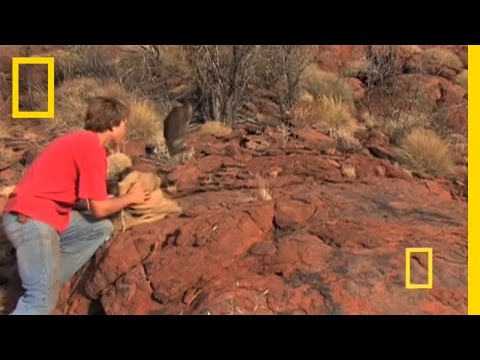
it’s early in the morning and
Australia’s a pwhile and a National
Geographic grantee Laura Roy kiss and
her team are on the moon from the 4×4 to
the trail to steep rocky cliffs
thereafter the black-footed rock wallaby
or waru South Australia’s most
endangered mammal these small marsupials
were once common throughout the ranges
of Central Australia but now because of
introduced predators hunting and changes
in land management fewer than a hundred
remain in the wild the scale of that
decrease is just enormous when when you
think about the fact that the early
explorers when they came on to the APY
lands and into these northern areas they
they described the the water was
swarming all over the hills Laura is
part of the wadu’ recovery team an
all-star Brigade of biologists
zookeepers vets and Indigenous
Australians dedicated to saving these
imperiled animals when they capture a
wallaby a runner carries it down to a
waiting vet first he sedates his furry
patient with gas to keep her from
hopping away during the examination
but this is no ordinary checkup they’re
looking for females with babies tucked
away in their pouches to take part in a
very special accelerated breeding
program
reproductive specialist david Taggart
explains
there’s a technique that we’ve developed
recently called cross-fostering and it’s
a technique that uses closely related
surrogate species to rear the patch
young of an endangered species in this
case the Wahoo’s cousin the more common
yellow-footed rock wallaby will serve as
the foster mother
the yellow cook takes on the burden of
lactating and nursing those young to
independence and that frees up the
worried mothers to psyche again mate and
have another young and so in this way we
can accelerate the breeding of the
endangered worry from one young annually
to up to six or eight young annually but
the baby has to be the right size for
the cross-fostering to work
unfortunately
this Joey is a little too big so when
the exam is over
the researchers carry mom back up the
hill and release her where she was
caught
meanwhile back at the camp
the team has found a female with a Joey
that’s just the perfect size they
carefully transfer the tiny wallaby from
its mother’s pouch to a portable
incubator but not to worry the mother
won’t be without a baby for long the
unique wallaby reproductive system keeps
a second fertilized embryo on standby
for just such an occasion in a month
it’s likely she’ll give birth to another
Joey
they will make all packed up and ready
to go this youngsters in store for an
airborne journey of nearly a thousand
miles
it’s 1:00 a.m. when the team arrives in
Adelaide where the Joey is once again
handed off and rushed to the Adelaide
Zoo
vets examine and weigh the youngster and
carefully place him in his new foster
mother’s pouch it doesn’t take him long
to find what he needs a well-earned meal
of fresh milk aunty should probably
drink up there’s a lot riding on his
survival
when he’s old enough to survive on his
own researchers will move the Joey to
this captive breeding facility at the
nearby Monarto zoo
here he’ll grow up among his own kind
with a little help from some human
friends
the hope is that these youngsters will
go forth and multiply
giving rise to a whole captive-bred
generation of water that will someday
return to the wild
and perhaps reclaim their former habitat
my hopeful Watteau is that in the long
term it would be amazing to have the
animals swarming all over the hills as
they used to be in the past and while
it’s unlikely that Laura and her team
will witness a swarm of Wallabies in
their lifetime
one thing’s nearly certain as long as
they’re on watch the Sun won’t go down
on the water sponsored by National
Geographic mission programs taking
science and exploration into the new
millennium
Please follow and like us: