
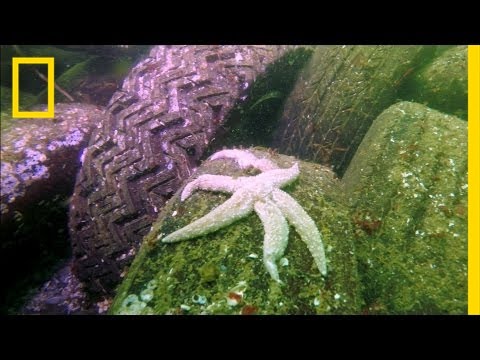
from Mexico all the way to Alaska there
has been a massive die-off of sea stars
the estimates are in the tens to
hundreds of millions of sea stars have
died in the last couple years it’s one
of the largest mortality events
associated with the disease that we’ve
ever observed in the ocean in this
region here in the sailors see there’s
almost 30 different species of sea stars
you can call it sea star or starfish for
the same thing so we’ve been looking at
the effects of sea star wasting disease
on populations of sea stars today we’re
gonna go out and we’re gonna survey a
population of sea stars on Whidbey
Island several years ago when we survey
the population there there were
thousands of sea stars but we’d had
reports recently that individuals were
starting to get sick there we’re
interested in how that population has
changed when we’re swimming around at
the site and we see just an arm dangling
off a rock no body nearby oftentimes as
sea star wasting disease conditions
progress than individual he’ll be
sitting there and it’s arm just
literally crawls away and rips away from
the body and in addition to that we’re
seeing the kind of telltale sign of the
disease which is basically a pile of
white goo that is the deteriorated
remains of a sea star weighed over here
several years ago stars covered the
bottom diseased the walls man we found
less than 20 today that’s just
depressing to see
this one here is the okra star it’s kind
of a common intertidal sea star that we
have it’s a poster child of sea stars I
would say and you can see the species
has five arms it’s missing one of those
arms here and you can see right here are
the internal organs that are you know
poking out from that particular wound
one of the obvious signs the disease are
these white lesions well that’s where
the tissue is starting to degrade we
came back in a couple of days we would
find probably something that looked like
this you know so this is the result of
wasting disease to identify the cause of
a particular disease is quite difficult
and it’s even more difficult in marine
organisms the part that I had was
collecting tissue samples we normally
send those tissue samples off to
colleagues that will do further analysis
maybe sequence DNA or look at a
composition of tissue underneath
microscopes the work that was done
pointed to a virus that is a Denso virus
causing sea stars to not be able to
defend themselves very well against
microorganisms we know so little about
sea star wasting disease that that was a
big step in our understanding of the
disease one of the major concerns when
you have a mass die-off is that all the
adults which are the reproducing
individuals are gone and as a result you
can’t make new babies so we were able to
identify and observe a couple juveniles
at the site it’s always very encouraging
to find the juveniles the hope is that
those individuals grow up unaffected by
the disease and can repopulate those
sites
you
Please follow and like us: