
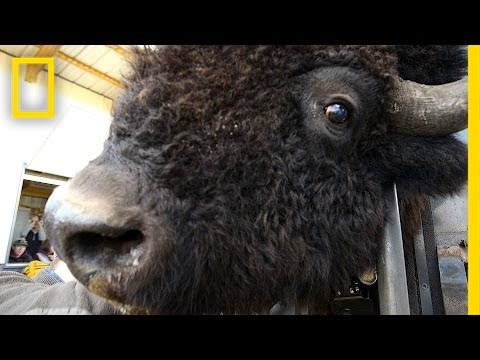
one of the challenges with bison is that
they are incredibly hairy animal if you
put a critter camp system around the
neck and hanging underneath the neck
what one would end up looking at is is a
lot of hair because in particular to
make big males had a long beard we just
gave them a little bit of a little bit
of a haircut to ensure that we could see
as much as we possible for them to chew
lice on a wonderful animals spot big and
powerful and potentially dangerous if if
not handled correctly and appropriately
a great thing about working with the
Nature Conservancy at the gun ranch is
that they have a very well coordinated
very well worked out system for working
with bison
so they bring the animals in they round
them up and they bring them into these
very heavy-duty shoots until eventually
as it is finally sort of a cage where
the Bison are brought to which holds
them very firmly so that they don’t
stress and their health can the
accession and ultimately death ligand
collars and GPS collars can be employed
the reason we put the critic hems on a
collar beneath the chin is because
that’s the standard protocol for
research with bison and this was a pilot
project to see whether or not the whole
concept report in your first place
now there’s also another reason for
using the collar with the camera
underneath rather than on top deploying
a chimera
on the top of the collar is very
challenging from a gravity perspective
from a weight distribution perspective
in all likelihood the system will
ultimately rotate providing essentially
no image at all so on this very first
deployment we decided to go ahead and
use the standard protocol let gravity be
our friend and see from underneath the
chin we had also hoped that that would
give us a great perspective of what the
Bison were feeding off this project is
all about the specific plants that the
Bison are feeding
and so we were hoping that the critic
and images we provide us that very
specific high-definition perspective be
able to see how they were selecting food
that there may be this piece of land
that these bison have the opportunity to
roam throughout is unplowed in all of an
American history so it’s provides a
unique opportunity really to see how the
Bison impact that terrain and how native
species of plant still there help to
direct where the Bison focus their
efforts
Please follow and like us: