
everything extraordinary are interesting
are fantastic about male Buddha paradise
is slowly the results of the selection
pressures of female birds of paradise or
their mates sometimes we think of this
as survival of the fittest this is about
individuals at varying ways that make
them more attractive to the opposite sex
and allow them to make more frequently
and we might think of this as survival
with the sexiest
this project all started back in 2004 I
received one of my dream assignments for
National Geographic magazine I’ve been
interested in birds of paradise for many
years but it took some doing to probably
convince the editors to sponsor a story
on the subject but I got an assignment
and I but I knew I couldn’t do it alone
and I started looking into who was doing
research in the field I learned about
Ed’s work he’d received a grant from
from the society a couple years before
and he was off in New Guinea making
expeditions and and using this rather
primitive video technology you see there
so so ed was out there or using video to
record the birds behavior and study
their evolution in a comparative way and
this was like I said eight years ago
look Sid like you also got a little
grayer since then but but really the
reason that it was such a perfect match
to team up with Ed was his his great
field experience and ability to locate
the birds in the field
he knows the calls down cold we could
arrive at a new location but we’d never
been to before and within a very short
period of time
ed would be able to home it on the birds
start to find there of our display sites
and so on so he really brought an
expertise in the field in New Guinea
that was really critical to make this
project possible tim is a scientist by
training and it is his PhD working in
the canopy in Borneo and is this this
skill this perspective as a scientist
and as a tree climber that’s been
extremely valuable and important to our
project working on birds of paradise and
so for me I was a biologist mostly
working on birds of paradise that I
could see from the ground or near the
ground and there’s a lot of them but
there are plenty that I wouldn’t have
been able to have access to at all if it
wasn’t for Tim’s and incredible ability
to get into the canopy and give us this
amazing canopy perspective so even me as
a bird of paradise biologist a lot of
these things I got to see for the first
time through the eye of Tim’s lens it’s
really key to get up in the canopy for
some of those species that display up in
the treetops you know some do display on
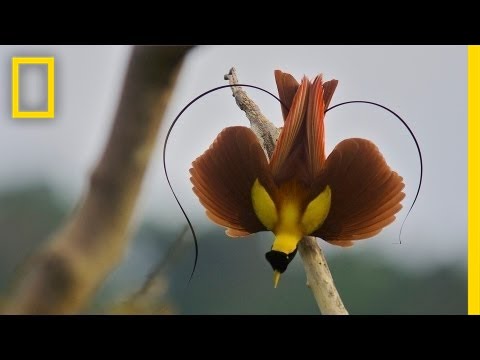
the ground but species like this red
bird of paradise choose the highest
perches up in the canopy in this case
the blind I built the photograph this
bird was 50 meters or 165 feet off the
ground which was actually the highest
one
I had to build but from this same blind
I photographed the same bird I think on
a different morning got this shot when
he was doing this inverted display and
that was what got us going five months
of fieldwork over three years between
2004 and 2006 that we spent working on
this story
and somewhere along the way during those
first three years probably in some field
camp not unlike this one and perhaps in
some fit of tropical delirium Tim and I
have this idea of you know hey this is
working how well we’ve done pretty good
on this first three years why don’t we
continue and try to see if we can
document all 39 and I don’t think at
that time we realize exactly what that
meant how long it would take us to
finish the rest but that became our
objective so of course in order to
document all 39 species that means going
everywhere that all the
birds-of-paradise occur so this is the
global range of the birds of paradise
it’s the the compilation of all the
different species distribution and you
can see that they occur on islands as
far west as up here along the equator
this is the homo hare island these are
the legendary Spice Islands that some of
you may be aware of the occur all
throughout the island of New Guinea the
mainland New Guinea but not on all of
the islands offshore New Guinea only
some and they also occur as far east as
these populations down here in Australia
some of them occur almost all the way
down to Sydney but even over here in
eastern Australia and of course this
took us eight years so five more years
after those original three we did 18
expeditions during the course at that
time we spent over 500 days in the field
visiting 51 unique field sites all
throughout that range all just a
document the 39 species yeah somehow
along the way I managed to take over
39,000 photographs and we’d only have
time to see all them tonight so so I’ve
made a small selection and so what I
want to do here is is give you a chance
to actually see these birds and see at
an example of one male from each of the
15 genera as if they were all perching
together so you can get a sense of the
extreme diversity in both size and shape
and coloration and also there’s a pigeon
over there which is probably a bird
you’re much more familiar with which is
also drawn to scale so you get a sense
of size and here’s a really great
example of diversity in size the greater
bird of paradise is
one of the bigger members of the family
and right next to him is his closest
relative a member of the genus that
Wilson’s bird of paradise is in and he’s
one of the smallest now we’re going to
slide over and I want to point out that
if you look at the species over there on
the far right those are the sort of the
earliest branch off the bird of paradise
family tree that’s what we’re looking at
here this shows their evolutionary
relationships and those are the ones
that are more crow like in color and
shape and form and that’s a good way of
pointing out that birds of paradise are
essentially glorified crows out of the
whole world of bird bird diversity birds
of paradise are most closely related to
crows and Jays things that you you know
commonly would see around here in DC and
not at all related to other colorful or
exotic or tropical birds you might see
if you you know went on safari or you
went to Costa Rica or something but
everything we saw there and everything
we’ve seen so far and most everything
we’ll see tonight are actually the males
but there’s an important other part of
this story of course right and that’s
the females this is a female of a
paradise rifle bird this was one of the
species that lives in Australia we found
this when a Tim took this photograph
just in the mountains outside of
Brisbane Australia as you can see the
females look very different than the
males they are brown much more subtly
colored not nearly as an ostentatious or
exaggerated but females play a very
important role in the evolution of
birds-of-paradise
this is the courtship display area of a
one male Corollas parodia he’s there in
the middle on his court and you notice
all the females lined up at the top
there you can actually see others in the
background and so the most important
take-home message that I want to give
you here is that female birds of
paradise are actually the ones calling
the evolutionary shots and that
everything that we’re going to see
that’s extraordinary or interesting or
fantastic about male birds of paradise
is slowly the result of the selection
pressures of female birds of paradise
for their for their mates that they
choose in context very much like this
probably most of you are familiar with
natural selection and that the concept
that individuals vary in traits that
better enable them to survive depending
on their environment sometimes we think
of this as survival of the of the
fittest
well sexual selection is a
very similar process but yet it’s very
distinct and instead of being about
individuals at very in ways that allow
them to survive better this is about
individuals that vary in ways that that
make them more attractive to the
opposite sex in this case the males and
allow them to make more more frequently
and we might think of this as survival
of the sexiest as one thing so this this
section we are calling 39 ways to woo
your lover and we’re not going to show
you examples of how all 39 of them do it
but it’s going to be a survey of some of
the great examples of extreme evolution
one of the birds-of-paradise that I most
wanted to see when I first started this
project was the this one the Wilsons
bird of paradise it’s one of the species
that clears a court on the ground to
keep the to make the area I guess where
the females are going to come and watch
them you know more attractive and
females do probably judge the males
based on the quality of their court as
well as their ornaments and and display
so this male will come down every
morning and and clean this court if any
leaves that have fallen overnight so
this is the male King of Saxony bird of
paradise these are incredible feathers
and unlike any other feather that you
would encounter in your everyday life
there actually have this plastic like
structure where the regular feather
material has been infused but male King
of Saxony birds of paradise but a lot of
time on top of these snags or on top of
a tree that overlooks their their
territory and they they call they
vocalize trying to attract a female in
to where they have their courtship
displays which is in the understory and
when a female gets close a male will fly
down from his perch where he’s surveying
his domain and go into the understory
will he’ll do a his courtship display on
a vine which is really difficult to find
in this you know forest of vines so
let’s take a look at that
we did an idea of what he does with
those extremes that
now to put this into perspective if a
male King of Saxony was a human you know
say a man my size those feathers would
be like having 10 or 12 foot poles or
rods sticking out of the size of your
head and able to move them around in all
directions with nothing more than
something equivalent to the muscles that
we use the wiggle or eyebrows with so
that alone is as an extreme feat of this
species so most of the birds that we’ve
showed you so far
you know attract mates by their amazing
colors their displays that are focusing
around we call sort of color shakers the
color flashers but there’s a whole group
of species that are not that colorful
but they specialize in transforming
themselves into incredible shapes and
this black sickle bill is one example
and take a look what he does here he is
on his perch and he’s got a special set
of feathers that he’s armed up around
his head and a female’s just arrived and
is giving him a close looking over this
is in the Foggia mountains in Papua and
this is actually one of the most
exciting videos that I shot during the
whole project because I knew that nobody
ever seen a female visit to this display
to this male and so although the it was
known that he did this display like that
exactly that the female actually came
and flew right up to the perch and
looked him over from such a close range
that was completely a new observation
here you can see a sequence of stills
that I made of the same bird on another
day where you can see these feathers
which are not winged his wings the wings
were actually kind of close over his
back there these feathers are special
shoulder or upper breast feathers
we call them epaulets but he can raise
them up around his face and completely
make this sort of ovoid shape over his
head to create this really unburdens to
be the main factor that’s their unique
display so another one of these
incredible shape-shifting birds of
paradise that transform from something
bird-like into something otherworldly is
is this fellow here this is the male
superb bird-of-paradise
he has this incredible iridescent brush
shield is sort of shaped like a delta
there or kind
like the wings on a pilot but much more
glorified but it’s what he does in his
moment of transformation during
courtship display that is really
incredible here he is on his log they
like to display up fallen logs in the
forest he sees a female up above and
he’s showing her his breast shield and
then there he transforms into something
that doesn’t look at all like a bird in
fact some people have looked at this and
commented after the fact that it looks
like a psychedelic smiley face or a UFO
or space alien
so he’s creating this incredible optical
illusion essentially is what it is those
aren’t his eyes that look like the eyes
on the smiley face there that’s actually
the feathers on top of his head that
he’s created this remarkable shape by
lifting his bill up and pushing those
feathers forward this is a superb
bird-of-paradise yep so here this is a
really neat shot you can actually see
the obscene behind-the-scenes what the
females never get to see all those
feathers spread around behind and you
can see his wings there I don’t know if
you notice that snapping sound but
that’s a non vocal sound that the male
is making by snapping his wings in some
interaction with his tail look how hard
he’s breathing he’s working hard to be
able to maintain this posture this whole
time while doing this performance all
right so this brings us to part two
bizarre behavior this is the male
Lanza’s parodia this is the group that I
actually have studied the most
throughout my research career all of the
members of this genus all the males they
have this incredibly iridescent patch of
breast feathers here and they all have
these six elongate wires that come out
from behind each eye three up behind
each eye with little spatula paddle tips
kind of like the King of Saxony but not
quite as extreme but pretty pretty
unique this one is the long-tailed
member of the of the genus and so
something that’s important to know about
all of the Perot Diaz but but this one
here in particular is that the male’s
all build and and maintain a display
area that we call a court so in a patch
of forest they find the right spot they
remove all the leaf litter they may move
away all the small growth and there’s
something important that all of them
have is this horizontal perch that spans
the cleared area there and that’s the
pre
requisite for making a good place to
build a court for a male parodia and so
for all the years studying Herodias this
is what we’ve we’ve done and this is Tim
here working on a blind next to where a
court would be kind of out there the
audience so you go out the forest with
your local assistance start getting
blind materials put stakes in the ground
and start tying it together using
natural those guys are fast don’t they
yeah and but importantly the way we
observe them is from the ground so we’re
looking at out the court you know not
very far away maybe just you know eight
or ten feet away from where Tim’s face
would be right there where the where the
lens would normally go and this was a
this was you know really important I
chose to study this genus because they
were very accessible they display on the
ground and it seemed like a really great
study and this is the view of the
quintessential parodia courtship display
we call this the ballerina dance it
looks like he might be wearing a skirt
or a ballerinas tutu there he dances
around on the ground on that court it’s
like his stage and those aren’t his
wings those are especially modified
feathers of his breasts and flanks that
he’s wrapped around his body and covered
his wings very much like those other
transformer birds-of-paradise
but the important thing here is where is
the female and what is she seeing
well the females perch on this
horizontal branch above and so the
question here for this bizarre behavior
story is what is it like to see this
display from the female’s perspective
and this is something that we had been
interested in from the very beginning of
our work together and Tim was interested
in from the very beginnings of the
photographic effort yeah I had a couple
of earlier attempts on previous trips to
get a camera above and look down on the
protea but it never really worked out
for various technical reasons and and
but finally on this last trip here that
we’re telling you about we really went
all out
full-on effort to get this angle from
above so what I did was I set up three
cameras one was right in the blind
looking at from the front kind of the
traditional view I set up another camera
on this side called camera B over here
that kind of looked across and got the
whole scene of the court
but then the key one camera C required
climbing up on the side of a tree and
attaching a very well-camouflaged camera
looking down and some of the newer you
know camera technologies that come a
bailable the last couple of years
allowed us to see through these cameras
and remotely control them with with
computers and so here I am climbing up
sort of the makeshift ladder that we put
together out in the forest out of bamboo
to attach a camera off they’re well
camouflaged and even more so after we
wrapped it with with leaves to look down
and get the view from above meanwhile we
ran the the cables from those two
cameras outside back to this cozy little
blind where edy was able to control them
from this laptop and I am there shooting
from the other camera with the big lens
get that front view so this is just a
really good example of why you have to
like who you’re working with on an
eight-year project like this we don’t
usually work in the same blind together
that whole area of the blind is about a
little bit bigger than the whole front
of this podium here first we’re gonna
look at that wide view again and
actually see the ballerina dance of the
wands is parodia now he does his bow he
comes out he’s walking out there’s not a
female there on this rendition he’s
doing a practice display which these
males do a lot again and again for the
hopes of getting it right when the
female is there but notice where he
pauses he does this twitching and he’s
waggling now if the female were there
the question is is what would this
really look like so here’s the the view
from above looking down
and so of course we knew it was going to
look different right you know it wasn’t
too much of a stretch of the imagination
to to think that it wasn’t going to look
the same as it looked like from the
ground view that we had been you know
looking at for so many years but I don’t
think we were quite prepared for how
different it would look even at this
point so he comes out the females
looking at him and it looks nothing at
all like a ballerina dancer and in fact
had we actually looked at this display
from the perspective from which ahead it
evolved right and that’s the perspective
of the female who’s who’s the chooser
here in this we probably would have
called it the wobbling ovoid display or
something like that not the ballerina
dance display so let’s take the let’s
just take a look at this again because
there’s something even more remarkable
than just the shape of that male from
above here’s two cameras that are
synched there’s the wide one on your
right and the females view on the left
there’s better light here but no female
there but the question is is what’s
going to happen when he does that head
waggling thing this is incredible flash
of these iridescent feathers on his on
his breast shield and then what he does
is he plunges his head down like this
and his breast goes up and it’s very
perfectly situated to reflect this
incredible yellow color directly up to
where the female would be sitting on
that perch there when you’re looking at
those feathering from the the front and
side they’re actually are blue or green
and it’s only when you look at them
directly head-on with the light behind
you that you see this incredible yellow
color so these feathers are iridescent
and that they show two different colors
depending on which direction you’re
looking at them and this yellow color
seems to have evolved specifically to
signal to the female above but yet
there’s something even more interesting
here that was a bigger shock to us and I
don’t know if you noticed and that one
there but there’s also something going
on in the back of his head well all male
Parodi has have this intensely
iridescent feather on the patch on the
back of their heads that we had never
seen them use and display before we
really had no idea what it was for well
it turns out when he plunges his head
down and that breast shield goes up at
the same time
this basically reflector on the back of
his head pops out and he uses it to
basically trace the waggle motion of his
head so the female can see what’s going
on because he’s so black she otherwise
wouldn’t be able to see that incredible
move
that we see from the front that we call
the head waggle so that was a completely
new discovery to us and we were thrilled
to have gone through all the effort to
see the female perspective and actually
made a new discovery not just seen it
and it just goes to show while some of
the scientific roots of this of this
project and how we’re discovering things
in the field in addition to just
documenting it which brings us to part
three and this is extraordinary beauty
of course says as you can understand we
didn’t just find this place totally on
our own we had contact with the local
villagers there and had permission to
work on their land and they acted as our
guides and took us into the forest and
it was really interesting experience
because this is an area where they’ve
been hunting birds of paradise for
hundreds maybe thousands of years and
these men were all experienced hunters
and but they had decided to set aside
this section of their forest of their
land and pretend stop hunting the birds
here you know in the hopes that maybe
some visitors would come to see them and
they could make a little money that way
and we were happy to support that that
idea in that effort and so these men
this man alike Kerry and his clan
members and helped me out and getting up
into the canopy and getting where I
could see these birds I saw as soon as I
got there I realized that I wasn’t going
to be able to photograph them from the
ground they were displaying up high and
I explained to you I said well I’ve got
my ropes and I’ve got my bow and arrow
I’ll shoot a line up and I’ll climb up
there and build a blind and they said
well what are you gonna build a blind
out alright so I’ve got my camouflage
cloth and stuff and you know that I did
this quite a bit and they’re like now
that that’s not going to work the birds
won’t come if you do that so I said well
okay what’s what do we do is that well
we have a certain way of building a
blind and you have to follow that the
protocol or the bruise don’t come they
start explaining it to me that you have
to get up there and and make the
main-floor platform with two main
support poles and then you’re only
allowed to use twelve cross pieces for
the floor and it all has to be tied
together with vines and I said well you
know I need to take quite a bit of
equipment up there I need a tripod and a
gear can I have a little floor and they
said no if you have more than twelve
poles the birds won’t come so I said
well can we put some men we space the
board’s a little bit and maybe have make
a little wider
have little spaces in the floor and they
said yeah that’s okay see that’s why you
see there’s a few holes in the floor
there so but anyway these guys were
amazing they free climbed up into the
tree using a technique that I wouldn’t
dare try they climbed up smaller trees
and then bent them over toward using a
strap that they threw around the bigger
tree and bent them to get toward each
other and then climbed over into the
bigger tree then they climbed up and
they did that again and they got about
you know 80 or higher feet up where we
were and helped me build this this
beautiful blind where I was able to
spend several days filming these birds
at their display like this so this is
what we call a laugher it’s a communal
breeding site where more than one male
of the greater with a paradise gather
you can see females are coming to check
them out notice that these notice that
these birds have a they have a phase in
their display where they kind of hope
you know freeze and pose what the
females have a really good look at them
and again here you can see a still image
from that type of a moment called the
flower pose where the male just freezing
and holding their pose letting the
females give them a really close looking
over and so you know I spent several
mornings and some afternoons in this
blind and I was getting the drive to see
that beauty to capture that beauty and
so that was always was one of my you
know motivating ideas is to try to
capture this this beauty in the wild and
I and I had in my mind a sort of a dream
shot of a bird of paradise with a with a
you know beautiful view over all over
the canopy in the background and I
realized after being in spending several
days shooting these birds from my blind
and the other tree nearby that hey maybe
I could actually get a get a camera up
in the tree where they were actually
displaying and this might be the place
where I could I could actually you know
go after that so here I am I decided to
climb up when the birds weren’t there in
the middle of the day
decided to climb up into the tree that
they had been displaying in I’ve got a
little camera you know on my head that’s
recording this you know here’s the lek
right here see these branches right here
this is the main display perch and the
second day perch there and there’s my
blind over there I’ve been shooting from
and right here
right there is the so called leaf cam
this setup allowed me to get the camera
close to the birds
where I couldn’t possibly build a blind
and have them tolerate my presidency
that would be too disruptive so on one
particular morning when I got this all
working I was up there you know starting
to get light and just as it starting to
get a little bit light mail started
arriving so I started recording video
some females are coming showing a little
interest a couple minutes later actually
with a female that was very interested
in gave what signal that she wanted to
go into the final sale displays the
males are doing this nut capping which
is a very fun
phase of the display that sound he’s
giving a vocalization they only do that
in this pre mating display the females
they’re ready to mate it will do that
display and make that sound only in this
context so that’s what it’s all about if
you’re a greater bird of paradise male
that’s that’s about as it good that gets
that’s the best way to start the day
yeah so he was uh having a good good
morning there and he he after this he
just decided to kind of relax hang out
up there on the ends of these branches
and the Sun sort of popped over the
horizon and I and I realized that before
my eyes at this dream shot that I had
had in my mind for so long was was
taking shape so I switched the camera
over to stills and I clicked the shutter
and that’s what I got thank you very
much
you
Please follow and like us: