
unlike photovoltaics that converts
sunlight to direct current to produce
electricity we actually use the sun’s
energy to focus sunlight onto a boiler
to create high-temperature high-pressure
steam which is then used to turn a
turbine to generate electricity what I’m
standing underneath is a heliostat thing
the holds two mirrors and those mirrors
are used to reflect sunlight onto the
boiler that you see right behind me
what you’re looking at here totaling 392
megawatts gropes output is the
equivalent of a medium-sized natural gas
plant we’ve eliminated the fossil fuel
and we’re using the sun’s energy to boil
the water to make the steam it’s a
trade-off you don’t have the nuclear
waste lasting for tens of thousands of
years and you don’t have the co2
emissions from coal or gas fired plants
but you take up a lot of space displace
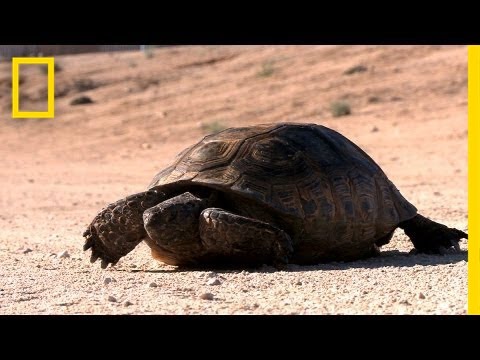
a lot of plants and wildlife there’s
thousands and thousands of square miles
out here that had been crawling with
tortoises back in the 40s and 50s that
no longer have tortoises and to find a
place that still has that abundance of
tortoises on it and to develop it was
probably the real shame of it the
problem is now that we’ve got this shift
where we’re taking five square miles of
public lands and putting mirrors on it
and it’ll never come back you’re always
talking about trade-offs so the question
is can you develop a project and still
be environmentally responsible and do it
in a way that actually enhances the
environment we found when we came on
site within the boundaries roughly a
hundred and seventy-three tortoises
those tortoises were moved into our
nursery where they are protected and
kept and what we found now is after this
time there is no statistically
significant difference in the survival
or mortality of those tortoises that
have been moved the ones you rescued are
moved out to the side and they’re there
now living with the resident tortoises
another thing they try and go back
and and they’re found walking along the
fence I think the one ray of hope that I
see is that like out the desert tortoise
Natural Area they’ve completely fenced
that 40-plus square miles now and it’s
the only place I’m aware of where where
tortoises are reproducing when you’re
talking about fossil fuels you have to
factor in the land used for exploration
extraction processing and then
transportation here we have a project
that actually collects the energy and
then converts it to electricity all
within a single location people
sometimes forget that’s exactly a very
efficient utilization of a sustainable
energy resource so a project of this
size will avoid nearly 400,000 metric
tons of carbon each year that otherwise
would have been emitted
you
Please follow and like us: