
have you ever wondered how ice skates
run something to do with the ice being
slippery well surprisingly it’s not as
simple as you might think and the exact
mechanism behind how ice skates actually
work has been hotly disputed for years
one theory is the heat generated by the
friction of the skates moving on the ice
produces a slippery film of water
between the metal blades in the ice this
sounds logical but it doesn’t explain
why skates are still slippery even at a
standstill another theory is it’s the
pressure of the skaters weight applied
through the narrow metal blades that
reduces the melting point of the ice and
again produces a slippery film to ride
on and it’s true pressure can reduce the
melting point of ice as this experiment
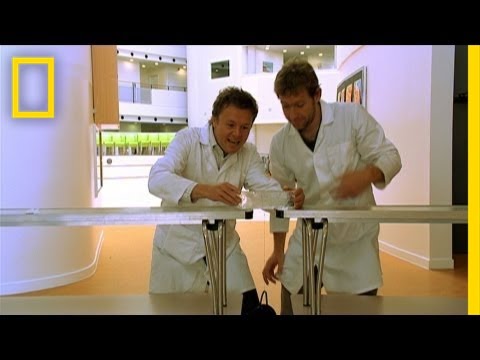
will demonstrate so we’ve got a block of
ice around which we’re going to place
this cheese wire which is attached to
some weights now watch this now just
like the ice skates the ice under the
wire is put under tremendous pressure
and this reduces the melting point of
the ice
it’s already starting to cut in there is
amazing
as the wire passes through the ice above
it refreezes as the pressure’s released
it’s incredible that is so cool and
after a few more minutes the wire was
ready to drop oh it’s working hey now
look Johnny one solid block of ice and
can you see that can you see that
frosted well it’s cut free going through
it is excellent and that is still very
very can’t break it can’t okay
solid unfortunately this pressure theory
doesn’t provide the whole answer either
a typical skater only produces enough
pressure to reduce the ice melting point
by a few degrees
which would make skating at anything
more than just below zero a bit tricky
so what’s the answer
well the latest scientific thinking is
that it’s a combination of the pressure
theory and the friction theory along
with the fact that the bonds that bind
the ice molecules together a weaker near
the surface so I mean after all that ice
is naturally slippery um well yeah
technically speaking
run something to do with the ice being
slippery well surprisingly it’s not as
simple as you might think and the exact
mechanism behind how ice skates actually
work has been hotly disputed for years
one theory is the heat generated by the
friction of the skates moving on the ice
produces a slippery film of water
between the metal blades in the ice this
sounds logical but it doesn’t explain
why skates are still slippery even at a
standstill another theory is it’s the
pressure of the skaters weight applied
through the narrow metal blades that
reduces the melting point of the ice and
again produces a slippery film to ride
on and it’s true pressure can reduce the
melting point of ice as this experiment
will demonstrate so we’ve got a block of
ice around which we’re going to place
this cheese wire which is attached to
some weights now watch this now just
like the ice skates the ice under the
wire is put under tremendous pressure
and this reduces the melting point of
the ice
it’s already starting to cut in there is
amazing
as the wire passes through the ice above
it refreezes as the pressure’s released
it’s incredible that is so cool and
after a few more minutes the wire was
ready to drop oh it’s working hey now
look Johnny one solid block of ice and
can you see that can you see that
frosted well it’s cut free going through
it is excellent and that is still very
very can’t break it can’t okay
solid unfortunately this pressure theory
doesn’t provide the whole answer either
a typical skater only produces enough
pressure to reduce the ice melting point
by a few degrees
which would make skating at anything
more than just below zero a bit tricky
so what’s the answer
well the latest scientific thinking is
that it’s a combination of the pressure
theory and the friction theory along
with the fact that the bonds that bind
the ice molecules together a weaker near
the surface so I mean after all that ice
is naturally slippery um well yeah
technically speaking
Please follow and like us: