
most people I think when they’re
thinking about Jade
imagine a bright green material that we
commonly see in jewelry but the Chinese
jade tends not to be that bright green
material it tends to be darker more
subtle colors
[Music]
the freer possesses one of the largest
collections of ancient shades from the
Neal the culture that we now call Lee
Jung Joo the culture is named after its
first discovery site near Hangzhou China
which is essentially doubt west of
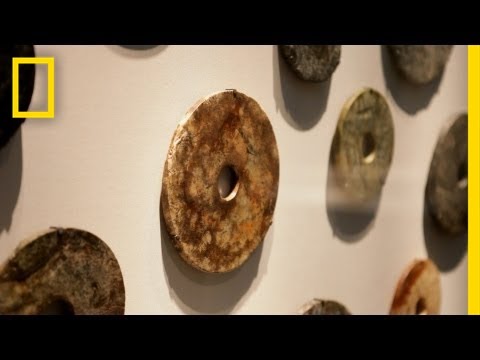
Shanghai be discs are essentially round
flat doughnuts they’re created from in
general
nephrite which is a specific kind of
jade material they were clearly
important to the society that created
them they’re found in Chinese tombs
elite burials often in large number the
ongoing mystery is exactly why they were
made and why they were put in Tunes I
think that the shape of the B was chosen
because they learned how to work that
shape using rotating tools a turntable
or you know some type of mechanical eyes
mechanical device to rotate the Jade we
have a lot of ideas about how Jade’s
were worked and we are quite sure they
were largely worked with mineral
abrasives so through the abrasive
process of rubbing the surface the Jade
one way or another whether it’s sawing
or creating a drill hole mineral braces
would have been used because no tools
would have been available during the
Neolithic period clearly it was not made
by average people these were highly
trained artisans who were responsible
for making these objects the material
itself is rare notoriously difficult to
work so that creation of these objects
in nephrite represents a great
expenditure of social wealth at the time
normally when Jade objects come into our
laboratory for examination the first
thing we do is we study it visually
under a microscope the curator – usually
would like to know the mineral
composition of the object we use
techniques such as x-ray diffraction and
Fourier transform infrared spectroscopy
to analyze the Jade material we look for
evidence of manufacturing to learn how
the object was made that includes
looking at the overall shape and form of
the object and more detail look at the
tool marks left on the surface of the
Jade because of the development of
archaeology in China and the great
interest in Liang to culture it’s
couraged us here at the Museum to use
our collection of some 125 objects as a
kind of sample to improve our
understanding of the manufacturing
techniques of this ancient culture
Please follow and like us: