
the Mekong River system is one of the
biggest and most productive in the world
more than 2 million tons of fish hauled
out of this river every year
there are over 1,000 species of fish in
these waters only the Amazon in the
Congo have greater diversity more large
fish occur in the Mekong than in any
other river in the world this may be
because of the rivers amazingly high
productivity and large expanses of
floodplain habitats its size and link
also mean that these waters provide
plenty of room to grow
Zeb Hogan believes that the giant fish
of the Mekong are critically important
to the survival of the region and that
they can tell us a lot about what might
be happening and other great rivers I
was out here working and seeing what was
happening and I wanted to do something
to try to stop the fish from going
extinct the World Wildlife Fund
researcher has literally immersed
himself in these waters for nine years
gone fishing you could say for what
could be the rivers greatest asset this
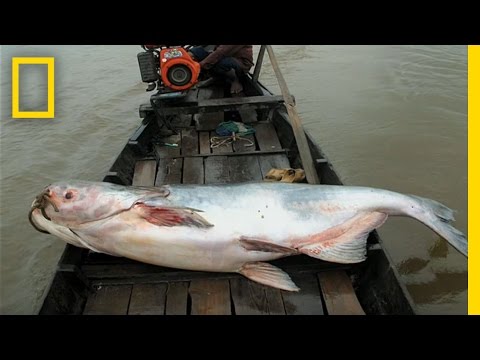
is the Mekong River catfish it is a
beast and has been known to weigh over
600 pounds but they’re getting harder
and harder to find because of zetz work
they have finally been listed as
critically endangered although it’s
nearly impossible to estimate their
exact population well nobody really
knows how many fish are left in the
river what we do know is that a hundred
years ago Fisher’s were catching
hundreds if not thousands of fish and
these days in a good year Fisher’s catch
ten to fifteen fish
[Music]
the giant catfish is a big part of the
culture along the Mekong River you can
see them represented by ancient art
[Music]
so in 2000 Hogan who is also a National
Geographic Society emerging Explorer
begin a one-man crusade to save the
giant fish and and tagged and released
65 kilos Zeb first went after the
fisherman oh so it really starts to
increase now we made an agreement with
fishermen with the fishers but catching
a fish that when they caught one of the
fish they would contact us and then we
would reimburse them for the fish we
would pay them for the fish then we take
the fish we have a special
rehabilitation tank where we’ll place
the fish in clean water with antibiotics
we leave the fish in the tank for a few
hours when the fish seems strong we take
that tank out into the middle of the
river tag the fish and then release it
back into the end of the Tonle Sap River
so that it can continue its migration
these days Zeb is working with the
Cambodian government and has had to
change his tactics local leaders won’t
allow them to pay fishermen for their
catch because they worry that his money
actually encourages people to go after
the big fish now these enormous
creatures are protected and fishermen
are required to release all giant
catfish a 1.3
exams work with locals suggest that the
population of these aquatic Giants is
spiraling down the first year I was here
they caught 11 fish and every year since
the catch has been slowly declining but
overfishing may be only part of the
problem we only know of one spawning
location for Mekong giant catfish and
that’s in far northern Thailand that
area of northern Thailand is just
downstream of a series of dams that
China’s constructed within the last ten
years and it’s also in an area that’s
being blasted and dredged I never heard
about anyone in the Zeb is also working
to help the fish regain its celebrity
status among the locals who live and
depend upon the Mekong River for their
livelihood this team has produced a book
about the catfish and is distributing it
to children this is a book that we did a
few years ago about giant catfish oh
just a story that mirrors the natural
migration pattern of a giant catfish
it’s very difficult to get idea across
them endangered species find children a
little bit more receptive to the message
Zeb believes that as goes the giant
catfish so goes the Mekong and if the
river can’t support these giant beasts
that it probably won’t be able to
support the people on its shores for
much longer
sponsored by National Geographic mission
programs taking science and exploration
into the new millennium
biggest and most productive in the world
more than 2 million tons of fish hauled
out of this river every year
there are over 1,000 species of fish in
these waters only the Amazon in the
Congo have greater diversity more large
fish occur in the Mekong than in any
other river in the world this may be
because of the rivers amazingly high
productivity and large expanses of
floodplain habitats its size and link
also mean that these waters provide
plenty of room to grow
Zeb Hogan believes that the giant fish
of the Mekong are critically important
to the survival of the region and that
they can tell us a lot about what might
be happening and other great rivers I
was out here working and seeing what was
happening and I wanted to do something
to try to stop the fish from going
extinct the World Wildlife Fund
researcher has literally immersed
himself in these waters for nine years
gone fishing you could say for what
could be the rivers greatest asset this
is the Mekong River catfish it is a
beast and has been known to weigh over
600 pounds but they’re getting harder
and harder to find because of zetz work
they have finally been listed as
critically endangered although it’s
nearly impossible to estimate their
exact population well nobody really
knows how many fish are left in the
river what we do know is that a hundred
years ago Fisher’s were catching
hundreds if not thousands of fish and
these days in a good year Fisher’s catch
ten to fifteen fish
[Music]
the giant catfish is a big part of the
culture along the Mekong River you can
see them represented by ancient art
[Music]
so in 2000 Hogan who is also a National
Geographic Society emerging Explorer
begin a one-man crusade to save the
giant fish and and tagged and released
65 kilos Zeb first went after the
fisherman oh so it really starts to
increase now we made an agreement with
fishermen with the fishers but catching
a fish that when they caught one of the
fish they would contact us and then we
would reimburse them for the fish we
would pay them for the fish then we take
the fish we have a special
rehabilitation tank where we’ll place
the fish in clean water with antibiotics
we leave the fish in the tank for a few
hours when the fish seems strong we take
that tank out into the middle of the
river tag the fish and then release it
back into the end of the Tonle Sap River
so that it can continue its migration
these days Zeb is working with the
Cambodian government and has had to
change his tactics local leaders won’t
allow them to pay fishermen for their
catch because they worry that his money
actually encourages people to go after
the big fish now these enormous
creatures are protected and fishermen
are required to release all giant
catfish a 1.3
exams work with locals suggest that the
population of these aquatic Giants is
spiraling down the first year I was here
they caught 11 fish and every year since
the catch has been slowly declining but
overfishing may be only part of the
problem we only know of one spawning
location for Mekong giant catfish and
that’s in far northern Thailand that
area of northern Thailand is just
downstream of a series of dams that
China’s constructed within the last ten
years and it’s also in an area that’s
being blasted and dredged I never heard
about anyone in the Zeb is also working
to help the fish regain its celebrity
status among the locals who live and
depend upon the Mekong River for their
livelihood this team has produced a book
about the catfish and is distributing it
to children this is a book that we did a
few years ago about giant catfish oh
just a story that mirrors the natural
migration pattern of a giant catfish
it’s very difficult to get idea across
them endangered species find children a
little bit more receptive to the message
Zeb believes that as goes the giant
catfish so goes the Mekong and if the
river can’t support these giant beasts
that it probably won’t be able to
support the people on its shores for
much longer
sponsored by National Geographic mission
programs taking science and exploration
into the new millennium
Please follow and like us: