
[Music]
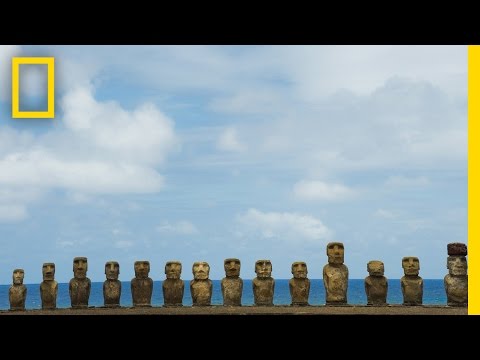
this whole business of giant statues
really cries out for an explanation what
happened when did it happen and why
these are the sort of enduring questions
that we think of as the mystery of
Easter Island
ever since Easter Sunday
17:22 when the first Europeans
accidentally sighted this isolated
island in the South Pacific
Easter Island has presented a dilemma
for explorers scientists and today an
increasing number of tourists but it was
here on Rapa Nui or Easter Island more
than two thousand kilometres from
another Polynesian island nearly 4000
kilometers from the coast of Chile
apparently without influence from other
cultures that a prehistoric society
evolved and produced the greatest
monuments and feats of engineering in
all of Polynesia really in all of the
world for that matter
well Rapa Nui is small it’s very small
and it is isolated this is it you’re
looking at the whole island if we
understand the size if we take a look at
Washington DC and we superimpose Rapa
Nui onto it gives you an appreciation
for its size that’s the right reaction
Easter islands moai now multi tons
statues some measuring more than 20
meters in length and weighing more than
75 tons were carved out of the islands
quarry of volcanic tuff and then
transported some of them several miles
over the islands rugged terrain these
statues were then placed on impressive
platforms called ahoo and this whole
business of giant statues and platforms
really cries out for an explanation what
on earth is going on here well the moai
were religious statuary like those found
elsewhere in Polynesia but had the
Society carved and transported just one
or two of these statues the
accomplishment would have been
noteworthy but actually not that
surprising other islands in Polynesia
have impressive stone statues and some
of them were even moved significant
distances but by our own count the
Islanders carved almost a thousand
statues more than 400 of these were
transported over rough terrain some
reaching every corner of the island
nowhere else in Polynesia had this
happened why did it happen on Rapa Nui
an island where people should have been
focused on where to find their next meal
how could a relatively poor society have
produced such impressive monuments were
people more numerous with more resources
in the past what happened when did it
happen and why these are the sort of
enduring questions that we think of as
the mystery of Easter Island
generally speaking Rapa Nui might have
just remained the of interest to just a
small group of researchers but its story
has grown to have a greater impact to us
it’s been given a modern message and a
warning for today’s grow global problems
Rapa Nui has been offered up as an
example of a society that overexploited
its own resources and destroyed itself
Jared Diamond describes this as ecocide
for ecological suicide here’s our
summary of the popular view of events as
presented by diamond and others
Polynesian settlers colonize the islands
sometime between 400 and 800 AD
centuries later elites gain control of
the island and with a population that
had grown too large competition ensued
for power and prestige consequently they
redirected a significant portion of the
islands resources and human energy into
insanely competitive statue building
cult that some have called a moai mania
this practice continues until it
literally took down the islands fragile
ecology and reduced the population to
the poor state in which Europeans found
it in the 18th century
so this account as told in this but by
many is often taken as a given people
just assume it’s true the story though
isn’t isn’t a brand-new story it
actually emerges with the speculation of
some of the earliest European visitors
French explorer la puros who visited the
island for a single day in April of 1786
suggested that the president unfortunate
condition of the Eastern Islanders was
due to the imprudence of the ancestors
who at some very distant time in the
past had cut
down there one natural resource a dense
forest this imprudence in destroying
their forest forms the foundation of
what a lot of what we think about what
we think we know about the island it is
really directly behind much of the
accounts of Rapa Nui as the site of some
kind of prehistoric catastrophe well
modern research confirmed that there was
a dense forest and it led some to
speculate that people had foolishly
called for the forest to be taken down
to provide tens of thousands of logs
needed to transport the giant statues
from the quarry to their shoreline
location Jared Diamond would suggest
that more trees had to be cut down for
additional agricultural fields to feed a
rapidly growing population and the
thousands of workers who were forced to
make and move the giant statues
according to Diamond the population
exploded reaching more than 15,000
forests disappeared and eventually
agriculture failed together these two
factors uncontrolled population growth
and over exploitation of the land
resulted in a critical drop of the
islands carrying capacity to make
matters worse the loss of forests meant
that people could no longer carve new
canoes for deep-sea fishing as well
without seaworthy vessels the excess
population could not be sent off in
search of new land as they had in the
past in essence according to this
version of history the Rapa Nui were
marooned on an island they had
impoverished by their own imprudent
actions increasing competition over
limited resources Diamond believed led
to warfare and finally cannibalism and
chaos this happened just before so it
said Europeans arrived to see the
remnants of a once thriving society that
had destroyed its environment and as a
result destroyed itself as diamond put
it the Islanders had committed ecocide
is this what really happened well in
2001 we began intensive fieldwork on
Easter Island five years later and after
as many seasons of fieldwork the story
that we believed was pretty
accurate was really falling apart before
our eyes it didn’t add up one aspect of
this was that the idea that the statues
had been knocked over in this period of
chaos and cannibalism and that warring
tribes out of revenge went and knocked
the statues down and this is supposed to
happen around 1680 AD before Europeans
arrived in 1722 well there’s a little
problem and you can take you know a
couple of minutes today on Google and
see that wait a minute
Europeans are illustrating standing
statues in and platforms in a pretty
good state well a researcher a historian
and an engineer got together and
speculated that something else might be
going on this reminder from Stanford
University’s web pages and a historic
photo thereof Louie Agassiz reminds us
that sometimes statues fall over in
earthquakes and the researchers on Rapa
Nui speculated actually hypothesize with
pretty good evidence that this might be
what happened there that statues
actually came down after European
contact with earthquakes if they were
never actually pulled down by warring
tribes the other the other one one other
piece of evidence here is supposedly
there is a proliferation of weapons of
mass destruction that look like this
yeah this is a matam and in it’s a
stemmed obsidian artifact and there are
thousands of these artifacts on the
island you find them everywhere and the
museum has tens of thousands of these in
their collections and these are
supposedly the weapons well we looked at
literally hundreds of these in the
museum collections and only once in a
while is there one that’s even vaguely
pointed and if you wanted to make
weapons you would probably make them
pointed more importantly there are
several studies independent studies
where archaeologists have studied the
edge of these tools under a microscope
and what they see is that these tools
were used in cutting and scraping plant
materials they are not weapons they
don’t have blood on them and things like
that so
what was supposed to be weapons of mass
destruction basically pocket knives for
working on agricultural products so
perhaps out the warfare that they’ve
been implicated in well the answer here
is that there really is no evidence of a
collapse before European contact the
collapse occurred with European contact
and as a result of it
Europeans introduced old-world diseases
and this scene of cooks visit to the
island where he describes skeletons
covering the surface and speculates
about where are all the people probably
was witness to an epidemic that had
occurred just a few years earlier with
the visit of the Spanish in 1770 so the
story gets a little worse of course
because in the early 19th century slave
trading began and the island was raided
on a regular basis ruffinelli people
were taken by force at gunpoint and
forced into laboring in South America
and in parts of Polynesia so sadly what
we see here is we’ve got a popular idea
of ecocide but what really happened was
a near genocide that devastated the
culture and the population as the result
of European contact and very sadly the
victims of cultural and physical
extermination have been blamed as
perpetrators of their own demise well
this realization about what was going on
on the island and the old story falling
apart meant that we had many questions
to ask and our research really began to
open up because a lot of things we
believed were true turned out not to be
one obvious question that that of course
many have posed up and that became very
important here in understanding the
archaeological record was how many
people did it take really did it take to
move a statue did it really take
thousands of people cutting down
millions of trees thereby bringing down
a society and its ecology as the
traditional story goes is this really
what it takes to
make and move statues around so we
started to explore that generally
speaking the archaeological what
archaeological explanations for how
statues remove all involve one form or
another some kind of wooden contraption
and this connections with a contraption
or some kind of wooden is really
important for the the sort of
traditional narrative because it’s the
mechanism by which the forest gets cut
down both for clearing land for food to
support people who move the statues as
well as the resources required to make
the contraptions to move the statues
around so this connection a lot of the
explanations really put these two things
together
here’s rano raraku this is the quarry
from which 99% of the statues were made
and then moved from there and we can see
all the statues that are stet we’re
going to basically finish ready to be
moved out and we can explain exactly why
some of them are still there when we
look at the quarry itself we see a sort
of a pattern step-like pattern of
construction and really this is well
very visible and something you can go
and observe you visit Rapa Nui today the
statues are carved out of the bedrock
and you see an a here the top side is
carved out until they get to the
underneath the statue where that the two
sides the carving meets the create sort
of a keel so the back is really
unfinished as it’s carved out of the
bedrock then once it’s broken from the
bedrock it slid down the slope and
generally the statues that are in the
bedrock are up high on the slopes and
this is important because it’s part of
making them moving them from those
locations is relatively easy because you
can just slide them down the slopes and
we can see that they’re slid down the
slopes and then stood upright at the
base of the slope in pits and we can see
there’s a lot of the statues that you
see outside and the quarry are standing
up often buried up to their heads but
though they’re actually in pits dug by
prehistoric people and they’re put there
in order to finish the statues because
on the top part where they’re first
carving them out of the bedrock they’re
unable to finish the backside of them
and so when they’re standing up they’re
able to get to the backside and then
complete the backend of the statue and
prepare it for this next step which is
transportation once they’re in the in
the pits they’re actually in a standing
position and then they’re moved out of
there so they carve out the rest of the
pit to create a trench to move the
statues out we also see some real inter
seeing differences in terms of the forms
of the statues the ones that are on the
roads versus the ones that are on the
platforms the roads that are the moai
that are on the roads tend to have a
much wider base and have a really
interesting forward lean the bases are
actually angled so the statues are
leaning very far forward to degree to
which they actually can’t stand up on
their own you have to actually prop them
backwards to keep them standing in
contrast the statues that are on the
platform are actually straight up and
down and have a great center of mass
that makes them very stable which again
what you would want to have a statute
you’re going to put it on a pedestal
you’d want it to be stable so it doesn’t
fall down and crush you so these the
differences between those is really
telling us they’re shaped in a certain
way before they get to the Yahoo and
then once they get there they’re free to
change them in addition the stat the
statues that are at the platform have
eyes carved into them the last step in
carving the statue and finishing them
before they’re they’re ready for the
religious adorn and other activities
that go on with that Native people
practice there so in order to sort of
explore explore this idea that there’s
move standing and how this might
actually work and in some of the physics
of it we built a three-dimensional model
a digital model to look at how the how
the the center of mass might work and
how these things that actually might be
manipulated in order to make them moved
we use the digital imagery lots of
photographs that were then were merged
together to create a three-dimensional
point cloud which represented a statue
and in the end it produced a really
precise digital replica of a statue now
the important part is this replica is of
a road statue the statues once they get
on they ah who are modified in order to
be stable and ready for being on the
platform but those ones in the road
which this is a replica
have these specific features of the
angled base and the wide the wide basis
and the forward leaning parts of it too
so using this digital replica and then
supported by the National Geographic
expeditions Council we generated an
actual replica a 5 ton ten-foot tall
concrete replica of a road statue that
precisely modeled a real statue that’s
on Easter Island this five
ton ten-foot-tall replica we called it
named it ho to ET and it is literally
one of the most in moving countered and
we were we took on the task of trying to
see if we could get it to move in a
standing position set to replicate what
we thought was going on pre historically
what we ended up with is a model that is
consistent with the evidence the
archaeological evidence and consistent
with basic physics about how you might
move something that is this tall at
using the features of the center of mass
of this statue itself in order to assist
you in doing so the statue basically by
rocket by hat because it has a forward
lean by rocking it back and forth what
happens is that the statue tends to fall
forward and as it falls forward on the
front edge it actually takes a step so
each time you walk forward you get it
you get a step in a twist and so you get
this rocking and rolling motion that
causes the statue to move forward and so
it’s essentially what we expected to
happen was if we could figure out where
to tie the ropes and if we could pull
the things in the right direction the
statue should actually start to take
steps and move on its own well it’s
great to talk about that in sections say
yes well this definitely shows this is
possible and so we took Howe to ET and
actually took on the task of trying to
make this happen and we got the results
here this of course is at the end of
several days of lots of things that
didn’t work but uh yeah but once we
really we had to trust the statue to be
shaped in a way that it would do its
thing and once it once we put in the
right things it just did its own it
started to walk and it was easy once it
got going
you see people pulling basically one arm
[Music]
sir thank you that is a lot of fun we we
were we were very happy when that
happened and here it is with the
beautiful artwork from National
Geographic what was remarkable to us is
that once we we sort of removed our own
preconceptions about what needed to be
done the statute really was engineered
to do this it was really the center of
mass was such that that it wanted to
walk all we had to do was not assume
that we had to drag it in a particular
twist it it was really just input in
putting the right amount of twist mind
amount of energy and it was really built
to walk we were able to move it 100
meters in about 40 minutes really is a
trivial kind of amount of energy but
really that’s a more testament to the
amount of engineering that went into
making these things so that was possible
in fact really easy to move so really
wasn’t armies of people necessary to do
this small groups could have done this
family sized groups could have made
these statues moving and the question
about well this is only a five ton
statues and only 10 feet tall what about
the larger ones well in fact this method
of moving wouldn’t necessarily require
you know to make it 20 foot statue
wouldn’t require two times the people
because as they get taller you actually
get more leverage to be able to tilt it
back and forth so it actually may have
not required a lot more people as the
statues got larger and larger well we
want to propose to you that well this is
absolutely amazing it’s perhaps not the
greatest achievement of the ancient
Islanders it was the great in fact the
greatest achievement was creating a
sustainable society that survived for
about 500 years on a remote and
difficult island while sailing over
3,000 kilometers from central Polynesia
the colonists of Rapa Nui were no doubt
happy to find land in the empty and
turbulent seas of the southwestern
Pacific but they may have been a little
disappointed when they examined their
new home unlike many other islands in
paulin
Asia perhaps like the area that they
came from in central Polynesia Rapa Nui
had no natural streams the colonists
would soon learn that growing their
crops would rely only on rainfall well
I’m afraid there was more bad news the
waters around Rapa Nui are not
particularly rich with fish our
excavations revealed that most of the
fish were from the rocky near shore
waters large deep-sea fish such as tuna
were not all that common
archaeologically we eat them and we
enjoy them today but not so common in
the past it seems people did not go
deep-sea fishing why didn’t they well
the option seems to be taken was taken
from them though the island had a dense
forest it was comprised of palm trees
with thin brittle bark and soft fibrous
interiors making them really useless for
canoes it’s kind of like a barrel
once the vessels they had arrived on
we’re no longer seaworthy the Islanders
could not really do much deep-sea
fishing this means they also lost the
opportunity to voyage in search of new
islands when times got tough so the
colors who arrived on Rapa Nui had to
make an important decision unless they
returned on the same broke boats that
brought them to the island there would
be no next opportunity the giant palm
trees numbering the millions were
unsuitable for carving canoes that
people had to make a living on Rapa Nui
or they would suffer perhaps they would
even die well these giant statues nearly
a thousand of them suggest pretty
dramatic story unfolded how did people
sustain themselves on this rather
difficult and challenging Island this is
the question that we would try to answer
in our research well over a several
seasons of fieldwork we excavated on the
on a kena dune you can see it here in
Google Earth satellite imagery the beach
here on the North Shore of the island
and the dune that forms from it and in
the next photo we can see the low
elevation aerial photograph that we took
from attaching a camera to a kite that’s
a lot of fun
and you can see the ahoo here and the
statues they’re showing their shadows
there in the front and then in the upper
part of the slide you can see our
excavations with a little wind barrier
around it on the dune well the
surprising thing in those excavations we
thought that the island was probably
settled around six 800 AD we were sort
of going with the consensus at that time
as it turned out the oldest cultural
layers in this excavation and indeed the
colonization of the island turned out to
be only 800 years ago turned out to be
around 1200 AD we realized in Rapa Nui
that if something as fundamental as the
radiocarbon date the first the
settlement date was wrong for the island
what else might be wrong well we’re
going to head north for a moment head
home and tell you about evidence from
the Hawaiian Islands that really started
to paint a different picture of Rapa Nui
as well in the Hawaiian Islands before
the arrival of Polynesians around 1200
AD the lowlands had been covered in a
forest of native palm trees these palm
trees are called perch artyom and they
look like this but once Polynesians
arrived the Hawaiian palm forest
disappeared and they disappeared fast
with perhaps just a feud in a few
decades these forests had crashed many
archaeologists had blamed Polynesians
for using fire to clear land for
agriculture
however puzzling new evidence indicated
that these palms had disappeared almost
instantaneously but with no trace of
burning it seems that the Pacific rat
Rattus excellence who had arrived on the
colonizers first canoes enjoyed an
environment free of predators and full
of native plants with fruits and seeds
rats can consume hard fix seed cases and
they destroy the reproductive potential
of many of the seeds they consume and
their impact had been Swift and
devastating
well the implications for Rapa Nui were
startling during our first excavations
we had been surprised to find so many
rat bones in the lowest layers of our
excavations but now we could put two and
two together the story from Hawaii was
telling us something about Rapa Nui if
rats played a huge role in deforestation
in the Hawaiian Islands think of the
impact they might have on tiny Rapa Nui
these rats could breed at staggering
rates doubling their numbers every 47
days a mating pair of rat can become a
population of millions in a couple of
years if you actually do the math in
about just under three years two rats
can make 17 million given Rapa Nui size
it could have supported a rat population
of about two to three million indeed
hundreds of palm nuts and you can see
them here that have been discovered on
Rapa Nui show the tell-tale signs of rat
gnawing and total seed destruction these
seeds are not going to grow once they’ve
been eaten like that and if we take a
look under the microscope here we see an
ancient Judea palm nut and the Tel
Terran incisor marks of rats that’s kind
of the smoking gun there well add to
this fire Polynesians completed what
rats started but what they were doing
was transforming a natural environment
into an agricultural environment like
people have done all over the world
burning provided a short-term release of
nutrients that helped the poor soils of
Rapa Nui well in terms of biodiversity
the loss of the forest was an ecological
catastrophe there were extinctions that
occurred but in human terms there is no
evidence that the forest provided an
important source of food or other
resources they weren’t useful for canoes
etc the loss of forests did not greatly
affect the ability of people to feed
themselves in some ways the forest was
in the way as long as there were trees
there would be palm nuts as long as
there were palm nuts there would be rats
that fed on them so the gradual decline
of the forest opened up more land for
cultivation of staples such as taro and
sweet potatoes
but the big questions really still
remain unanswered we understand a little
bit more about the transformation the
island into a cultivated landscape but
we still still understand the state
related to the moai the statues
what role did the the moai play why here
of any place there had to be a reason
why society showed such an immense and
intense interest in commitment to statue
building what many ways we think the
island has been really misunderstood the
and really because we bring lots of
preconceptions about the way things
should be vast area the Ion vast areas
of the island are covered in stone
during our initial field seasons we had
looked at these carpets of volcanic rock
and assumed that they are natural
geologic features but they’re actually
engineered human created landscapes that
people are making these rocks breaking
these rocks and putting them there for a
particular purpose a solution to
problems of growing the crops in this
poor soil that also coupled with
irregular rainfall and then occasionally
strong winds and we saw that what Robin
knew if people were doing was growing
crops in a way in this rock mulch as a
way of being sustainable and that that
provided a really different kind of path
to success well a tradition of statue
carving already existed in central
Polynesia where Rapa Nui people came
from and they did statue carving for
religious reasons it makes perfect sense
imagine their perspective on this we
build statues and monuments to our
deified ancestors because it’s the right
thing to do going back in time they
might ask you don’t you build statues to
your ancestors this cultural even
religious rationale had the unintended
consequences of diverting time and
energy away from larger garden plots and
therefore larger families which the
limited environment of the island could
not possibly sustain so honoring your
ancestors appeasing the gods was exactly
the right thing to do and it yielded a
sort of a big evolutionary payoff for
people on the island the basis of the
argument is really just simple Darwinian
Ellucian small isolated populations with
unpredictable and limited resources just
like prehistoric Rapa Nui are exactly
the kinds of places that one would
expect to see elaborate cultural
investments appear in a population now
this making statues may be amazing to us
but really statues building statues is
exactly the right thing to do in this
particular kind of environment well the
descendants of the ancient Islanders are
still on the island today a lot of
people ask us well where did all the
people go and we say well they are there
and some are here tonight they live
among nearly a thousand statues and it’s
really it’s really that we owe them an
explanation of what happened on that
island we need we need to understand
what happened on that island and get it
right so what we’ve offered this evening
is quite a different perspective of Rapa
Nui history good science requires that
we critically evaluate ideas in light of
the evidence we can’t just make things
up we need to account for what’s there
on the ground what really happened our
research has revealed that the ancient
Islanders were not reckless our research
has revealed that the ancient Islanders
were not crazy they did exactly the
right thing for that Island
they were ingenious engineers in terms
of not only statues and moving them but
also agriculture and sustainability and
the stability of that agriculture they
avoided collapse on a small poor and
isolated island they are the story of
remarkable success the only collapse the
only collapse came with the diseases
introduced from the outside world after
1720 – and as a result of it well we
believe that understanding the past and
getting the details right and being
accountable for that has much to offer
in knowing who we are and where we are
heading in these most challenging times
the tiny yet very
special island of Rapa Nui offers a
message from the past for all of our
futures thank you very much thank you
[Applause]
[Music]
you
Please follow and like us: