
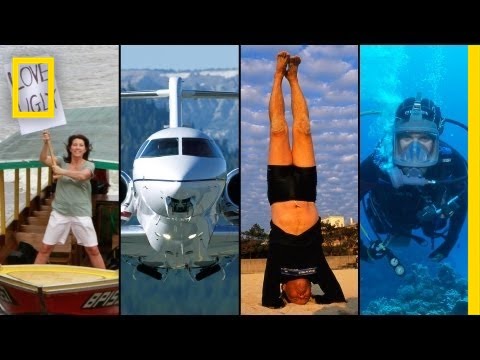
I got my first National Geographic grant
10 years ago and thanks to that grant
now I help save the last while places in
Barrington Irving all of 23 years old is
hoping to be the youngest person to fly
solo around the world and the first
african-american to do so
we’re trying to address the shortage of
you pursuing careers in aviation it
doesn’t matter where you’re coming from
what you have what you don’t have anyone
can achieve their dream
we teamed up with National Geographic to
find demographically confirmed areas
where people are living measurably
longer we can therefore also find of de
facto formula for longevity
I can hold
I love freaks nature’s odd Falls are
truly the most amazing animals on earth
the great thing about one of the great
things there are many about this panel
tonight is the diversity they represent
of the work of National Geographic
exploration is not what it was a hundred
years ago we explore in all areas from
flying an airplane around and using it
to teach kids about science and math
studying the ugliest creatures on the
planet
studying the oceans and for people like
me at this age finding out where do
humans live the longest this is an
urgent question at this stage in my life
Dan Buettner who has written the book
the Blue Zones about the places on the
planet and is it places that enable
people to live longer than the average
human
well we found five places essentially we
reversed engine engineer longevity so we
found a place in the highlands of
Sardinia the Norrell province were there
more male hundred year olds than any
place else that’s where you’ll want to
retire about 10 times as many with the
Kola Peninsula of Costa Rica if you go
straight east of Los Angeles about 80
miles you exit at the loma linda exit
off of highway 10 the first thing you
see is a Del Taco in a Wiener Hut and
you’ve arrived at America’s Blue Zone
and that is the highest concentration of
seventh-day adventists and Adventists
live about 10 years longer than the rest
of us so my job was to try to piece
together an explanation how do they do
it and what are the lessons we can learn
it’s one thing to live a long time but
are you happy while you’re alive he also
knows the happiest places on the planet
but I was thinking of happy
you look at in reeks Allah now he’s a
jovial guy he’s a smiling guy but
sometimes I think he’s like the grim
reaper of the ocean because he always is
coming back telling me stories about the
next coral reef that is dying it must
get depressing seeing what’s happened in
the oceans so is that a story of
throwing up your hands or is there a
story of hope in what you’re doing it’s
difficult to be optimistic when you
think about conservation everyday when
you think about what we are doing to the
ocean and the planet in general it’s
very frustrating and it’s it’s difficult
to be optimistic however there are some
bright spots out there there are places
that are so remote that they have they
have never been fished that look like
the ocean thousand years ago and there
are also some marine reserves these
places that have been set aside without
fishing where marine life has come back
and when you dive in these places and
you see the capacity of the ocean to
restore itself to replenish itself that
gives you hope
Enric Sala is one of our National
Geographic explorers and residents
illusi kook is one of our newest
emerging explorers and she has set for
herself a very difficult task and that
is trying to convince us that the
ugliest cute we’re not talking about the
homo sapiens species you’re and you’re
saying she’s saying that there’s too
much attention paid to the the pandas
and the polar bears they’re the poster
children of conservation and you want
people to look at frogs toads I’ve got
nothing against the charismatic
megafauna you know they’re very
charismatic animals but I think that
there are other animals out there that
maybe need a little bit of a help a bit
of a PR boost and that’s what I feel
like that’s my job all right what’s the
ugliest creature you found that you’re
trying to do that you could put on a
poster you can’t say a fellow panelist
well these are these
there’s a lovely frog that lives at the
bottom of a lake in in the Andes
that’s called Tama Tobias coleus which
is a Latin for aquatic scrotum frog got
dealt a fairly raw deal of the peels
thanks Mike whoever named in the first
place and what does that look like he’s
quite a sight
he’s quite a saggy looking creature and
he’s amazing you know he’s got an
amazing evolutionary story he lives in a
place that no one phibian should live
you know he lives two and a half miles
up in the air where it’s freezing cold
and there’s intense UV light and he
survives all that by living only at the
bottom of the lake and he never ever
surfaces and in order to do that he’s
had to stop breathing air through his
lungs and only breathe through his skin
which has evolved these copious folds
which increased the surface area and he
can just breathe through his skin which
is and when and ironically when he’s out
of breath what he does is press helps to
increase but push ups to increase the
flow of water and therefore oxygen
around his skin so he really has a hard
life yeah
Barrington Irving another of our
emerging explorers as you saw in the
film flying around in the plane was
trying to be hoping to become the
youngest person to fly solo pilot a
plane solo around the world and become
also the first African American to do
that this was when 2007 yep
2007 started in March how many days
later 97 17 97 days 145 flight hours and
20 what 27,000 mile 20 7,000 miles you
became it aged 23 23 so what happened
what got you into a cockpit because you
were living in Miami yep and what kind
of neighborhood yeah so you know grew up
and what a toughest neighborhoods in
Miami between Carol City and Liberty
City you know one day I’m in a store
mining my own business and this airline
pilot walks up and
sesame hey son have you ever thought
about becoming a pilot looked at him
crazy I told them to go smart enough to
fly plane and then I asked him how much
money he made after he answered the
question I took interest in becoming a
pilot and well how do you make that jump
it’s one thing to be interested but to
go from that neighborhood where you were
living
what was the route I mean there are two
pivotal things that he did one he
provided me the opportunity to sit in
the cockpit of a Boeing triple7 and I
had the opportunity to play with all the
buttons in the cockpit and I said to
myself you know what I think I can do
this and the second opportunity he
provided me was to go flying in a small
single-engine airplane just over in my
neighborhood and that’s when it hit me
it’s like oh my gosh there’s a world out
there and I was just flying over my
neighborhood and that changed my life
forever I turned down a full football
scholarship to pursue a career in
aviation to come back to what makes
people happy obviously he found
something barren can found something
that made him happy is that a key is it
finding a purpose a purpose is a key but
actually the biggest determinant when
when we did this worldwide sort of meta
analysis of happiness around the world
when you boil it all down the the cake
ingredient with its most important and
in happiness is where you live so if you
weren’t unhappy the the most powerful
thing you can do is move to a happier
place so you take for example you
moldavia with the former Soviet bloc
people as a rule are pretty unhappy
there on a scale of one to ten they rank
about a three but when you take Moldova
and immigrants and move them to
Copenhagen Denmark one of the happiest
places in the world within about a year
they start reporting the happiness level
of their adoptive home so if you want to
get happier and you’re not happy where
you are move to Denmark not Washington
and a lot of people can’t move so there
must be some other ingredients the Indus
of some of this match longevity
longevity of reason yes so if you are
unhappy the effect of unhappiness on
your health is as bad as a cigarette
habit it’s worth it because about eight
years off of your life expectancy but
probably the biggest predictor of being
happiest looking at a person’s social
network the happiest people in the world
socialize about six hours a day and
that’s not Facebook it’s FaceTime so if
you have a half a dozen friends who you
can call on a bad day and you regularly
socialize with them that’s that’s does
more than just about anything to stack
the deck in your favor Lucy does this
grow them frog have any friends he’s
always to pop for him in one unfortunate
ways that he when I eventually caught up
with him he was in he was in a blender
is that people believe that he he can
he’s like her sort of back street viagra
in Peru and they were this is serious
he’s got friends he’s got friends who
wanted to drink him and a fruit drink
it’s pretty urgent because not only is
he being drunk but he’s also the fungus
that’s killing off amphibians worldwide
has actually arrived at Lake to the
kharkhorin is having an amazing effect
as well what maybe a little more than
the third of the frog species are
threatened now forty percent actually
forty percent yeah and there’s a little
over six thousand species I think so a
huge number of frogs are being
threatened at this stage and Lucy’s
trying to tell that story by finding
ones with funny names and also licking
frogs yeah I did I did liqueur frog
actually I I went to go I went to Bogota
I was invited by some frog I wrote a
blog about frogs for about six months
and I traveled around South America and
I got invited to Colombia by some frog
scientists who read my blog and and I
went to go and visit them and then I got
there and they were studying poison dart
frogs
they said and the guy who’s the sort of
chief scientist said that he went out
and when he was out on the field he
could figure out if abroad was poisonous
or not by licking it which I thought was
the very definition of foolhardy
thinking like completely crazy thing to
do so I did what he said mine licked one
and I knew I had to lick him really hard
and then and then nothing was happening
and then with sort of rogue scientist
said to me he goes you’ve got you’ve got
to try hard maybe but to agitate him and
he was seemed quite agitated he’s making
these little cheap cheap noises and I
felt really bad and anyway eventually
this huge Bernie numbness I can Gulf my
face and I think I’d overdosed on it I’m
the only person to come to Papa tar and
overdose on frog but you know there we
go okay kids don’t try this
don’t try to agitate a frog by waking up
yeah now in reek a huge percentage of
the world’s population lives along
coastlines and depends on the ocean for
their protein source their fishing is a
big issue and yet fishing is what is
depleting much of the ocean can we have
both yet we can have both so about half
of the population lives near the coast
and seafood is the main source of animal
protein for about the billion people the
problem is that we have this particular
taste online nobody would think of
eating lions or Tigers these are the
type of fish that we like to eat the
tuna the large groupers the Sharks so
the ocean cannot support this level of
consumption of the of the top predators
and our footprint in the ocean is so
large that we have basically ran out of
ocean there are very few places only in
the southern ocean and there the Arctic
ice that have not been tapped by the
fishing grounds so there are solutions
and one is to eat cows instead of lions
to eat fish that are lower on the food
chain
eat more mussels and oysters which in
addition of being farmed in a way that
doesn’t destroy the marine environment
they also clean
and capture carbon so they are great
carbon sink and what we need to do all
in addition to that is to develop
aquaculture
that is sustainable because we most from
large-scale hunting into agriculture
thousands of years ago on on the land
but in the ocean where we are still
hunting fishing is not harvesting
fishing is large-scale hunting and we
cannot the ocean cannot support this
level of consumption so the everybody is
worried about peak oil but we already
reached peak fish in the late 80s and
the catch the global catch of wild fish
has been going down since and in
contrast the amount of seafood that is
produced by farms by aquaculture has
been increasing and now aquaculture
provides about half of the seafood that
we eat and so aquaculture is on the rise
and global you know the wild fish catch
is going down so the only way we will be
able to continue eating fish from the
sea is through sustainable aquaculture
but in a way that doesn’t deplete marine
resources and why you see the
devastation has happened much of the
ocean you see the fish stocks the
population that is declined on the other
side we have put in some marine reserves
small percentage of the ocean but we
have protected it and it comes back
faster than then the land comes back
when we protect an area so that there is
hope it doesn’t take long for fish to
rebound well you know it’s absolutely
spectacular that the recovery on this in
this place actually what got me into
this business was you know when I was a
kid I was watching the documentaries of
Jacques Cousteau on TV and seeing all
these whales and dolphins and sharks and
it was fantastic and I was living on the
Mediterranean coast of Spain and I was I
went swimming and I didn’t see any of
that richness
and say wow you know this is something
that belongs only to this tropical
season wow these guys are so lucky to go
to all these exotic places here you know
it’s just little pun and until the day I
do for the first time in a marine
reserve that had been protected for a
few years and everything that goes to
show that was there the large groupers
the sea bream the stingrays in large
numbers and then I realize wow this is
this is incredible that you know there
is hope we if this works here in the
Mediterranean which is the most over
fished
sea on the planet these protection
measures this marine reserve should work
everywhere and there are so many fish
inside this reserves and they reproduce
so much that part of them spills over
and after a few years usually in five
years
the fishermen around these reserves are
catching more than elsewhere
Barrington you set the goal to fly
around the world
solo you did it at 23 but that really
was only one more beginning step in the
journey because you decided I need to
give the same inspiration to other young
people and you started an academy you
have something called the STEM Academy
to teach science and technology and
engineering and math and and get kids
involved in aviation even building an
airplane yeah so how did that go well
I’m here to talk about it and it’s it
was actually a phenomenal challenge to
take sixty kids mostly from failing
schools in Miami and challenge them to
build a flyable aircraft from scratch
riveting the wings figuring out the fuel
system the avionics even making the
seats that that I sit in and my
challenge was to them was if you build
it I’ll fly it and these were kids
between the ages of 13 and 18 years of
age and they build it in a remarkable
ten weeks and I put my life on the line
in fluid
that honestly worked out to true success
and now to this day a young lady that
was in our program we’ve had a number of
success stories but a young lady in our
program who can tell you where sixteenth
of an inch was on a ruler at that time
she’s now a math major on a full
scholarship at Duke University so it’s
just a power these students are not just
pursuing aviation career fields but you
know they’re going into other fields
related to science and math and it’s all
about exposure and now you’re going to
take it to the next level
worldwide and the plans are what next
October or a year from this coming
October yeah you’re going to launch a
flying classroom and and where are you
going
who are you hoping to reach and how are
you going to do this well what we’re
doing is we’re transforming a
nine-passenger private jet into the
world’s first flying classroom which
will give us the ability to travel to
all seven continents teach from the air
broadcasts these students and classrooms
or homes be able to interview other
explorers and when I land in the
different destinations I’ll join
explorers and scientists in different
parts of the world to highlight their
work show their data and information as
well as collecting data and information
from the air and her kids gonna follow
along from schools here in the United
States and and all of this it’s virtual
all you need is internet connection and
to be part of it so we’re well I want to
provide students the same experience I
had when I met my mentor but do it on a
larger scale through virtual technology
and highlighting pioneers such as these
guys here along the journey to really
inspire them and show them what’s out
there it’s their world and they need to
know you know they play a key part in
shaping their future lucy has done
something that’s made millions of people
smile I don’t know how happiest made
them put together a video on sloths and
it’s gone viral
how many have looked at it now that that
one particular video is probably watched
by over 7 million people well
it’s called meet the floss if you want
to go to YouTube you can find it it’s
better quality on Vimeo but yeah
Vimeo go to Vimeo and it’s just pictures
of sloths
it’s yeah cute they are bit bother
business living cuts newsy and sort of
goofy and sloppy and this is part of the
story of telling animals that don’t get
their profile put out yes sloths have
had a reputation for being lazy dirty
and stupid and and and derided for being
for being for being lazy and the thing
that sort of really fascinates books or
annoys me and why want to sort of every
knows is this there’s nothing great
about being fast you know being slow is
a fantastic evolutionary strategy and
thus life is really successful animal
they are very they like stealth ninjas
basically they they move so fast you
don’t even see the movie the major
predator is the harpy eagle and it’s
thought that they move so slowly that
they actually moved the movement it goes
under the radar if the harpy eagle is
like you know flying above the trees and
and the slow time in really slowly and
it’s totally disguised as a tree you
know because it’s got two species of
algae and like 200 species of insects
and it’s fur which is how they got the
reputation being dirty
did you look a slide you know I I draw
the line at licking a sloth yeah well I
like the fact that Lucy’s taken the
second half of inspiring people who care
about the planet which we want to see
how they’re all doing this you find out
the information but then you’ve got to
inspire people so how do you reach
people how do you reach the young people
these kids and how do you reach the rest
of us one way is put up video that makes
6 million 7 million people check it out
on YouTube is that the new way to
communicate well definitely I mean you
can’t ignore the Internet I mean so I
think it’s fantastic I mean I it’s you
know I totally embraced the internet
because it’s enabled me to broadcast to
an almost you know infinite audience
using a mobile phone you know that’s all
you need now we all have the power to be
broadcasters and tell our stories which
i think is is really empowering
really fantastic thing you know when I
was a kid you know I could only drink in
a video camera would have cost tens of
thousands of dollars even and they no
hope of editing it you know so now it’s
so exciting that you can reach these
audiences can you give us much
information in because you can’t put you
can’t put a half hour documentary on you
nobody will watch the whole half hour so
how long was there sloth film that’s off
video doesn’t give any information it’s
it’s only that 90 seconds long but I
where I place it then draws in an
audience I think so there are people
like Oh
sloths and then they might read more
about the you know my website I’ve got a
I start up the sloth appreciation
society actually to reclaim the sloth is
a true king of the jungle and so I’ve
got lots of information there about
their biology and written books and I’ve
made documentaries which go into the
story further but it’s about sort of
like drawing an audience in that might
not necessarily have come to a
conservation program you know it’s about
preaching to a wide audience for me
anyway and dan has found another way to
get people involved and that’s to get
entire cities to try to follow some of
the rules that you have learned about
what makes people healthier and live
longer and try as an experiment there’s
an entire city you’re doing this in
Minnesota and well do in Minnesota Los
Angeles now the whole state of Iowa is
trying to become a Blue Zone believe it
or not we got another grant from
National Geographic Explorer Council to
actually find parts of the world that
were unhealthy and got healthier and
there’s only two in the world we found
one in Scandinavia 145 thousand people
in 1970 had the highest rate of heart
disease in the world and they brought it
down by 80% and they maintained it for
about 30 years and cardiovascular
disease is about a 500 billion dollar a
year problem in America the way they did
it the secret was to not rely on
individual responsibility they didn’t
nag you to get out of the ghetto out
from in front of the TV or eat your bed
Stables or get your exercise they
changed the environment and we started
in Albert Lea Minnesota and we blues
owned it and in eighteen months we
brought down their health care cost by
about 40 percent it actually worked
and then Los Angeles brought us in and
beginning next month we start with our
first four cities in in Iowa how long is
the experiment been going on that first
city and it’s three years it’s not its
third year now and it’s still working
still we’re sticking with the plan yes
it’s an evolving blueprint but
essentially we put into place little
things that move a population one or two
percent like for example you prohibit
drive-through fat and fast-food places
fewer people eat fast food there’s less
idling so the airs a little bit cleaner
you put a policy in place in schools
forbidding kids to eat hallways in
classrooms and the BMI of that class
goes down by 11%
you don’t even have to touch the
900-pound grill so we have a hundred and
ten of those little things and we don’t
make the city do it we say here’s the
portfolio you choose the 60 or 70 you
want to do will help you implement them
over the next couple years we use Gallup
to measure on the front end and we
measure on the back end and our feet are
held to the fight we don’t get paid
unless unless we make the population
healthier so a great program and that’s
what master Geographic is trying to do
find out information bring it back share
to inspire people and then hope that
they will take that message and do
something that either changes the planet
or changes themselves individually and
that is the purpose of National
Geographic as we say once again our
message to inspire people to care about
the planet and then to do something once
you know what the challenges are to try
to solve the problems there are answers
there are zones that we can put up
choices we can make so that the almost
200,000 years of Homo sapiens doesn’t
have to end in a story of the extinction
you
Please follow and like us: