
hi in the remote desolate borderlands of
Nepal in Tibet there is this ancient
kingdom far beyond the reaches of the
modern world it feels like it has this
great expansive spiritualness to it
this is Mustafa the place of Mustang
it’s not something that’s on the lips of
every single person I mean generally
people think you’re talking about a car
you’re talking about a horse or you’re
talking about the ranch okay and it’s
really hard to discuss with American
audiences most must on and pronounce it
properly if some people think you’re
saying moose dung or something like that
so it gets difficult for us when we’re
talking about Mustang but the word most
on is actually it’s an anglicisation of
global smog tongue which actually means
in western tibetan the plane of
aspiration or the plane of spiritual
longing and this is really what’s
emblematic of this incredible place it
feels like it has this great expansive
spiritual nough stew it it feels like it
has this great depth of antiquity to it
and when you travel in this place you
can’t help but feel the great
impermanence of it and you can’t help
but feel yourself become very very small
very much like a grain of sand much like
what you’d see in the Kali Gandaki River
that’s there in the bottom of that
photograph but high in the remote
desolate borderlands of Nepal and Tibet
there’s this ancient kingdom far beyond
the reaches of the modern world it’s
surrounded by some of the world’s
highest peaks and Riven into by the
great Kali Gandaki watershed
this is Mustang it’s known as the
kingdom of lo by all of its inhabitants
and those locals also revere a king
who’s the 25th in direct succession to
the first king of Nepal who founded that
royal lineage more than six hundred
years ago the place is a remarkable
essay in a variety of different types of
occupations of battles sometimes violent
and
control of trade that’s gone all up and
down this Kali Gandaki watershed
conducted primarily by horsemen people
with yaks and other beasts of burden
they’ve traded virtually everything from
salts to silks up and down this valley
this animation will give you an idea of
the depth of the Kali Gandaki River on
one side is the great peak of dalla Giri
and other side is Annapurna
both of them in excess of 26,000 feet in
height the village of Lamont tongue or
the city of Lamont tongue was
established by the first king of Nepal
Nepal in the walled city that you see
here was actually finished construction
by his son on gradenko sometime in the
14th century if you’re to travel in this
place you’ll understand the timelessness
of it you’ll go into these ancient
monasteries that were created somewhat
after the walled city was created and
you’ll be able to see these practices
that have been going on for more than
600 years but Mustang is a kingdom with
a mystery and that was really the reason
why I initially got excited about
traveling there and this was way back in
1981 when I was first visiting this
place and doing a trek around the
annapurna region which is a classic Trek
that many people do when they go to
Nepal
I noticed caves surrounding some of the
ramparts of the walls of the Kali
Gandaki River that you see here which
resembles our own Grand Canyon with
soaring sandstone walls and obviously an
incredible River at the bottom of it
of course traveling up and down this
region today is very much like it was
300 years ago you still see people
loading up donkey trains loading up
horse trains traveling with salt
traveling with all of their daily needs
any number of things would be put on the
backs of horses and for trade and for
travel for exploration but also for
pilgrimages for religious objectives
effectively to move into probably a
higher level of self-actualization and
that is why many people still travel in
this region to go into some of the
sacred spots that they believe they’ll
be able to take great tidings learn more
about the teachings of people who have
passed before them and achieve greater
ascendancy along life’s great path of
course traveling into
stung going into some of these tombs
going to some of the caves finding the
human remains is very much like a times
capsule it’s like going back into time
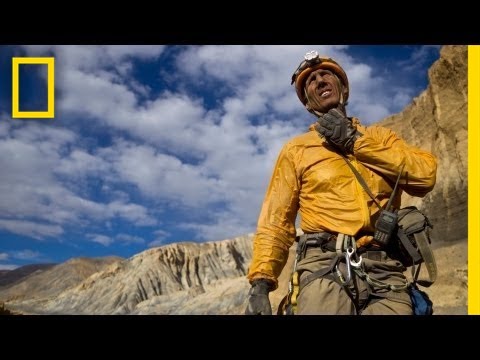
as climbers we get into these places
having gone over in a very difficult
terrain the rock is oftentimes very
unstable oftentimes shifting it
unfortunately requires a lot of
different types of skills sometimes
we’ll use ice climbing techniques to
climb rock it’s just very unstable
landscape for us to travel in but we get
inside and we’re immediately transported
back hundreds of years frequently we
also feel like we’re getting close to
the people who might have lived there we
see the toolmarks in the back of the
walls we see the human remains we see
some of the things that people would
have discarded and left behind and we
try to imagine effectively what their
lives were like the Lotus born Saint
also known as Padma Sun bhava in Sherpa
or Tibetan he’s known as guru Rinpoche
and he’s the Blessed teacher this is a
being supposedly who was the first being
to summit Mount Everest supposedly in a
chair made of gold on a Sun beam of
light he was able to ride to the rooftop
of the world by the same token
Padma Sun bhava guru Rinpoche was one of
the first beings to travel up the Kali
Gandaki region and establish monasteries
of Buddhist faith in this place
supplanting the Bond traditions that
existed beforehand and there are stories
of legendary battles of guru rinpoche
between he and the demon or demoness of
this incredible region of Mustang and
when one looks at the walls they’re
multi-coloured red yellow black
supposedly all these colors emanate from
bits and pieces of the demon that Guru
Rinpoche was able to vivisect and then
fling into the landscape so these are
just remarkable stories that one hears
throughout the course of one’s travels
throughout most on and the Everest
region one also hears about Guru
Rinpoche telling about the 108 Bay eul’s
Bay Yule is a word in Tibetan which
means sanctuary and supposedly there are
almost these parallel universe that
abide in certain places that if one’s
reached a level of self-actualization
one can slip inside of them but without
achieving that level
would never even know that they exist so
this is really the etymology of the
shangri-la myth in many ways the
Tibetans know it as Shambhala and
certain people believe that there are
actually these earthly paradise that
truly exists some of the artwork that
one would see commemorate the life of
Buddha commemorate obviously the
animistic traditions and of course the
bun tradition that existed far before
Buddhism but one of the caves that we
went inside is known as the snow leopard
cave reason being is this particular
cave really showed no passing of any
individual any being other than the
tracks of this this little kitty here
and it was interesting for us to look at
this place and to explore this place
because we were thinking if a place like
shangri-la actually did exist on earth
could it exist in a cave in Muslim could
it be a place that was once known for
being no high difficult to get to
but perhaps the sentient teachers lived
in these places perhaps there were
places for people to meditate in this
area the artwork that existed inside was
it there for the people to focus their
concentration and to move beyond
obviously the cares concerns of this
earthly life well it’s difficult for us
to say I mean this is one of the great
myths that we did explore when we were
there could there have actually been a
shangri-la could there have been an
earthly paradise in this place it’s
difficult to say you know there’s this
enchantment of the human mind with
archetypal utopian landscape that it’s
as old as myth and it’s ephemeral as a
dream we seem to have this incredible
yearning for places that don’t exist
of course looking into this incredible
place and climbing into this landscape
is a transcendent experience for me
personally and certainly for dr.
Alderfer and also for Corey as well this
is a place where one sees the presence
of humanity one sees the landscape
melting changing right in front of your
eyes and it’s a great great testament to
the great impermanence of life but to
give you an idea of what it’s like to
take a step inside we actually have
architectural drawings as part of our
inventory process and the things we
collect to try to effectively document
all of our travels but we also have
created this animation to try to take
you all inside like most of the stones
cave complexes the approach is a
struggle but once inside the rooms are
level and plans are much like a house
many floors have long corridors
either perpendicular or parallel to the
cliff vertical shafts connect one level
to the next cave colonies can range from
two levels to ten
some levels containing as many as 15
rooms suit on walls indicate cave
kitchens and storage rooms hold large
granny’s most of the complexes have a
single monastic room at the uppermost
level a later edition by religious
practitioners these high temple rooms
sit atop cave complexes that can have
sixty to eighty rooms a high-rise hewn
into a high Himalayan cliff so for us to
bring back this inventory to document
the materials that we find inside the
caves and then to try to present them
and to make sense of them requires
obviously an incredible team that’s why
we have obviously someone like it mark
Alderfer mark is the real deal he’s
truly the real Indiana Jones with all
the great academic credentials and none
of the looter mentality so thank you
very much everyone and I’d like to pass
over the leadership here at this point
you
Nepal in Tibet there is this ancient
kingdom far beyond the reaches of the
modern world it feels like it has this
great expansive spiritualness to it
this is Mustafa the place of Mustang
it’s not something that’s on the lips of
every single person I mean generally
people think you’re talking about a car
you’re talking about a horse or you’re
talking about the ranch okay and it’s
really hard to discuss with American
audiences most must on and pronounce it
properly if some people think you’re
saying moose dung or something like that
so it gets difficult for us when we’re
talking about Mustang but the word most
on is actually it’s an anglicisation of
global smog tongue which actually means
in western tibetan the plane of
aspiration or the plane of spiritual
longing and this is really what’s
emblematic of this incredible place it
feels like it has this great expansive
spiritual nough stew it it feels like it
has this great depth of antiquity to it
and when you travel in this place you
can’t help but feel the great
impermanence of it and you can’t help
but feel yourself become very very small
very much like a grain of sand much like
what you’d see in the Kali Gandaki River
that’s there in the bottom of that
photograph but high in the remote
desolate borderlands of Nepal and Tibet
there’s this ancient kingdom far beyond
the reaches of the modern world it’s
surrounded by some of the world’s
highest peaks and Riven into by the
great Kali Gandaki watershed
this is Mustang it’s known as the
kingdom of lo by all of its inhabitants
and those locals also revere a king
who’s the 25th in direct succession to
the first king of Nepal who founded that
royal lineage more than six hundred
years ago the place is a remarkable
essay in a variety of different types of
occupations of battles sometimes violent
and
control of trade that’s gone all up and
down this Kali Gandaki watershed
conducted primarily by horsemen people
with yaks and other beasts of burden
they’ve traded virtually everything from
salts to silks up and down this valley
this animation will give you an idea of
the depth of the Kali Gandaki River on
one side is the great peak of dalla Giri
and other side is Annapurna
both of them in excess of 26,000 feet in
height the village of Lamont tongue or
the city of Lamont tongue was
established by the first king of Nepal
Nepal in the walled city that you see
here was actually finished construction
by his son on gradenko sometime in the
14th century if you’re to travel in this
place you’ll understand the timelessness
of it you’ll go into these ancient
monasteries that were created somewhat
after the walled city was created and
you’ll be able to see these practices
that have been going on for more than
600 years but Mustang is a kingdom with
a mystery and that was really the reason
why I initially got excited about
traveling there and this was way back in
1981 when I was first visiting this
place and doing a trek around the
annapurna region which is a classic Trek
that many people do when they go to
Nepal
I noticed caves surrounding some of the
ramparts of the walls of the Kali
Gandaki River that you see here which
resembles our own Grand Canyon with
soaring sandstone walls and obviously an
incredible River at the bottom of it
of course traveling up and down this
region today is very much like it was
300 years ago you still see people
loading up donkey trains loading up
horse trains traveling with salt
traveling with all of their daily needs
any number of things would be put on the
backs of horses and for trade and for
travel for exploration but also for
pilgrimages for religious objectives
effectively to move into probably a
higher level of self-actualization and
that is why many people still travel in
this region to go into some of the
sacred spots that they believe they’ll
be able to take great tidings learn more
about the teachings of people who have
passed before them and achieve greater
ascendancy along life’s great path of
course traveling into
stung going into some of these tombs
going to some of the caves finding the
human remains is very much like a times
capsule it’s like going back into time
as climbers we get into these places
having gone over in a very difficult
terrain the rock is oftentimes very
unstable oftentimes shifting it
unfortunately requires a lot of
different types of skills sometimes
we’ll use ice climbing techniques to
climb rock it’s just very unstable
landscape for us to travel in but we get
inside and we’re immediately transported
back hundreds of years frequently we
also feel like we’re getting close to
the people who might have lived there we
see the toolmarks in the back of the
walls we see the human remains we see
some of the things that people would
have discarded and left behind and we
try to imagine effectively what their
lives were like the Lotus born Saint
also known as Padma Sun bhava in Sherpa
or Tibetan he’s known as guru Rinpoche
and he’s the Blessed teacher this is a
being supposedly who was the first being
to summit Mount Everest supposedly in a
chair made of gold on a Sun beam of
light he was able to ride to the rooftop
of the world by the same token
Padma Sun bhava guru Rinpoche was one of
the first beings to travel up the Kali
Gandaki region and establish monasteries
of Buddhist faith in this place
supplanting the Bond traditions that
existed beforehand and there are stories
of legendary battles of guru rinpoche
between he and the demon or demoness of
this incredible region of Mustang and
when one looks at the walls they’re
multi-coloured red yellow black
supposedly all these colors emanate from
bits and pieces of the demon that Guru
Rinpoche was able to vivisect and then
fling into the landscape so these are
just remarkable stories that one hears
throughout the course of one’s travels
throughout most on and the Everest
region one also hears about Guru
Rinpoche telling about the 108 Bay eul’s
Bay Yule is a word in Tibetan which
means sanctuary and supposedly there are
almost these parallel universe that
abide in certain places that if one’s
reached a level of self-actualization
one can slip inside of them but without
achieving that level
would never even know that they exist so
this is really the etymology of the
shangri-la myth in many ways the
Tibetans know it as Shambhala and
certain people believe that there are
actually these earthly paradise that
truly exists some of the artwork that
one would see commemorate the life of
Buddha commemorate obviously the
animistic traditions and of course the
bun tradition that existed far before
Buddhism but one of the caves that we
went inside is known as the snow leopard
cave reason being is this particular
cave really showed no passing of any
individual any being other than the
tracks of this this little kitty here
and it was interesting for us to look at
this place and to explore this place
because we were thinking if a place like
shangri-la actually did exist on earth
could it exist in a cave in Muslim could
it be a place that was once known for
being no high difficult to get to
but perhaps the sentient teachers lived
in these places perhaps there were
places for people to meditate in this
area the artwork that existed inside was
it there for the people to focus their
concentration and to move beyond
obviously the cares concerns of this
earthly life well it’s difficult for us
to say I mean this is one of the great
myths that we did explore when we were
there could there have actually been a
shangri-la could there have been an
earthly paradise in this place it’s
difficult to say you know there’s this
enchantment of the human mind with
archetypal utopian landscape that it’s
as old as myth and it’s ephemeral as a
dream we seem to have this incredible
yearning for places that don’t exist
of course looking into this incredible
place and climbing into this landscape
is a transcendent experience for me
personally and certainly for dr.
Alderfer and also for Corey as well this
is a place where one sees the presence
of humanity one sees the landscape
melting changing right in front of your
eyes and it’s a great great testament to
the great impermanence of life but to
give you an idea of what it’s like to
take a step inside we actually have
architectural drawings as part of our
inventory process and the things we
collect to try to effectively document
all of our travels but we also have
created this animation to try to take
you all inside like most of the stones
cave complexes the approach is a
struggle but once inside the rooms are
level and plans are much like a house
many floors have long corridors
either perpendicular or parallel to the
cliff vertical shafts connect one level
to the next cave colonies can range from
two levels to ten
some levels containing as many as 15
rooms suit on walls indicate cave
kitchens and storage rooms hold large
granny’s most of the complexes have a
single monastic room at the uppermost
level a later edition by religious
practitioners these high temple rooms
sit atop cave complexes that can have
sixty to eighty rooms a high-rise hewn
into a high Himalayan cliff so for us to
bring back this inventory to document
the materials that we find inside the
caves and then to try to present them
and to make sense of them requires
obviously an incredible team that’s why
we have obviously someone like it mark
Alderfer mark is the real deal he’s
truly the real Indiana Jones with all
the great academic credentials and none
of the looter mentality so thank you
very much everyone and I’d like to pass
over the leadership here at this point
you
Please follow and like us: