
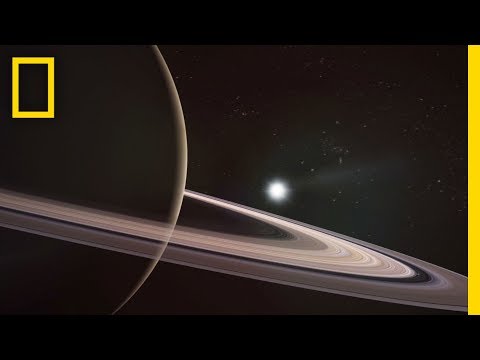
with its gold color and stunning rings
Saturn is quite a planetary gem Saturn
is the second largest of the eight
planets and it is about ten times as
wide as Earth despite its size saturn is
actually the lightest planet it is
predominantly made of the gases hydrogen
and helium and because of its particular
gaseous composition saturn is the only
planet in the solar system that’s less
dense than water if the planet were
placed on an enormous ocean it would be
able to float
Saturn’s gaseous makeup also means that
it has no true surface at its centre the
planet has a dense core of water ice and
rocky material but it has no actual
landmass instead it’s mostly made of
gases liquids and yellow ammonia
crystals that swirl around the planet
creating golden clouds and storms the
largest storm on Saturn is at its North
Pole it’s over twice the size of Earth
and shaped in a near-perfect hexagon
each of the six size is believed to be
the result of jet streams which all
encircle a massive hurricane because of
Saturn’s inhospitable environment the
planet cannot support life but some of
its moons might Saturn has more than 50
confirmed moons and each varies in size
and terrain Enceladus one of Saturn’s
smallest moons is covered in ice and
only about as wide as a state of
Pennsylvania Titan Saturn’s largest moon
is nearly as wide as Canada Titan is
also the only moon in the solar system
with clouds and advanced atmosphere both
Titan and Enceladus have underground
oceans that would make them potentially
capable of sustaining life Saturn’s
moons may also play a role in shaping
the planets signature feature it’s rings
Saturn’s ring system is the largest and
most complex in the entire solar system
the rings are made of icy and rocky
remnants from comets asteroids and moons
the particles range in size from being
as small as dust to as big as mountains
the ring system is divided into seven
groups of rings altogether there are as
wide as four and a half earths but only
about two-thirds of a mile thick how the
Rings are able to stay on track and
intact has to do with Saturn’s smallest
moons called shepherding moons these
tiny satellites orbit between the Rings
and they seem to use their gravity to
shape the ring material into circular
paths Saturn has fascinated scientists
and amateur astronomers alike for
thousands of years the ancient Greeks
and Romans who named the planet after
the god of agriculture believed it was a
star it wasn’t until the 17th century
after the telescope was invented that
scientists like Galileo Galilei
Christian Huygens and Giovanni Cassini
could take a much closer look only then
was Saturn’s planetary status discovered
and ultimately its many moons and
brilliant rings because of its planet
like moons lightweight composition and
dazzling ring system Saturn continues to
mesmerize us to this day
[Music]
you
Saturn is quite a planetary gem Saturn
is the second largest of the eight
planets and it is about ten times as
wide as Earth despite its size saturn is
actually the lightest planet it is
predominantly made of the gases hydrogen
and helium and because of its particular
gaseous composition saturn is the only
planet in the solar system that’s less
dense than water if the planet were
placed on an enormous ocean it would be
able to float
Saturn’s gaseous makeup also means that
it has no true surface at its centre the
planet has a dense core of water ice and
rocky material but it has no actual
landmass instead it’s mostly made of
gases liquids and yellow ammonia
crystals that swirl around the planet
creating golden clouds and storms the
largest storm on Saturn is at its North
Pole it’s over twice the size of Earth
and shaped in a near-perfect hexagon
each of the six size is believed to be
the result of jet streams which all
encircle a massive hurricane because of
Saturn’s inhospitable environment the
planet cannot support life but some of
its moons might Saturn has more than 50
confirmed moons and each varies in size
and terrain Enceladus one of Saturn’s
smallest moons is covered in ice and
only about as wide as a state of
Pennsylvania Titan Saturn’s largest moon
is nearly as wide as Canada Titan is
also the only moon in the solar system
with clouds and advanced atmosphere both
Titan and Enceladus have underground
oceans that would make them potentially
capable of sustaining life Saturn’s
moons may also play a role in shaping
the planets signature feature it’s rings
Saturn’s ring system is the largest and
most complex in the entire solar system
the rings are made of icy and rocky
remnants from comets asteroids and moons
the particles range in size from being
as small as dust to as big as mountains
the ring system is divided into seven
groups of rings altogether there are as
wide as four and a half earths but only
about two-thirds of a mile thick how the
Rings are able to stay on track and
intact has to do with Saturn’s smallest
moons called shepherding moons these
tiny satellites orbit between the Rings
and they seem to use their gravity to
shape the ring material into circular
paths Saturn has fascinated scientists
and amateur astronomers alike for
thousands of years the ancient Greeks
and Romans who named the planet after
the god of agriculture believed it was a
star it wasn’t until the 17th century
after the telescope was invented that
scientists like Galileo Galilei
Christian Huygens and Giovanni Cassini
could take a much closer look only then
was Saturn’s planetary status discovered
and ultimately its many moons and
brilliant rings because of its planet
like moons lightweight composition and
dazzling ring system Saturn continues to
mesmerize us to this day
[Music]
you
Please follow and like us: