
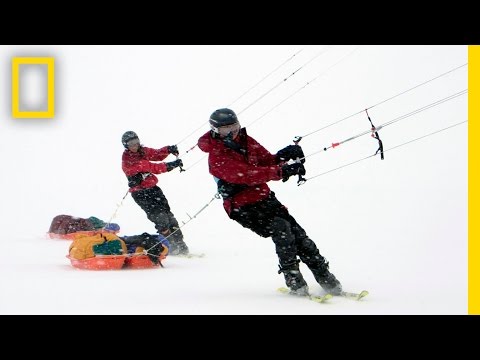
Sara and I put together a trip we
decided that we would do it with kites
to make the route that we set out to do
we had average a marathon a day to tell
you the truth I think if I really knew
what every detail of every exhibition
I’d probably never head out on it to
start with
and it’s moments like this that you
forget the hard days and you remember
why you’re outside and why you’re doing
this we’re gonna start this presentation
but before we get there we’re gonna move
backwards a little bit in time exactly
25 years back when our parents had this
amazing dream that they wanted to go all
the way around back in Ireland it’s the
world’s seventh biggest island and they
wanted to do it in a very traditional
way with dogs and so they embarked on
this wonderful dream and when they
finished the expedition either they ran
out of money and couldn’t fly all the
dogs back or the story they’d like to
tell us of course is that you know they
fell in love with the Arctic and this is
where they wanted to be so they flew
Sara and I up and sure enough we got
introduced to life in the North pretty
early on so this is myself and my
brother Eric in our homemade parkas
Lerman had a dog sled at an early age
one of my mom’s rules was we were not
allowed to watch TV we didn’t even have
cable in a house so we were kicked
outside on many occasions and as we got
older we started to spend more and more
time outside and so in the beginning we
tagged along with our parents for a
little while we did this amazing South
Pole trip I just turned 20 series 18 in
the shot it was a 52 days ski trip to
the South Pole and and then later on
Sarah continued to travel with dad this
is a picture of myself and my dad at the
North Pole in the middle of a hundred a
expedition so both Eric and I continued
to do expeditions some of them together
some of them apart and this is a picture
that taken on the Arctic Ocean on a
different expedition I was up there
guiding and I’m wearing a suit swimming
across open water and it’s about minus
40 outside so doing expeditions with
other people sometimes you get yourself
into situations where you’re like why am
I here of course I wasn’t there I was
back in University studying and I was
kind of being like why am I not there
but maybe not this exactly I was kind of
like hey you know there’s funner ways of
doing this Arctic exploration thing
other than pulling sleds and whatnot and
so Sara and I put together a trip after
that year of University and we decide
that we would do it slightly differently
we would do it with kites kites had
often been used as a form of recreation
but hadn’t really been used as a form of
transportation all that much and we
thought that we could really go
somewhere with these so expedition we
decided to retrace the historical
Northwest Passage it’s an important
route because back in the
turn-of-the-century is a shipping route
they thought it’d be a quicker way to
get to China from England to China
obviously it never became a shipping
route but people have sailed it however
nobody had ever done it in the
wintertime so we thought would it be fun
to go back and to use her kites and her
skis and do this in the wintertime so we
started in the Northwest Territories on
the west and the small community of
Tuktoyaktuk and we retraced the passage
linking up all these small Inuit
settlements along the way ending in Pond
Inlet where the ocean widens back up in
northern Baffin Island on top of a lot
of planning we obviously had to secure
the calories we needed for this
expedition there was a ton of food 85
days of food imagine that’s a lot of
shopping carts of food and of course
we’re eating about 5,000 calories a day
kind of like a big turkey meal might as
well make that easy right and we brought
along a lot of chocolate with us to be
exact I think is about 200 bars of
chocolate and five kilos of hot
chocolate and we ran out of fresh so
with our food our gear two sleds each we
headed out to do an attempt on the
Northwest Passage to make the route that
we set out to do we had averaged a
marathon a day so when there’s winds
that was great
we were harnessed to a kite we were
pulling our gear and sleds behind and we
could rock it the thing with this route
is we didn’t always have good trains and
we definitely did not always have good
wind and when there was no wind we would
ski hauling about 200 pounds of gear
each that’s kind of where the kites work
against you is if there’s no wind we
each had four kites a person so we would
switch our kites depending on how much
win there was bigger kites for Less wins
smaller
for more wind but of course you’ve got
to haul four kites you know when there’s
a when there isn’t any wind when the
hardest challenges during our trip
though was the rough ice the thing with
Isis is not like a map you can’t just
pull out your map and say oh looked it’s
really bad here let’s go here because it
freezes differently every year and
depending on the currents and depending
on the winds when it freezes it can vary
widely from rubble like this to open
water
and obviously this you can’t kite
through you can’t ski through you can
hardly walk through it and you certainly
can’t average a marathon a day through
it the storms were also one of our
biggest challenges this one particular
day we set out in high hopes to get some
good distance and the storm came in and
it’s so windy that even with their
smallest kites but for different types
of kites we had big ones for really
light winds they’re 13 metres and we had
really small ones for storm winds and
even our smallest kites we couldn’t hold
them down they were just picking us off
the ground and kind of tossing us around
we couldn’t stay together either and
we’re worried that we get split apart
one person with a tent the other person
with a stove so I have two tent I was
fine I was worried though and he had the
satellite phone I don’t know how that
happened so we roll up her kites and
instead we skied into headwinds and it
just kept picking up to the point where
we couldn’t even stand up on our skis so
we decided to walk and by this time we
had done like five kilometers pretty
slow it was kind of a pitiful day but at
the same time you know you can use days
like that to do things like what we’ve
just shown you here to take pictures to
catalogue not every day can be about
making miles sometimes there’s still
reason to get out of bed even if it’s
not your primary goal one of the
highlights of the trip though was these
small communities that I talked about a
longer route we had six hours that was
important there’s seven different
communities and they’re all small Inuit
settlements about a thousand people give
or take and we’d pull into these
communities and the people were so
welcoming
we stayed with families in every
community they’d welcome us in there at
their homes and also give us a chance to
kind of repack repair stuff pack more
chocolate and call mom and ask her for
things you know
can you send another gift package to the
next community we need more sleds they
keep falling apart it also give us a
chance to do talks in the schools but
the kids most importantly talk to the
locals about the route ahead so again
ice has always been a big issue with the
the Northwest Passage ever since you
know the Northwest Passage was theorized
originally it was you know crossing at
the Great Lakes and then you know
suddenly got moved further and further
into Canada and to kind of the
unexplored area it wasn’t until 1906
that this Norwegian guy called a months
and decided to give a try at the
Northwest Passage and him and six men
and a tiny ship set sail and there’s
been four years sailing the Northwest
Passage when a months and did the trip
he proved that it’s not or at that time
was not a viable shipping route you’re
not gonna spend four years trying to
ship spices back and forth from Asia to
Europe and now here we were about a
hundred years later doing the same route
in the wintertime I believe that the
Arctic is one of the most beautiful
places and I feel lucky to not only get
the chance to travel through it but also
have lived there and grown up there and
it’s moments like this that you forget
the hard days and you remember why
you’re outside and why you’re doing this
the other great part about the Northwest
Passage is there’s quite a bit of
wildlife there everything from the
migratory birds that were coming back in
the springtime to the locals
you know the caribou the musk ox
Wolverines all the rest of that and
unlike a lot of the ice cap trips that
we had done in the past this was really
an exceptional trip as we got to see a
lot of wildlife we got to interact with
a lot of it and of course polar bears
this guy was a rather and friendly bear
we were taking a little break eating
some snacks and he came out of the rough
ice and was quite curious about our
kites
he wasn’t too sure what happened there
but I bet you it’s probably the first
time you’d ever seen a kite yet the
color green in his life
of course the going was about to
actually get a little bit tougher at
this point in the expedition just after
Joe Haven there’s this little place here
called boo Thea Strait it’s a long
section of ice that has kept open
year-round or somewhat open year-round
due to the currents that travel through
there and basically these currents just
churn up the ice it’s literally a big
blender so even before we got right up
to booth here the other big challenge
was just getting through this huge
amount of jumbled ice that had refrozen
right in front and we did about an hour
of hauling really really hard hauling to
get basically the distance you know two
city blocks at most it’s how far we got
in it and suddenly I looked up and I was
like goodness that horizon line which is
quite close doesn’t look like it’s
standing still all that much and this is
what we were looking at essentially we
quickly decided it wasn’t worth going
out there until we had a better view of
it we climbed up a little hill and this
is not a James Balog film this is not
happening in over several years this is
happening within the span of 15 minutes
on this time-lapse so this ice is really
motoring along so we stood up there and
we had a decision to make we could cross
it or we could do a detour so we figured
we’d sleep tight tonight and make a
decision the next morning so we went to
bed and about 4:00 in the morning I
heard something outside the tent
what happened act you will come to sound
something outside I guess so I woke up
seconds before I heard something to kind
of rub it on the fabric of the tent he
kind of tried to bite the tent in
several areas first before actually
pawing it and then I’m kind of like half
awake wondering what the sound is and
next thing I know this polar bear is
jumping on the tent with his two front
paws and he’s landing on top of me on my
chest
everything happened so fast I got it on
my sleeping bag in record time and
started screaming by this time area what
you got out of your sleeping bag and
jumped on mine and started screaming
which is not the way I usually like to
wake up in the morning but yeah I think
was just a kick the side of the tent as
hard as I could so I just started
kicking with the bear on the other side
and I like to think that I kicked him in
the face but whatever I did he backed up
and when he backed up
he backed back into her bear fence this
is one of the corner flares with two
flares on each side and he actually
slept the floor off when he backed up so
by this time I opened the door and Eric
runs out first on his way out he grabs a
shovel of course Eric is blind as a bat
with glasses on for vision and that was
in socks feet so Santa makes a run for
the gun which you know yeah this shovel
here which is a small aluminum shovel
it’s not the greatest weapon against
bears but still it’s nice to have a
little bit of backup sometimes bear the
bear ends up getting about 20 to 30 feet
away from me and stops and looks back
and at that point in time he decides I
look a little bit you know
yeah pretty defenseless even compared to
his seal and that bear took a turn
around and
came straight back towards where I was
and at that point I was freaking out you
know I had a shovel but I should have
grabbed some toilet paper also that
would have been probably more useful at
this point in time those two go hand in
hand so I swung as hard as I could and
hit the the bear just right broad across
the face and its face was kind of in
level with mine and obviously not that
far away cuz that shovels not all that
big and you know I gave it absolutely
everything I had and it did nothing I
mean that bear
he stopped which is very nice of him but
it definitely we definitely didn’t
consider leaving or any of those other
things so at that point the screaming
it’s very intensified a little bit more
and I slowly snuck backwards again
without my glasses I couldn’t really
judge how much of an effect it had on
the bear he didn’t seem too disturbed
but so I slowly started sneaking
backwards to get to you again another
corner of that bear fence to be able to
manually set one of them off and right
as I got to the other corner that bear
fancy le bear kept kind of making these
fake lunges and I kept pretending I was
gonna smack him and I got to the the
other end I don’t know what I did with a
shovel I might have thrown it at the
bear but I reached down grabbed the pen
flow will flare and set it off right as
the bear was kind of coming up over top
of me and he ducked as a little roman
candle kind of fired over top of them of
him and then got sprayed down by all
these little flares essentially and
that’s when Sarah
luckily emerged out of the tent so but
this time Eric is screaming shoot the
censored censored censored there and I
come out of the tent I have a shotgun in
hand and I knew I had two decisions one
I could shoot the bear two I could aim
high hoping that the bullet would scare
the bear away at this time too I only
had two bullets loaded in the gun so to
aim high was a huge risk because if he
didn’t run I would have only had one
bullet left I decided to aim high I
decided to give him one last chance and
I aim just above his head and I shot the
bullet off and he paused
then he slowly turned and kind of
wandered off no blood was lost that day
it ended well for both the bear and us I
think on our side her confidence was
slightly shattered I think the bear
survived the whole thing a little better
than we did man who nobody would need a
coffee if you got woken up by a bear
every morning they’re just like walks in
Durham and then he’s like good morning
and walked out I mean you’d be fine
you’d be set for the rest of the day
like so away be amazing yeah that was
interesting Sarah eventually came around
to my way of thinking and we decide to
head for the detour on our way south and
you know I just wanted to get out of
there as fast as I possibly could and we
just kept seeing bears that day this
place was basically like a sushi bar for
Paris you know that ice that was
streaming by it’s kind of like a
conveyer belt they just sit there watch
though there’s a seal I guess I’ll go
ahead and take that one and yeah luckily
they were well fed that probably was a
good thing but at the same time they
were there were a lot of bears and we
ended up seeing six bears in that day
and luckily at the end of the day caught
a little bit of wind so we headed south
we added 550 kilometers to a detour you
can see here the red route is what we
intended to do and the blue route
heading south was what we actually did
and then you know the only thing that we
had to rely on was these big south
storms you know the storms generally
came and pushed up from the south but
for the most part a lot of hauling into
headwinds which was just really
unfortunate you know you just kick
yourself because every time you’re
hauling into a headwind like this you
knew how do you chosen the other route
this would be an amazing beam reach just
a wonderful direction to travel in so
we’re slipping on schedule we really
need to make it to this community and it
just looked like they would never be
wind again and one of my good friends
did our weather updates he’s of
weathermen
and we got a weather update one day he
texted it onto her satellite phone and
it read Bob Dylan just turned 70 today
and times are changing the winds will
pick up at six below for 24 hours before
does the parent again so I really hope
you can make it to Igloolik next hope
that we could also at 6:00 in the
morning following Sarah’s sleep schedule
which was let’s ski late into the night
and then sleep for hours and get out and
then start kiting so it sure enough got
up really really early in the morning
layer kites out and essentially waited
for the winds to pick up and sure enough
they did pick up and it was a pretty
tremendous try of patience 24 hours so
it’s really a non-stop marathon at that
point a mix of skiing and kite skiing
and luckily at the end of 24 hours right
as that wind was about to come down we
pulled we got right up to a clue like
within 5 kilometers of a glue-like
before the winds finally died and there
we had a pretty interesting decision to
make we could restock at chocolate one
restock on food but this was our last
community before we got to her end point
the next section was 400 kilometers and
by now it was May 31st and the snow was
melting and we still had a huge distance
to go and we didn’t know whether we
would be able to make it before the snow
and the ice completely disappeared so
Eric and I sat down and we thought about
it would we continue or would we you
know cut our losses and end here we kind
of hummed and hawed and eventually one
of the amazing things with the North
that you can kind of go in front of the
local supermarket and there are people
that gather there and you just pull out
Maps and you start asking people and
they’re like I don’t know about this
route but some guy when God his
grandfather this guy Theo and he told us
you know back in the day they would
people used to know where the snow
stayed the longest and they would go on
this route and he kind of drew it out
and that area had snow and so with that
information and a great weather update
that said we had a couple days of wind
we took off for our final destination in
hopes that it wouldn’t melt out
and as you can see the snow started to
melt and it started to melt really
really fast and of course you know at
this point we were really low in
elevation we only added another five
kilometers to go to the sea ice we
figured great we get to the sea ice will
get winds you’ll be able to cruise into
the community let’s take it easy should
be fine but we got to the sea ice and
guess what you were starting with
melting really fast what’s happening
here is in the springtime the snow on
top of the sea ice melts but it’s kind
of trapped on top of the sea ice it has
nowhere to drain so it creates this pool
of water on top of still very safe solid
sea ice although not very fun to travel
through and we travels through this four
days is about calf deep water that we
sludge through by this time where it’s
led to a wreck there was holes in them
everything was wet and after 85 days
3,300 kilometers sorry we’re Canadian
toy working kilometers and not miles we
finally pulled into the small town of
Pond Inlet our end point in local
fashion we were greeted by the mayor
they had a whole brigade out you know
they had sirens going off and whatnot it
was a great end of the expedition the
community is really held it together for
us a lot it was what we look forward to
is meeting the people who lived and
traveled in this land and so you know as
happy as we were to come into this town
and go home
you know showers beers friends we’re
also really sad to leave the expedition
it had been such an amazing 85 days
unbelievable challenges as Sarah
mentioned had we known the challenges
before we probably wouldn’t have
embarked but after doing the trip it
just brought back so much and I want to
end their talk with a quote that a
really good friend of ours Curtis who is
also a past expedition partner on some
of our expeditions wrote and it wraps
everything up very nicely tired days and
aching bodies will quickly be forgotten
as a highlights and wonders of the
expedition like all great moments in
life begin to sink in thank you
you
Please follow and like us: