
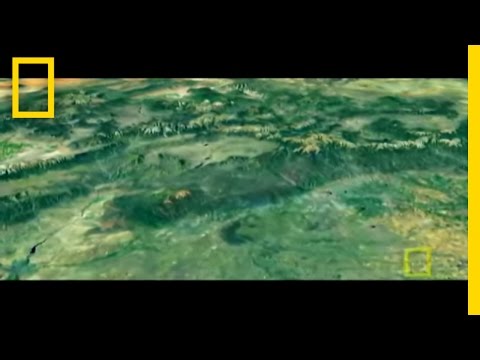
on our journey south along the Rocky
Mountains we’re entering a very
different landscape from Montana
southward the Rockies are made from
ancient granite 1.7 billion years old
granite makes up much of the deepest
part of the continental crust
that’s why geologists call this rock the
basement
the Canadian Rockies are built from
sedimentary rocks piled up on top of the
continental foundations so why does
granite suddenly appear here in the
American Rockies
but there’s an even greater puzzle
Mountains usually form close to plate
boundaries but the southern Rockies sit
a long way from the plate margin
the Front Range in Colorado is a
thousand miles from where the Pacific
and North American plates actually meet
geologists have come up with an
explanation
they believe that the subducting
pacificocean plate is responsible oh Sh
in crust had been pushed deep into the
mantle beneath North America for a
hundred million years when something
unusual happened
plate started to subduct at a shallower
angle instead of plummeting steeply it
sliced beneath North America
horizontally this change had dramatic
consequences the big oceanic plate in
the Pacific didn’t go deep down he went
in shell like a spatula under a pizza so
something happened sixty-eight million
years ago over in California that plate
drives under North America but instead
of diving deeply it comes in shallow and
a thousand miles away from the coast up
from the ground sprout the Rocky
Mountains for millions of years the
ocean plate scraped along the underside
of North America it created friction
breaking up the basement granite of the
North American plate and punching it
upward
structural geologist Karl Karl strim
demonstrates because it was at a
shallower angle beneath North America it
was scraping along the base of North
America when that happens it puts the
plate under compression like this
because it’s being both pushed at the
end and scraped along at the bottom so
it squeezes pushes up the mountains and
it transferred this mountain building
from the edge to great distance from the
plate margin the shallow angle
trajectory of the Pacific Ocean plate
explains why these mountains formed so
far inland and it also explains the
presence of granite thrust up through
layers of sedimentary rock the broken
granite became the Rocky Mountains of
the south
Red Rocks park Denver Colorado a
landscape forged by granite uplift the
granite mountains here have been pushed
up for miles on top of the granite lie
spectacular red slabs of rock known as
flat irons they’re the patchwork remains
of sedimentary rock that once blanketed
the entire granite basement Kirk Johnson
demonstrates how these granite peaks
punched up through the layers of red
rock around them I’m going to use my
assistants Veronica and Ian to help me
explain how the Rocky Mountains in
Colorado formed imagine if you will that
Veronica naeun are composed of 1.7
billion year old metamorphic rocks the
basement Rock of Colorado before the
mountains grew layers of sedimentary
rock covered the granite and then in
about sixty eight million years ago the
mountain where ian is starts to break
and lift up and move up so you see the
uplift forming what’s happening is that
layer of sediments being deformed is
bent and these are the Flatirons at Red
Rocks as the mountain comes up overlying
sediment eroded off and deposited into
the adjacent basin and eventually Ian’s
granitic back is exposed as the core of
the Rocky Mountains
Veronica remains deeply buried beneath
Denver still covered with deep sediments
and the set of us I wrote it off the
uplifting Rocky Mountains
Mountains we’re entering a very
different landscape from Montana
southward the Rockies are made from
ancient granite 1.7 billion years old
granite makes up much of the deepest
part of the continental crust
that’s why geologists call this rock the
basement
the Canadian Rockies are built from
sedimentary rocks piled up on top of the
continental foundations so why does
granite suddenly appear here in the
American Rockies
but there’s an even greater puzzle
Mountains usually form close to plate
boundaries but the southern Rockies sit
a long way from the plate margin
the Front Range in Colorado is a
thousand miles from where the Pacific
and North American plates actually meet
geologists have come up with an
explanation
they believe that the subducting
pacificocean plate is responsible oh Sh
in crust had been pushed deep into the
mantle beneath North America for a
hundred million years when something
unusual happened
plate started to subduct at a shallower
angle instead of plummeting steeply it
sliced beneath North America
horizontally this change had dramatic
consequences the big oceanic plate in
the Pacific didn’t go deep down he went
in shell like a spatula under a pizza so
something happened sixty-eight million
years ago over in California that plate
drives under North America but instead
of diving deeply it comes in shallow and
a thousand miles away from the coast up
from the ground sprout the Rocky
Mountains for millions of years the
ocean plate scraped along the underside
of North America it created friction
breaking up the basement granite of the
North American plate and punching it
upward
structural geologist Karl Karl strim
demonstrates because it was at a
shallower angle beneath North America it
was scraping along the base of North
America when that happens it puts the
plate under compression like this
because it’s being both pushed at the
end and scraped along at the bottom so
it squeezes pushes up the mountains and
it transferred this mountain building
from the edge to great distance from the
plate margin the shallow angle
trajectory of the Pacific Ocean plate
explains why these mountains formed so
far inland and it also explains the
presence of granite thrust up through
layers of sedimentary rock the broken
granite became the Rocky Mountains of
the south
Red Rocks park Denver Colorado a
landscape forged by granite uplift the
granite mountains here have been pushed
up for miles on top of the granite lie
spectacular red slabs of rock known as
flat irons they’re the patchwork remains
of sedimentary rock that once blanketed
the entire granite basement Kirk Johnson
demonstrates how these granite peaks
punched up through the layers of red
rock around them I’m going to use my
assistants Veronica and Ian to help me
explain how the Rocky Mountains in
Colorado formed imagine if you will that
Veronica naeun are composed of 1.7
billion year old metamorphic rocks the
basement Rock of Colorado before the
mountains grew layers of sedimentary
rock covered the granite and then in
about sixty eight million years ago the
mountain where ian is starts to break
and lift up and move up so you see the
uplift forming what’s happening is that
layer of sediments being deformed is
bent and these are the Flatirons at Red
Rocks as the mountain comes up overlying
sediment eroded off and deposited into
the adjacent basin and eventually Ian’s
granitic back is exposed as the core of
the Rocky Mountains
Veronica remains deeply buried beneath
Denver still covered with deep sediments
and the set of us I wrote it off the
uplifting Rocky Mountains
Please follow and like us: