
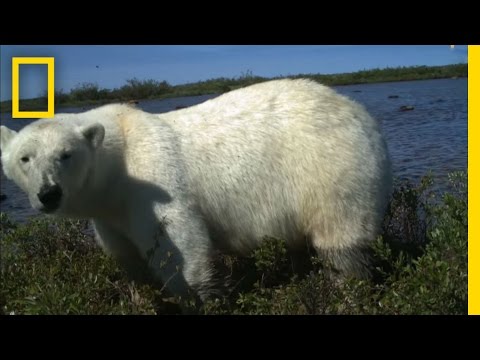
this is one of the most exciting shots
of the summer seeing this bear reach
into the nest come up with the egg in
its mouth and you can see this perfectly
preserved egg not yet crushed just
sitting in the Bears teeth and then it
goes ahead choose the egg and to me it’s
really cool because I don’t usually get
to see polar bears that close most of
our work we’re looking through spotting
scopes at polar bears or we’re seeing
them from helicopters and to see a polar
bear so clearly right in front of the
camera when you can even make out its
ear tag was just a real treat for me
once we place these cameras it’s really
just a waiting game to see what sort of
data we’re gonna get at the end of the
season so after about two months of
waiting to go collect the data we flew
out down along the coast and even as we
approached the area from the helicopter
I could see that a couple of the posts
were knocked over and the cameras were
laying on the ground
we brought the data back to camp and and
took a look at it our curious bear had
been up to the camera and had chewed on
the case a little bit
it is just like the boogeyman all of a
sudden the geese are there in the next
frame there’s a bear you know right in
front of the camera and then of course
then we watch we keep watching and the
geese eventually leave and that’s
because all the eggs have been eaten by
that bear these are large green eggs in
each of these Eider nests and they look
maybe about twice the size of a chicken
egg but they’re packed full of calories
so in each of these nests there’s four
or five eggs over the course of about a
week or a week and a half
they ate almost 250 maybe up to 300
Eider nests and so that’s almost the
calorie equivalent of two hundred and
fifty thousand calories one of the other
exciting observations and surprising
observations at least for me was seeing
the female bear with her cub and how
they learned how to hunt throughout the
summer or at least that’s the impression
I got it seemed that they started off
just sort of opportunistically stumbling
across nests in the Eider colony but
over the course of several days we
watched them actually get better at it
they began systematically hunting for
fur nest and then eventually they even
started getting good at hunting female
ducks we started to see her almost stock
the nest and then eventually run up to
the nest pounce on the female and then
eat her and the eggs as well so for me
that was really cool to watch that
happening
these images were all taken in mid June
of 2013 collected with remote wildlife
cameras we’re using them to look at
waterfowl predation the whole phenomenon
of polar bears eating eggs is something
that we’ve known about for a while and
the question really is like how much are
they doing it and is it increasing over
time because of climate change from our
camp we can look out to the west and see
a glacial esker and that’s where the Sun
sets every night and you just get these
beautiful red yellow orange sunsets
regularly and so for me that’s just one
of the highlights of being out in the
field all summer
Please follow and like us: