
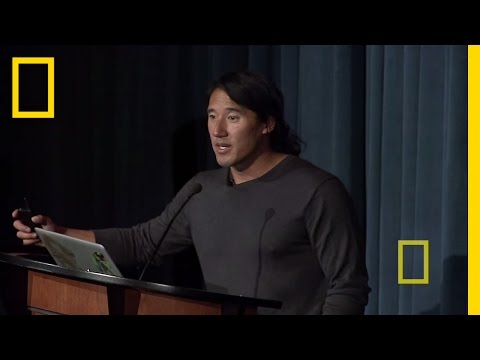
ultimately like the process of climbing
is very rewarding to people
it’s very difficult physically but it’s
also a very kind of cerebral support
it’s slow and methodical and you have to
think
you can’t move very well when you’re
scared you have to be able to kind of
control that fee
maintain your breathing there’s very
real consequences when you make mistakes
you make a wrong move when you’re free
soloing you fall hundreds or thousands
of feet died
so I grew up in Mankato Minnesota my
parents were from China they were both
working at the University and this is
actually my backyard so I grew up kind
of in the flatlands pretty much you know
if you go outside of Mankato you can
stand in spots where there’s cornfields
like 360 degrees and just you know I
think a lot of people think it’s very
unlikely place for an alpinist to come
from but I think in some ways it
prepared me well because it was really
cold and but I grew up with you know
kind of a lot of expectations from my
parents they wanted me to do a lot of
different things I started playing the
violin when I was three and a half and
you know did a lot of different sports I
swam competitively and and studied the
martial arts and was competing every
weekend and there was a lot of kind of
expectations to do well and especially
in school so I was kind of set up to you
know be a it’s not I always thought
there’s only three things I could be
when I grew up whoo that was like a
lawyer or a doctor or a businessman or
something like that you know because so
when I kind of went to college I studied
international relations Asian Studies
focused a lot on kind of international
law and policy and during that time I
really fell in love with with climbing
and I also grew up skiing there was a
little hill behind my house called Mount
kado which is like 400 vert or something
and it’s actually not a hill it’s it’s
there’s cornfields on top and then it
drops it’s a river valley so the hill
that drops from where the cornfields
start into the river valley that’s that
was my ski hill and basically like if I
did well in school
I got to go skiing and I kind of always
knew that I had this you know I had this
little song that I would sing that it
was based in Chinese is basically like I
want to go outside and play that’s yeah
and I’ve just repeated over and over and
over and they’d be like well they’ll
finish your violin or go finish that and
I’d be like okay so I knew I wanted to
go outside and play and in college I
found I skied on ski team and then I am
found climbing and so after college you
know I went to the Bay Area and I was
looking for a job trying to you know
thinking that I would find something in
the professional realm but then I just
didn’t I couldn’t get myself excited
about it and so I kind of made up my
mind I had this great idea I was like
hey mom dad I’m gonna take a year off
I’m just gonna get it out of my system
I’m gonna climb and ski full-time don’t
freak out it’s it’s really temporary I
just I got to do it for me so
essentially their worst nightmare was
realized when probably close to seven
years later I was still living in the
back of my car and just doing odds and
ends for jobs
shoveling Roos and waiting tables and
the really you know in love with what I
was doing and where I was spending my
time I would wake up in the back of my
Subaru in Yosemite or in the Eastern
Sierras or in the Tetons and I would
just think like you know there’s no
other place that I would rather be how I
just felt so fortunate and every day I
would you know I knew that since I
wasn’t doing anything else I was going
to throw myself at climbing and skiing
and really kind of taking myself as far
as I could in that realm so Yosemite was
a very kind of influential home for me I
spent a lot of time there
over the course of seven years made a
lot of friends I felt like I found my
community there people that were really
passionate about what they were doing
and every day you know you’d go out and
climb and I mean really living the good
life
after spending a lot of time there you
know my aspirations changed and I really
wanted to go and take what I learned in
Yosemite to some of the greater ranges
of the world and it was in Yosemite that
I picked up a camera for the first time
I took a photo with a friend’s camera
who wanted to be a photographer I took a
photo with it and he eventually tried to
sell his photos and a client bought the
one photo having me the one that I took
so and they paid me and at the time you
know I could live on nothing forever
basically and they paid $500 for this
photo of course now I know for the
usages that they used it for they should
have paid me like many thousands of
dollars but at the time I didn’t know
and I was like if I take one photo a
month I could do this forever you know
and I was like okay this is awesome so I
wish I you know I’m sure some
photographers probably cringe and
they’re like god he has no sense of
creativity or the tradition of
photography but that was really how I
started I didn’t really have a sense of
like wanting to be a artist or
photographer in any other way than to
continue what I was doing so I took you
know a camera and I started to head out
into the world and really you know you
70 is a special place for me because it
launched me into this career and you
know over the course of the next 10 11
12 years I traveled the world and and
really got to shoot on some really
insane assignments with some amazing
people and some amazing
occasions
I think after kind of traveling around
for years and years and really you know
sometimes spending 300 days a year on
the road I’ve come to find that you know
my heart really is in places that are
close to home and you Semele kept
drawing me back and I don’t think it was
a an accident that I pitched the story
to National Geographic about Yosemite so
part of the story
is definitely about the culture the
climbing culture so you know I really
wanted to capture the kind of the
cutting edge of climbing what was
happening there and then kind of what
the lifestyle was and I remember when I
spent time there
we are always laughs we like yeah
there’s you know a leisure class at both
ends of the economic spectrum and we
know which one we’re at hahaha and you
know all you did was climb and you know
watch your friends up on the wall here a
couple guys messing around on the alcove
swing it says giant swing it goes like
200 feet up in this kind of overhanging
cave so when you went off the end you
would just fly over the valley I was
trying to get an interesting angle so I
had Joo marred up the rope and I was
hanging off the rope and I was telling
this guy hey okay run off the end and
then he’d run off the end and I would
hold on for dear life and I got got
lucky with one of these images also very
critical on this shoot was my good
friend Mikey Shafer he was incredible on
this shoot he took very good care of me
while I was running around trying to
figure out what to shoot he kind of made
sure I didn’t fall off the cliff
we spent tons of time moving gear like
very little time shooting you know it’s
like to get one shot sometimes took two
days of prep on the front end getting
all the gear up you know
he’d spend like three four five days
sometimes just to get a shot we had
hundreds and hundreds of meters of rope
thousands of feet of rope constantly
climbing up and down I’ll cap and this
is a very common scene I’d be like
shooting I turn around I might give you
like did you get it man okay yeah I
think I got it and like all right let’s
get out of here I like this photo only
because the this is signing up to stay
in camp four and I really think climbing
is a very cerebral sport it’s very slow
it’s a very methodical you have to be it
requires a lot of mental discipline and
often requires a lot of planning and I
thought that is interesting you know you
show up at 6:00 in the morning and
people are waiting to sign up and
everybody’s reading could be trashy
stuff I don’t know but so I think the
three kind of styles of climbing that
are really getting pushed is free
soloing which is where you’re climbing
without a rope free climbing which is
where you’re climbing with a rope but it
allows you to push the technical aspects
of it so the really really difficult
physical climbing but there’s some
mental space that you can reserve extra
mental space you can reserve for the
climbing because you know that if you
fall the Rope is going to catch you and
then there’s speed climbing so in terms
of free soloing undoubtedly the greatest
free soloists that ever lived
is this kid Alex Honnold
here he’s soloing separate reality which
comes out this 40-foot roof it’s about
almost a thousand feet off the deck and
I’m absolutely sure that I was way more
terrified than he was at this moment
he’s pulling the lip here he is soloing
on 2,000 feet off the deck on Half Dome
and of course thank God ledge and this
is called thank God ledge because it’s
actually one of the biggest ledges that
you get on that face and it’s obviously
not very big it’s a very sheer face so
back to I’ll cap I want to talk a little
bit about kind of one of the final areas
of climbing that is being really pushed
and that’s that’s free climbing and
there are two guys that have been
working on this route one of the longest
most sustained and most difficult routes
on El Cap probably in the world and
that’s Tommy Caldwell
and Kevin Jorgenson Tommy on the right
Kevin inside his poor ledge and they’re
climbing at night because it was too hot
to climb during the day this is a fairly
common scene on El Cap hanging out in
the portaledge solar panel because
they’ve got their iPhones up there
they’re working you know it’s like it’s
like their apartment essentially and
they’ll go up there for a couple weeks
and just hang out up there and work
through these different pitches they
have to kind of stock camp and then they
move in and it’s kind of regular life up
on the wall again they’re climbing at
night because it’s cooler and the rubber
on the shoes stick a little bit better
and it really comes down to it and I
mean there’s all of the climbs have
different names and some pitches have
different names which is it like a rope
length on a root so if you know this
root has 36 pitches on it and you know
some pitchers will get different names
and there’s kind of some famous pitches
on El Cap that you hear about that are
notorious for being difficult and to
give you an idea I liked one of the
pitches is called something like lifting
the car off the baby pitch
that’s the kind of effort and strength
it requires to do that I was like wow
that’s a good name they’re like yeah
what do you think I think it makes
pretty good point
uh-huh and then finally a base-jumping
which is a very contentious issue in
Yosemite because it’s illegal but a lot
of climbers have started BASE jumping
because if there was BASE jumping
allowed in Yosemite it would be just
like rock climbing it would be the
center of the universe for BASE jumping
it’s like the ultimate place and a lot
of the people there cannot help
themselves here they are in squirrel
suits and they’ll literally fly for two
minutes without pulling their chutes and
they’ll proximity fly across the faces
and then turn out to the valley and fly
all the way across the other side and
then turn all the way up and go down
Valley and then come back and they have
there’s this whole system of
communications you know they’ve got
spotters to make sure you know they know
the schedules of the you know Rangers
and there’s all the like I’m delivering
the pizza and it’s like okay ready for
delivery you know it’s like it’s it’s a
cat-and-mouse game for sure and it’s
it’s been kind of serious but part of
the reason for this BASE jumping is that
you know a huge part of the goal for
them is to link these different
formations in the shortest amount of
time because again speed is one of the
things so they want to link the South
Face of Mount Watkins in the background
with Half Dome and Al Capp all in a day
and obviously the fastest way down is
when they get to the top of Half Dome
they run off the edge and then they get
to the bottom and then they’re you know
down two hours faster than if they had
to hike so that’s kind of like it’s it
sounds funny but you know the final
evolution in climbing might be flying
so it was really great to spend you know
time with a lot of guys that I used to
spend time with and also watch this new
generation of climbers come up the final
we’ll edit a video is kind of an on
assignment piece that is a little
overview of the shoot I’ve been assigned
to shoot a feature story for National
Geographic about the climbing culture
and the cutting edge of climbing that’s
happening u7t today I had almost 60 days
of shooting in Halle we’ve had some
pretty epic days
semele is the epicenter of climbing a
lot of the greatest climbing feats in
history have happened here and they’re
happening right now I started climbing
here 15 years ago and making a community
here with with all the other dedicated
you 70 climbers so it’s really special
for me to be able to come back here and
shoot with my peers climbers don’t
perform in an arena or Stadium
they don’t have stands full of fans
watching them really I see my job is
being able to tell that story carrying
loads today top of El Cap and it gets a
good couple shots climbing in general is
about understatement I think it’s
impossible for people to express their
experiences up there about to drop in
and not shoot with Leo I think you
cemani climbing has a certain purity to
it because the climbers are up there
battling it out pushing through physical
and mental challenges far from the eyes
of the world there’s nobody there to see
it be able to bring that story back
bring those moments back to people is is
really inspiring for me because part of
my life’s work
cool I think that’s it thanks
you
is very rewarding to people
it’s very difficult physically but it’s
also a very kind of cerebral support
it’s slow and methodical and you have to
think
you can’t move very well when you’re
scared you have to be able to kind of
control that fee
maintain your breathing there’s very
real consequences when you make mistakes
you make a wrong move when you’re free
soloing you fall hundreds or thousands
of feet died
so I grew up in Mankato Minnesota my
parents were from China they were both
working at the University and this is
actually my backyard so I grew up kind
of in the flatlands pretty much you know
if you go outside of Mankato you can
stand in spots where there’s cornfields
like 360 degrees and just you know I
think a lot of people think it’s very
unlikely place for an alpinist to come
from but I think in some ways it
prepared me well because it was really
cold and but I grew up with you know
kind of a lot of expectations from my
parents they wanted me to do a lot of
different things I started playing the
violin when I was three and a half and
you know did a lot of different sports I
swam competitively and and studied the
martial arts and was competing every
weekend and there was a lot of kind of
expectations to do well and especially
in school so I was kind of set up to you
know be a it’s not I always thought
there’s only three things I could be
when I grew up whoo that was like a
lawyer or a doctor or a businessman or
something like that you know because so
when I kind of went to college I studied
international relations Asian Studies
focused a lot on kind of international
law and policy and during that time I
really fell in love with with climbing
and I also grew up skiing there was a
little hill behind my house called Mount
kado which is like 400 vert or something
and it’s actually not a hill it’s it’s
there’s cornfields on top and then it
drops it’s a river valley so the hill
that drops from where the cornfields
start into the river valley that’s that
was my ski hill and basically like if I
did well in school
I got to go skiing and I kind of always
knew that I had this you know I had this
little song that I would sing that it
was based in Chinese is basically like I
want to go outside and play that’s yeah
and I’ve just repeated over and over and
over and they’d be like well they’ll
finish your violin or go finish that and
I’d be like okay so I knew I wanted to
go outside and play and in college I
found I skied on ski team and then I am
found climbing and so after college you
know I went to the Bay Area and I was
looking for a job trying to you know
thinking that I would find something in
the professional realm but then I just
didn’t I couldn’t get myself excited
about it and so I kind of made up my
mind I had this great idea I was like
hey mom dad I’m gonna take a year off
I’m just gonna get it out of my system
I’m gonna climb and ski full-time don’t
freak out it’s it’s really temporary I
just I got to do it for me so
essentially their worst nightmare was
realized when probably close to seven
years later I was still living in the
back of my car and just doing odds and
ends for jobs
shoveling Roos and waiting tables and
the really you know in love with what I
was doing and where I was spending my
time I would wake up in the back of my
Subaru in Yosemite or in the Eastern
Sierras or in the Tetons and I would
just think like you know there’s no
other place that I would rather be how I
just felt so fortunate and every day I
would you know I knew that since I
wasn’t doing anything else I was going
to throw myself at climbing and skiing
and really kind of taking myself as far
as I could in that realm so Yosemite was
a very kind of influential home for me I
spent a lot of time there
over the course of seven years made a
lot of friends I felt like I found my
community there people that were really
passionate about what they were doing
and every day you know you’d go out and
climb and I mean really living the good
life
after spending a lot of time there you
know my aspirations changed and I really
wanted to go and take what I learned in
Yosemite to some of the greater ranges
of the world and it was in Yosemite that
I picked up a camera for the first time
I took a photo with a friend’s camera
who wanted to be a photographer I took a
photo with it and he eventually tried to
sell his photos and a client bought the
one photo having me the one that I took
so and they paid me and at the time you
know I could live on nothing forever
basically and they paid $500 for this
photo of course now I know for the
usages that they used it for they should
have paid me like many thousands of
dollars but at the time I didn’t know
and I was like if I take one photo a
month I could do this forever you know
and I was like okay this is awesome so I
wish I you know I’m sure some
photographers probably cringe and
they’re like god he has no sense of
creativity or the tradition of
photography but that was really how I
started I didn’t really have a sense of
like wanting to be a artist or
photographer in any other way than to
continue what I was doing so I took you
know a camera and I started to head out
into the world and really you know you
70 is a special place for me because it
launched me into this career and you
know over the course of the next 10 11
12 years I traveled the world and and
really got to shoot on some really
insane assignments with some amazing
people and some amazing
occasions
I think after kind of traveling around
for years and years and really you know
sometimes spending 300 days a year on
the road I’ve come to find that you know
my heart really is in places that are
close to home and you Semele kept
drawing me back and I don’t think it was
a an accident that I pitched the story
to National Geographic about Yosemite so
part of the story
is definitely about the culture the
climbing culture so you know I really
wanted to capture the kind of the
cutting edge of climbing what was
happening there and then kind of what
the lifestyle was and I remember when I
spent time there
we are always laughs we like yeah
there’s you know a leisure class at both
ends of the economic spectrum and we
know which one we’re at hahaha and you
know all you did was climb and you know
watch your friends up on the wall here a
couple guys messing around on the alcove
swing it says giant swing it goes like
200 feet up in this kind of overhanging
cave so when you went off the end you
would just fly over the valley I was
trying to get an interesting angle so I
had Joo marred up the rope and I was
hanging off the rope and I was telling
this guy hey okay run off the end and
then he’d run off the end and I would
hold on for dear life and I got got
lucky with one of these images also very
critical on this shoot was my good
friend Mikey Shafer he was incredible on
this shoot he took very good care of me
while I was running around trying to
figure out what to shoot he kind of made
sure I didn’t fall off the cliff
we spent tons of time moving gear like
very little time shooting you know it’s
like to get one shot sometimes took two
days of prep on the front end getting
all the gear up you know
he’d spend like three four five days
sometimes just to get a shot we had
hundreds and hundreds of meters of rope
thousands of feet of rope constantly
climbing up and down I’ll cap and this
is a very common scene I’d be like
shooting I turn around I might give you
like did you get it man okay yeah I
think I got it and like all right let’s
get out of here I like this photo only
because the this is signing up to stay
in camp four and I really think climbing
is a very cerebral sport it’s very slow
it’s a very methodical you have to be it
requires a lot of mental discipline and
often requires a lot of planning and I
thought that is interesting you know you
show up at 6:00 in the morning and
people are waiting to sign up and
everybody’s reading could be trashy
stuff I don’t know but so I think the
three kind of styles of climbing that
are really getting pushed is free
soloing which is where you’re climbing
without a rope free climbing which is
where you’re climbing with a rope but it
allows you to push the technical aspects
of it so the really really difficult
physical climbing but there’s some
mental space that you can reserve extra
mental space you can reserve for the
climbing because you know that if you
fall the Rope is going to catch you and
then there’s speed climbing so in terms
of free soloing undoubtedly the greatest
free soloists that ever lived
is this kid Alex Honnold
here he’s soloing separate reality which
comes out this 40-foot roof it’s about
almost a thousand feet off the deck and
I’m absolutely sure that I was way more
terrified than he was at this moment
he’s pulling the lip here he is soloing
on 2,000 feet off the deck on Half Dome
and of course thank God ledge and this
is called thank God ledge because it’s
actually one of the biggest ledges that
you get on that face and it’s obviously
not very big it’s a very sheer face so
back to I’ll cap I want to talk a little
bit about kind of one of the final areas
of climbing that is being really pushed
and that’s that’s free climbing and
there are two guys that have been
working on this route one of the longest
most sustained and most difficult routes
on El Cap probably in the world and
that’s Tommy Caldwell
and Kevin Jorgenson Tommy on the right
Kevin inside his poor ledge and they’re
climbing at night because it was too hot
to climb during the day this is a fairly
common scene on El Cap hanging out in
the portaledge solar panel because
they’ve got their iPhones up there
they’re working you know it’s like it’s
like their apartment essentially and
they’ll go up there for a couple weeks
and just hang out up there and work
through these different pitches they
have to kind of stock camp and then they
move in and it’s kind of regular life up
on the wall again they’re climbing at
night because it’s cooler and the rubber
on the shoes stick a little bit better
and it really comes down to it and I
mean there’s all of the climbs have
different names and some pitches have
different names which is it like a rope
length on a root so if you know this
root has 36 pitches on it and you know
some pitchers will get different names
and there’s kind of some famous pitches
on El Cap that you hear about that are
notorious for being difficult and to
give you an idea I liked one of the
pitches is called something like lifting
the car off the baby pitch
that’s the kind of effort and strength
it requires to do that I was like wow
that’s a good name they’re like yeah
what do you think I think it makes
pretty good point
uh-huh and then finally a base-jumping
which is a very contentious issue in
Yosemite because it’s illegal but a lot
of climbers have started BASE jumping
because if there was BASE jumping
allowed in Yosemite it would be just
like rock climbing it would be the
center of the universe for BASE jumping
it’s like the ultimate place and a lot
of the people there cannot help
themselves here they are in squirrel
suits and they’ll literally fly for two
minutes without pulling their chutes and
they’ll proximity fly across the faces
and then turn out to the valley and fly
all the way across the other side and
then turn all the way up and go down
Valley and then come back and they have
there’s this whole system of
communications you know they’ve got
spotters to make sure you know they know
the schedules of the you know Rangers
and there’s all the like I’m delivering
the pizza and it’s like okay ready for
delivery you know it’s like it’s it’s a
cat-and-mouse game for sure and it’s
it’s been kind of serious but part of
the reason for this BASE jumping is that
you know a huge part of the goal for
them is to link these different
formations in the shortest amount of
time because again speed is one of the
things so they want to link the South
Face of Mount Watkins in the background
with Half Dome and Al Capp all in a day
and obviously the fastest way down is
when they get to the top of Half Dome
they run off the edge and then they get
to the bottom and then they’re you know
down two hours faster than if they had
to hike so that’s kind of like it’s it
sounds funny but you know the final
evolution in climbing might be flying
so it was really great to spend you know
time with a lot of guys that I used to
spend time with and also watch this new
generation of climbers come up the final
we’ll edit a video is kind of an on
assignment piece that is a little
overview of the shoot I’ve been assigned
to shoot a feature story for National
Geographic about the climbing culture
and the cutting edge of climbing that’s
happening u7t today I had almost 60 days
of shooting in Halle we’ve had some
pretty epic days
semele is the epicenter of climbing a
lot of the greatest climbing feats in
history have happened here and they’re
happening right now I started climbing
here 15 years ago and making a community
here with with all the other dedicated
you 70 climbers so it’s really special
for me to be able to come back here and
shoot with my peers climbers don’t
perform in an arena or Stadium
they don’t have stands full of fans
watching them really I see my job is
being able to tell that story carrying
loads today top of El Cap and it gets a
good couple shots climbing in general is
about understatement I think it’s
impossible for people to express their
experiences up there about to drop in
and not shoot with Leo I think you
cemani climbing has a certain purity to
it because the climbers are up there
battling it out pushing through physical
and mental challenges far from the eyes
of the world there’s nobody there to see
it be able to bring that story back
bring those moments back to people is is
really inspiring for me because part of
my life’s work
cool I think that’s it thanks
you
Please follow and like us: