
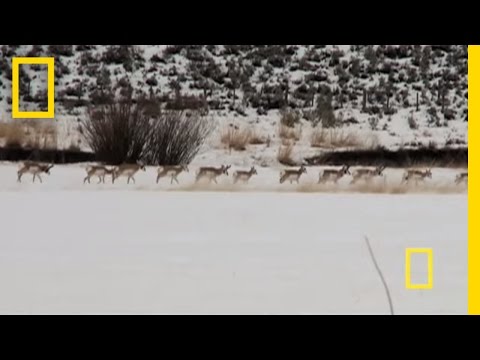
every fall this herd of pronghorn
antelope treks more than a hundred miles
Grand Teton National Park to their
winter habitat in the upper Green River
Valley of Wyoming this phenomenal
migration one of the longest in North
America has been taking place for the
past six thousand years as the snows
develop and forge becomes unavailable
they migrate and move back the hundred
to 150 miles back to the sagebrush
basins of the upper Green River Basin
where they can access orge through the
winter relying on information collected
from VHS radio collars researcher Hall
Sawyer map this particular pronghorn
migration route in 1998 with a half a
million animals roaming the range
Wyoming is home to almost as many
pronghorn as people within a
hundred-mile radius of casper wyoming
which is located right in the center of
the state there’s more pronghorn than
anywhere else in the world Wyoming
sustains most of the pronghorn in North
America but part of the pronghorns
habitat is becoming increasingly
fragmented by human development and some
worry that crucial quarters are being
severed
two men have an ambitious plan to find
out which obstacles the pronghorn have
to navigate conservationist and
adventure Rick Ridgeway and photographer
Joe Reese have sent out to document this
year’s migration Joe proposed to walk
with those pronghorn on foot nobody had
ever done that before on foot and more
importantly document the migration in
photographs so that we could increase
the awareness about the migration and
the threats to the pronghorn Joe Reece
is one of national Geographics young
explorers he’s a biologist and a
wildlife photographer we walked the
distinct paths that the pronghorn
migrated in the fall and in the spring
we we wanted to view the landscape
through the eyes of the pronghorn and
see the obstacles that the prime
currency see the beauty of the landscape
as well as that human obstacles the duo
quickly establishes that pronghorn are
encountering some modern and
conveniences on their ancient pathway
and one day we estimated herd of about
eight hundred animals moved past this
near trappers point Wyoming it’s a
natural bottleneck that has been reduced
by a subdivision we watch the pronghorn
dodge cars and people along Highway 191
and 352 when they hit a migratory
bottleneck animals are confined to a
narrow passageway the squeeze can be
caused by vegetation or human
development in the case of trappers
point it’s both
every year between 1500 and 2000
pronghorn crossed through this
bottleneck twice a year once in the
spring and once in the fall vehicle
wildlife collisions are a problem all
across the state but they become
particularly problematic during these
migratory time periods when there’s a
lot of animals moving across the roads
the most common barriers the animals
face our roads and fences fences pose a
problem the pronghorn because they’re
not evolved to jump over fences they
move underneath them and if fences are
woven wire that they can’t move under a
lot of times they simply can’t pass
through in order to capture intimate
photographs of the migration Joe uses
remote cameras congra antelope can see
ten times better than we can so if you
move at all they see you and they’ll
stop and they’ll go the other way you
have to use remote camera systems that
don’t make any movement and take the
pictures by himself he positions the
cameras in specific areas along the
migration path often hiking miles to
find the perfect spot
Joe’s ultimate goal is to get shots of
the herd in motion to capture the
essence of this unique long-distance
journey I my photograph this migration
to inspire people to care about it it’s
an incredible migration and people need
to know about it it’s happening right in
the middle United States and it’s the
second longest migration in the Western
Hemisphere Joe also documents the
migration from the air with a help of
pilot Chris Boyer of light Hawk an
organization that provides free flights
for conservationists aloft Joe can
clearly see potential roadblocks during
one of my aerial photography flights I
documented human development within the
corridor as more and more barriers are
installed the threat to this migration
is increased the team discovers that oil
and gas fields are also threatening the
corner there are already more than 8,000
wells on public lands with plans to
double that in the next decade these
remarkable aerial photographs document
the changes since the 1980s in the last
hundred years the migration route has
been threatened by human development by
suburbs and by Ranchettes and now by oil
and gas development in the southern part
of their range the team’s extensive
documentation of the pronghorn corridor
may help officials target where they
need to act there are ways to protect
wildlife corridors that are still
compatible with a with human occupation
in an area and for example a rancher can
install fences that allow pronghorn
antelope for example to go under them
without getting hung up on the Bob Dwyer
world the team also hopes their efforts
will spark an interest in protecting the
animals
the pronghorn migration corridor is 125
miles long and only a mile wide it’s not
going to take that much to protect it if
the human impact on this migration were
to continue then it’s possible that the
migration route might be cut off and if
that were to happen there would be no
more pronghorn antelope in the Grand
Tetons and that would be tragic for
everyone with commitment and planning
the pronghorn could continue their great
annual migration just as they’ve done
since the last ice age sponsored by
National Geographic mission programs
taking science and exploration into the
new millennium
Please follow and like us: