
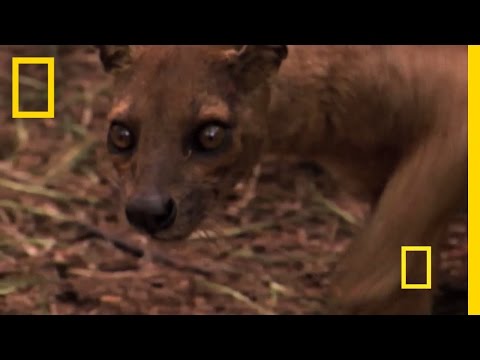
Pusa is the largest carnivore on
Madagascar it’s the top predator it’s
the natural king of the jungle I’m Luke
dollar for about 17 years I’ve been
coming to Madagascar a country
biologists like myself like to think of
as a petri dish of evolutionary history
it’s so unique that four out of five
organisms you find here you won’t find
anywhere else
one of the most elusive is the fussen
which I study who said what what’s a
number busan g6 JD a g6 okay got it
I didn’t come to Madagascar to study the
fusa I came for the reason that most
people come to Madagascar the lemurs
lemurs are the famous icons of this
island and I was studying a particular
lemur and then this linger ups and
disappears turns out that this lemur had
been eaten by this predator I’d never
heard of before the fusa in other parts
of the world we have whole guilds of
large carnivores that maintained that
that top predator level in Madagascar
it’s one animal
it’s a pretty impressive 1/2 what I’m
going to be painting for is the fleshy
part it’s not
right now we’re about 60 seconds if I
had to imagine what the common ancestor
between the mongooses the cats and the
hyenas looked like way back when I
imagined it would look a lot like a
photo she scratched up her face a little
bit but there’s just life light
abrasions
we’ve come to learn that fus are active
pretty much equally day and night three
hours on four hours off for hours on
three hours off throughout the 24-hour
cycle and we’ve come to learn through
going through tons and tons of scats
Lucia poop and identifying everything
that was in them that they eat pretty
much everything in the forest with a
heartbeat some of that is lemur some of
that is rodent some of that is reptile
but fussa are in fact an
equal-opportunity predator those two
things alone are just amazing in terms
of not having realized this about an
animal that is so important to the
survival and the maintenance of the
systems in Madagascar throughout the
island I estimate that there’s
definitely fewer than 3000 flukes are
left in the wild and so I spend half
probably more of my time working on the
conservation of the species because not
doing so would guarantee that by the end
of my career I’m going to have a whole
trove of information about a recently
extinct species
you
Please follow and like us: