
off the southeastern coast of Africa
lies the island of Madagascar you may
know Madagascar for its wild eyed lemurs
but it’s also home to one of the world’s
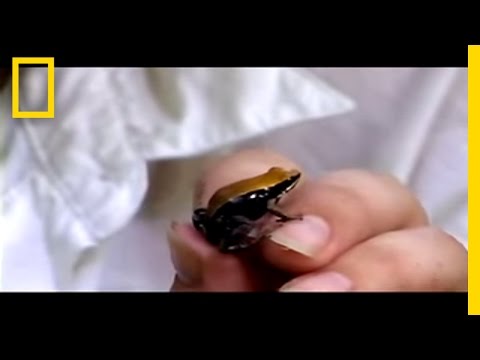
most colorful and Vivian’s the Mantella
poison frog poison frogs aren’t born
poisonous but rather their proof of the
old saying you are what you eat their
toxins come from something in their diet
which is largely ants millipedes and
minds but which of those insects is it
exactly and will a collapse of insect
diversity threaten the frogs ability to
survive meet herpetologist and National
Geographic grantee Valerie C Clark this
is mental a bit silly Oh a very
widespread Malagasy poison frog nerd
occurs throughout the country this
appears to be a graphic female how do I
know because it’s just very very fat for
each site Clark and her team used GPS
data to log the frogs location and other
useful information they also need to
collect as many insects as possible to
try to track down exactly what these
frogs are eating we used what’s called a
mini Winkler’s
to get an idea of the local arthropod or
insect diversity with a focus on ants
and what we do is we chop up
and sift like leaf litter then we put it
into a mesh bag we hang the mesh bag
inside of a nice slick nylon bag it’s a
little plastic bag at the bottom with
alcohol in it as the soil dries out
inside of this mesh bag the insects
leave it to try to find moisture or soil
and fall out and become our symbols
they’re quick little buggers how do you
sample the toxins in a frog’s skin well
there are a couple of methods on this
trip I’ve just been taking alcohol
unlike a little tissue and wiping their
backs to get some additional samples to
look at variability in individual poison
frogs at different sites the Clark also
has another way of testing for these
toxins in the field what she calls a
quick lick taste test oh it’s definitely
bitter bitterness equals toxic the
reason Clark doesn’t keel over from the
poison is because Mantella are only
mildly toxic to humans they are brightly
colored best to serve as a warning to
potential predators to stay away these
alkaloid chemicals in the Frog skin that
may be harmful to other creatures could
be helpful to humans they might hold the
key to new medicines such as pain
relievers and heart disease fighting
drugs by sampling frogs for their toxic
chemicals we’re perfecting Lee taking a
shortcut to the many many chemicals that
exist in countless insects in the
rainforests I really want poison frogs
to be viewed by the general public in
the same way that the Madagascar’s
charismatic chameleons and lemurs are I
believe that they’re really really
important
because they lead us to drugs and
potential green pesticides but also just
because they’re gorgeous back in the
village the results look promising oh
here we go
loser a notice preparer yes a little
millipede that has several alkaloids in
common with Mantella poison frogs I’m
very excited about these this is
certainly making up the great portion of
them until a diet and has great
potential to end up being some of the
sources of their chemicals in order for
the frogs toxins to be effective they
need a variety of prey to dine on the
bigger the forests the more insects to
choose from the frogs have more of these
different chemicals and undisturbed
primary rainforest which is just another
reason to show that as we start to
disturb rainforests and cut them down
there are less toxic chemicals that have
the potential for drug development so
the more primary forests that we have
the better chance we have of finding new
drug leads near the end of her journey
Clark has collected five hundred tubes
of insects these are dietary footprints
that could lead her to some sources of
the frogs toxins I believe that
understanding factors that affect the
lintel distribution is critical for
designing good conservation strategies
clearly she has a lot of lab work ahead
of her but already she’s coming to one
conclusion in order to save the poison
frogs of Madagascar people have to save
the habitat with its diversity of
insects sponsored by National Geographic
mission programs taking science and
exploration into the new millennium
Please follow and like us: