
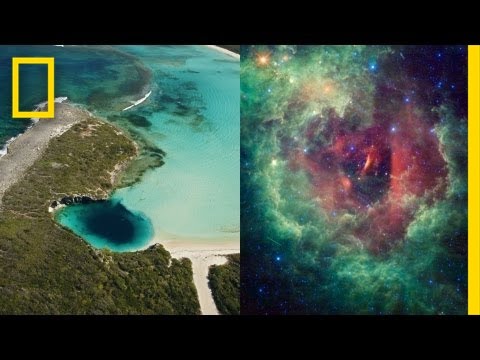
it turns out that the Big Idea series is
actually a big idea on its own and it
turns on this thought and that is that
when you put together too good but
extremely different things when you put
those two things together you may get
something unexpected and surprising and
you know I’m thinking kind of examples
in the cooking world so for example
maybe like Molay sauce you know where
you have a variety of different chili
peppers mixed with chocolate which would
normally expect maybe you put that on
chicken and you end up with something
that’s kind of knock your socks off good
and surprising
so our job tonight is to find the
exquisite flavor in the combination of
knowledge from two different parts of
the world of science from two radically
different approaches to exploration what
could – such seemingly divergent areas
of inquiry have in common as we create a
virtual Venn diagram of the evening in
our minds and that’s something I know
all of you do where will the overlaps
lie Adams work has helped us to better
understand the narrative of the universe
mapping its history and future by
measuring its shape Kenny’s work has
provided a chronicle of the Earth’s
history and a roadmap for better
understanding current climate changes we
can ponder how their exploration of the
unknown whether it’s the darkness of the
universe or deep pockets within the
Earth’s within the Earth’s underground
caves and ask ourselves how does this
provide clarity both on our origins and
the future of the cosmos
but what one thing that I wanted to kind
of start out with was in both of your
work there are and have been very
significant moments of discovery so you
know like Kenny you swim into one of
those amazing kind of Cathedral spaces
or in your case Adam you know you you
have this moment where you’re kind of
like going well this calculation must be
wrong or so describe a little bit about
what it’s like for the that moment of
discovery and um you know what I’m
fishing for is it is it gonna be similar
or different I’m gonna jump in here and
say I think what’s similar is I’m I’m
guessing that we’re both scared at that
moment
Kenny’s probably scared cuz he could die
I’m just scared that I’ll embarrass
myself and because you know it’s much
easier I mean I see from my colleagues
every day people make mistakes all the
time you know they run out of their
office going wow something really weirds
going on but most the time it’s a bug or
it’s a mistake or a minus sign in the
wrong place and so you’re for me I was
just very afraid for many weeks and
months as I kept analyzing this data
that I had made a mistake and it would
be a stupid mistake yeah and how about
you Kenny it’s a it’s a strange
combination actually a you all getting a
ha moment by literally sticking your
head into a muddy hole you’re not sure
but once you get into a cave and you
realize the cave is going that’s the aha
moment but then comes very long periods
of waiting which I think you know when
you see it come out in the popular press
and even in you know peer-reviewed
journals
that’s usually after months if not years
and years of whatever you found getting
put through the wringer yeah still still
by I mean pretty amazing moments and I
think the interesting thing is that time
is a factor for both of you and and in
fact time is something that I think’s
really worth us talking about because
you both operate in these kind of
incomprehensible stretches of time I
mean Adam your stretches of time are
just totally ridiculous
and and Kenny’s yours are also pretty
ridiculous but but talk a little bit
about how you think about time and and
also is time kind of on your side in
terms of your research or is it working
against you well one of the strange
aspects of our research is the existence
of dark energy the fact that the
expansion is accelerating taking at face
value if we don’t end up learning
something else about dark energy implies
that eventually the universe will be
expanding faster than the speed of light
now you may have heard nothing to travel
faster than the speed of light that’s
true
nothing is traveling faster than the
speed of light it’s actually space
itself the the imaginary distance
between two points which is growing
faster than the speed of light that has
real strange consequences which is
eventually we won’t be able to see
distant objects anymore the distant
galaxies will essentially wink out
because they will be moving away from us
faster than the speed of light light
will not be able to reach us from them
and so it’ll get dark and dark and dark
it’s sort of if you can imagine
concentric shells moving in until we can
only see the very nearby objects right
around us and so some people have even
pointed out billions of years from now
cosmologists will not be able to
discover what we discovered so we’ll
have to leave some good notes I just I
have a you know more existential dilemma
grappling with time I mean certainly
when you look at the evolution of life
if we believe that time scale that I put
up you realize to a certain degree are
in significance of humans as a species
on the opposite end of the time spectrum
when I’m in a cave you’re keenly aware
of every second that’s passing because
your time is intricately linked to the
air and your tanks or whatever you’re
breathing sources so every second feels
you’re literally feeling time pass and
the two extremes I mean it puts you into
this thought about you know the deepest
thoughts about what life is and why
we’re here and will we
as being here and how much we want to be
here as a you know an individual isn’t a
species that wants to keep keep
surviving but then you step back and you
look at how how fleeting our our lives
are our generations are in geologic time
I always find it but you’re all keeping
me up at night just to jump in here I’m
struck by one similarity that I wouldn’t
have imagined but the amount of time you
could stay down there and investigate as
you say is limited and the second so
precious we actually face the same sort
of thing
the time on the Hubble Space Telescope
is incredibly precious and very
difficult to obtain there is only one
Hubble Space Telescope all astronomers
want to use it it’s oversubscribed by a
factor of ten so there’s you know ten
experiments or projects we would like to
do or ten years worth for every one year
that’s available and so we schedule it
down to the second and so I may get
allocated for the science project that I
want to do a certain amount of time that
will be you know allocated in seconds
and I very jealously look over the
schedule of how to get the most out of
those seconds and I’m struck with how
similar that is to the seconds you can
spend in your environment right and
probably similarly there’s some places
where you know you’re only going to get
to go there once shift gears a little
bit but one thing we were talking about
earlier is this idea of how you kind of
perceive your field or how you did and
not accept the received wisdom for you
Adam you know there was this kind of
understood idea you showed us the three
well it’s really the one the crunch
diagram and that was the way to think so
let’s talk a little bit about you know
accepting or not accepting pushing or
not pushing you know being skeptical or
not being skeptical and what what value
that has not just for science but as
explorers I mean I think whether its
genetic
or I think there’s a genetic trait among
certainly people who are into
exploration and exploration religious
science
your natural skeptic you don’t believe
what you see so you push further and
it’s certainly that’s why we’re we were
talking before it makes me laugh when
you know the scientific community is
accused of making a concerted effort of
some kind of hoax whether its climate
change or something else our job I get
paid to rip apart my colleagues papers I
mean that’s how you make a name for
yourself just from a survival and ego
standpoint but also I think it’s what
drives you is you don’t take things at
surface value and it’s a very tricky as
a you know as a teacher to get students
to you want to teach them a certain set
of information then you want them to
question that set of information and
it’s a fine balance between telling them
there is no truth you got to go for it
you know and except for a lot
unfortunate I think a lot of academics
do want students to do what they do and
I think that’s a real that’s a shame
when they put pressure that way mm-hmm
well I mean I think of this example of
Einstein I was talking about before
where okay he had one idea about the
universe and it was wrong and he was
willing to accept that move on to the
next thing and then you know he had made
an important discovery he didn’t even
know that was an important discovery we
discovered everybody else was wrong that
that actually was important and so this
is I mean we’re just so used to this as
the process of science I mean it’s not
it’s not like somebody handing us a
sacred tome and saying these are the
rules of the universe
you know you will obey though but rather
you know we are figuring out the rules
of the universe and you know our only
guideposts is this process of science
where we’re gonna do an observation
we’re gonna make a measurement we’re
gonna see what it shows we’re not gonna
take anything for granted because that’s
the system that has taught us you know
go back to Galileo when everybody
thought you know all the bodies went
around the earth and he you know put
that telescope up and showed you know
his contemporary leaders the moons of
going around Jupiter and that’s I mean
you know we we have bought into this
process of discovery by seeing and doing
and not accepting and so it’s work it
works remarkably well and I you know we
just believe that that’s the way to
you I mean unfortunately my
five-year-old and 9 year old have
adopted that skepticism with everything
I say it’s time for bedtime well based
on what theory today
really it’s getting a little annoying so
I I think we got to open it up to
questions from the audience I’m sure the
typical Geographic audience is pulsing
with brilliant questions so there are
microphones circulating and let’s this
first one right on the aisle here I
would like to ask Adam if you could take
a moment for those of us who do not know
a great deal about astronomy and explain
what happened with the Big Bang and what
was before I wasn’t there by the way I
understand this is speculation sorry
what happened with the Big Bang and what
there was before yes so the Big Bang is
a little bit of a misnomer in that you
know people tend to think of it they get
the wrong picture probably from TV or
movies that there’s an explosion
somewhere in space and really the Big
Bang is really a Big Bang Theory and
it’s the fact that we see as we look
back in time as we look out to look back
in time we see everything was closer
together everything was hotter
everything was younger and so it is very
natural to form this theory that
everything is moving out you know it was
actually given this statement like a Big
Bang as a ridiculed statement by the
leading opponent of the theory of
a Big Bang a Fred Hoyle who believed in
in the 1950s an alternative called the
steady state theory whose so we said Oh
what do you think the universe just
started it’s a Big Bang people were like
pretty pretty much yeah because all the
all the evidence is there of exactly
what would happen and so we have an
understanding of when that process
occurred it was about 13.7 billion years
ago how do we know that well I told you
we know how fast the universe is
expanding and so it isn’t hard to sort
of run that movie backwards in time
instead of expanding
the universe contracting at that same
rate how long ago was everything back at
a single point 13.7 billion years ago as
to what occurred before that we really
don’t know I mean we really I mean it
may not even be possible to know it may
be that the universe sort of you know is
created at that moment as a quantum
fluctuation it may be that whatever
occurred before there’s no record of it
that transmits forward you know somebody
wants asking you know what is it that
you’d want to transmit forward we think
that our universe can be described by
six numbers now that’s our current
thinking on the cosmological model you’d
almost want to write down those six
numbers on a fortune cookie and pass it
through you know that Big Bang moment
you know this was us and you know before
the next universe starts but we really
don’t know about that earlier moment we
just we have a very good empirical
understanding of the evolution of our
universe since that point in time when
it was all out of point here right here
in the middle hi so you’ll have to
forgive me for being the devil’s
advocate on this my question to both of
you is why does it matter why does
knowing that the universe is expanding
matter and why does it matter if we
discover a species that went extinct two
million years ago well let me go to the
general question why’d go into an
underwater cave and pretty much we can’t
send remote operated vehicles or used
ground-penetrating radar to get a sense
of where what’s going on with our water
sources beneath our feet in many parts
of the world so it’s very practical
selfish I want to know where our water
is so we know where to put or not put a
dairy or a chemical plant or a dump or
something like that so you know a human
health survival from water the new
species if I want to put it in a not
just knowledge for knowledge sake but in
a selfish framework is you know a lot of
our pharmaceuticals metal of medical
advances come from life life forms
extremophiles microbes and other you
know sponges for examples algae related
to corals things like that so you know
from a
whether you look at it as a business
breakthrough why I mean why do we want
to make medicines why do we want people
to live longer if we have too many
people on the earth I mean those are
those are things you can answer for me
but I mean there are some very practical
reasons but certainly to make policy
decisions related to natural natural
resource management I think is one
answer I can give in my case I would say
that nature hides the laws of physics in
difficult to reach places extremes of
energy or space and so if we want to
understand the laws of physics we often
have to look at the universe as the
laboratory that we can’t build here and
so that’s how we learn now learning
about the laws of physics has always led
to has always been a central engine of
technology I mean whether it was you
know quantum mechanics in the 1930s led
to lasers and semiconductors and
transistors you know I talked about
Einstein and his theory of gravity well
general relativity is baked into any of
you use a GPS to figure out your
position you’d be off by many kilometers
each day from your location if we want
to locate positions on a planet use
cellphones use mapping technology I mean
I can go on and on but all of the modern
technology we have comes from a deeper
understanding of laws of physics now I
would be the first to admit it isn’t the
kind of research that leads to you know
the iPhone 7 I mean it won’t be out I
know next next year or the quarter after
that this is basic research it’s long
term but it’s it’s been the biggest
payoff because you know the research you
do for the iPhone 7 you know doesn’t
revolutionize your ability to identify
where you are you know as a random spot
on a planet and things like that
so you know it definitely has practical
applications but you know Einstein would
have been shocked that the about the GPS
satellite system so but there isn’t
there also a practical there’s another
practical side you know Kenny in your
case you’re telling us about the history
of the planet and like a lot of social
sciences
you know we learn from the past so that
we can know the future in terms of
climate there’s an interesting record
there maybe it’s not predict no that’s
that’s right there certainly I mean the
there’s the samples we’re getting from
the dust and the speleothems of
stalagmites will directly impact how we
go about you know change our climate
models which has implications for our
ability to plan for the future which is
a you know very uncertain future in many
ways well we know climate change is
happening we don’t have a great sense of
what regional changes will be in the
timescales that things may occur and you
know the sensitivity of the climate
system so anything that helps us record
variability of the past is a step toward
better understanding the future well you
know I know that we could go and go and
go but infinitely but yes that’s right
if space is accelerating to income but I
want to I just want to thank both of you
so much and thank the audience for a
fantastic you all has to even
you
actually a big idea on its own and it
turns on this thought and that is that
when you put together too good but
extremely different things when you put
those two things together you may get
something unexpected and surprising and
you know I’m thinking kind of examples
in the cooking world so for example
maybe like Molay sauce you know where
you have a variety of different chili
peppers mixed with chocolate which would
normally expect maybe you put that on
chicken and you end up with something
that’s kind of knock your socks off good
and surprising
so our job tonight is to find the
exquisite flavor in the combination of
knowledge from two different parts of
the world of science from two radically
different approaches to exploration what
could – such seemingly divergent areas
of inquiry have in common as we create a
virtual Venn diagram of the evening in
our minds and that’s something I know
all of you do where will the overlaps
lie Adams work has helped us to better
understand the narrative of the universe
mapping its history and future by
measuring its shape Kenny’s work has
provided a chronicle of the Earth’s
history and a roadmap for better
understanding current climate changes we
can ponder how their exploration of the
unknown whether it’s the darkness of the
universe or deep pockets within the
Earth’s within the Earth’s underground
caves and ask ourselves how does this
provide clarity both on our origins and
the future of the cosmos
but what one thing that I wanted to kind
of start out with was in both of your
work there are and have been very
significant moments of discovery so you
know like Kenny you swim into one of
those amazing kind of Cathedral spaces
or in your case Adam you know you you
have this moment where you’re kind of
like going well this calculation must be
wrong or so describe a little bit about
what it’s like for the that moment of
discovery and um you know what I’m
fishing for is it is it gonna be similar
or different I’m gonna jump in here and
say I think what’s similar is I’m I’m
guessing that we’re both scared at that
moment
Kenny’s probably scared cuz he could die
I’m just scared that I’ll embarrass
myself and because you know it’s much
easier I mean I see from my colleagues
every day people make mistakes all the
time you know they run out of their
office going wow something really weirds
going on but most the time it’s a bug or
it’s a mistake or a minus sign in the
wrong place and so you’re for me I was
just very afraid for many weeks and
months as I kept analyzing this data
that I had made a mistake and it would
be a stupid mistake yeah and how about
you Kenny it’s a it’s a strange
combination actually a you all getting a
ha moment by literally sticking your
head into a muddy hole you’re not sure
but once you get into a cave and you
realize the cave is going that’s the aha
moment but then comes very long periods
of waiting which I think you know when
you see it come out in the popular press
and even in you know peer-reviewed
journals
that’s usually after months if not years
and years of whatever you found getting
put through the wringer yeah still still
by I mean pretty amazing moments and I
think the interesting thing is that time
is a factor for both of you and and in
fact time is something that I think’s
really worth us talking about because
you both operate in these kind of
incomprehensible stretches of time I
mean Adam your stretches of time are
just totally ridiculous
and and Kenny’s yours are also pretty
ridiculous but but talk a little bit
about how you think about time and and
also is time kind of on your side in
terms of your research or is it working
against you well one of the strange
aspects of our research is the existence
of dark energy the fact that the
expansion is accelerating taking at face
value if we don’t end up learning
something else about dark energy implies
that eventually the universe will be
expanding faster than the speed of light
now you may have heard nothing to travel
faster than the speed of light that’s
true
nothing is traveling faster than the
speed of light it’s actually space
itself the the imaginary distance
between two points which is growing
faster than the speed of light that has
real strange consequences which is
eventually we won’t be able to see
distant objects anymore the distant
galaxies will essentially wink out
because they will be moving away from us
faster than the speed of light light
will not be able to reach us from them
and so it’ll get dark and dark and dark
it’s sort of if you can imagine
concentric shells moving in until we can
only see the very nearby objects right
around us and so some people have even
pointed out billions of years from now
cosmologists will not be able to
discover what we discovered so we’ll
have to leave some good notes I just I
have a you know more existential dilemma
grappling with time I mean certainly
when you look at the evolution of life
if we believe that time scale that I put
up you realize to a certain degree are
in significance of humans as a species
on the opposite end of the time spectrum
when I’m in a cave you’re keenly aware
of every second that’s passing because
your time is intricately linked to the
air and your tanks or whatever you’re
breathing sources so every second feels
you’re literally feeling time pass and
the two extremes I mean it puts you into
this thought about you know the deepest
thoughts about what life is and why
we’re here and will we
as being here and how much we want to be
here as a you know an individual isn’t a
species that wants to keep keep
surviving but then you step back and you
look at how how fleeting our our lives
are our generations are in geologic time
I always find it but you’re all keeping
me up at night just to jump in here I’m
struck by one similarity that I wouldn’t
have imagined but the amount of time you
could stay down there and investigate as
you say is limited and the second so
precious we actually face the same sort
of thing
the time on the Hubble Space Telescope
is incredibly precious and very
difficult to obtain there is only one
Hubble Space Telescope all astronomers
want to use it it’s oversubscribed by a
factor of ten so there’s you know ten
experiments or projects we would like to
do or ten years worth for every one year
that’s available and so we schedule it
down to the second and so I may get
allocated for the science project that I
want to do a certain amount of time that
will be you know allocated in seconds
and I very jealously look over the
schedule of how to get the most out of
those seconds and I’m struck with how
similar that is to the seconds you can
spend in your environment right and
probably similarly there’s some places
where you know you’re only going to get
to go there once shift gears a little
bit but one thing we were talking about
earlier is this idea of how you kind of
perceive your field or how you did and
not accept the received wisdom for you
Adam you know there was this kind of
understood idea you showed us the three
well it’s really the one the crunch
diagram and that was the way to think so
let’s talk a little bit about you know
accepting or not accepting pushing or
not pushing you know being skeptical or
not being skeptical and what what value
that has not just for science but as
explorers I mean I think whether its
genetic
or I think there’s a genetic trait among
certainly people who are into
exploration and exploration religious
science
your natural skeptic you don’t believe
what you see so you push further and
it’s certainly that’s why we’re we were
talking before it makes me laugh when
you know the scientific community is
accused of making a concerted effort of
some kind of hoax whether its climate
change or something else our job I get
paid to rip apart my colleagues papers I
mean that’s how you make a name for
yourself just from a survival and ego
standpoint but also I think it’s what
drives you is you don’t take things at
surface value and it’s a very tricky as
a you know as a teacher to get students
to you want to teach them a certain set
of information then you want them to
question that set of information and
it’s a fine balance between telling them
there is no truth you got to go for it
you know and except for a lot
unfortunate I think a lot of academics
do want students to do what they do and
I think that’s a real that’s a shame
when they put pressure that way mm-hmm
well I mean I think of this example of
Einstein I was talking about before
where okay he had one idea about the
universe and it was wrong and he was
willing to accept that move on to the
next thing and then you know he had made
an important discovery he didn’t even
know that was an important discovery we
discovered everybody else was wrong that
that actually was important and so this
is I mean we’re just so used to this as
the process of science I mean it’s not
it’s not like somebody handing us a
sacred tome and saying these are the
rules of the universe
you know you will obey though but rather
you know we are figuring out the rules
of the universe and you know our only
guideposts is this process of science
where we’re gonna do an observation
we’re gonna make a measurement we’re
gonna see what it shows we’re not gonna
take anything for granted because that’s
the system that has taught us you know
go back to Galileo when everybody
thought you know all the bodies went
around the earth and he you know put
that telescope up and showed you know
his contemporary leaders the moons of
going around Jupiter and that’s I mean
you know we we have bought into this
process of discovery by seeing and doing
and not accepting and so it’s work it
works remarkably well and I you know we
just believe that that’s the way to
you I mean unfortunately my
five-year-old and 9 year old have
adopted that skepticism with everything
I say it’s time for bedtime well based
on what theory today
really it’s getting a little annoying so
I I think we got to open it up to
questions from the audience I’m sure the
typical Geographic audience is pulsing
with brilliant questions so there are
microphones circulating and let’s this
first one right on the aisle here I
would like to ask Adam if you could take
a moment for those of us who do not know
a great deal about astronomy and explain
what happened with the Big Bang and what
was before I wasn’t there by the way I
understand this is speculation sorry
what happened with the Big Bang and what
there was before yes so the Big Bang is
a little bit of a misnomer in that you
know people tend to think of it they get
the wrong picture probably from TV or
movies that there’s an explosion
somewhere in space and really the Big
Bang is really a Big Bang Theory and
it’s the fact that we see as we look
back in time as we look out to look back
in time we see everything was closer
together everything was hotter
everything was younger and so it is very
natural to form this theory that
everything is moving out you know it was
actually given this statement like a Big
Bang as a ridiculed statement by the
leading opponent of the theory of
a Big Bang a Fred Hoyle who believed in
in the 1950s an alternative called the
steady state theory whose so we said Oh
what do you think the universe just
started it’s a Big Bang people were like
pretty pretty much yeah because all the
all the evidence is there of exactly
what would happen and so we have an
understanding of when that process
occurred it was about 13.7 billion years
ago how do we know that well I told you
we know how fast the universe is
expanding and so it isn’t hard to sort
of run that movie backwards in time
instead of expanding
the universe contracting at that same
rate how long ago was everything back at
a single point 13.7 billion years ago as
to what occurred before that we really
don’t know I mean we really I mean it
may not even be possible to know it may
be that the universe sort of you know is
created at that moment as a quantum
fluctuation it may be that whatever
occurred before there’s no record of it
that transmits forward you know somebody
wants asking you know what is it that
you’d want to transmit forward we think
that our universe can be described by
six numbers now that’s our current
thinking on the cosmological model you’d
almost want to write down those six
numbers on a fortune cookie and pass it
through you know that Big Bang moment
you know this was us and you know before
the next universe starts but we really
don’t know about that earlier moment we
just we have a very good empirical
understanding of the evolution of our
universe since that point in time when
it was all out of point here right here
in the middle hi so you’ll have to
forgive me for being the devil’s
advocate on this my question to both of
you is why does it matter why does
knowing that the universe is expanding
matter and why does it matter if we
discover a species that went extinct two
million years ago well let me go to the
general question why’d go into an
underwater cave and pretty much we can’t
send remote operated vehicles or used
ground-penetrating radar to get a sense
of where what’s going on with our water
sources beneath our feet in many parts
of the world so it’s very practical
selfish I want to know where our water
is so we know where to put or not put a
dairy or a chemical plant or a dump or
something like that so you know a human
health survival from water the new
species if I want to put it in a not
just knowledge for knowledge sake but in
a selfish framework is you know a lot of
our pharmaceuticals metal of medical
advances come from life life forms
extremophiles microbes and other you
know sponges for examples algae related
to corals things like that so you know
from a
whether you look at it as a business
breakthrough why I mean why do we want
to make medicines why do we want people
to live longer if we have too many
people on the earth I mean those are
those are things you can answer for me
but I mean there are some very practical
reasons but certainly to make policy
decisions related to natural natural
resource management I think is one
answer I can give in my case I would say
that nature hides the laws of physics in
difficult to reach places extremes of
energy or space and so if we want to
understand the laws of physics we often
have to look at the universe as the
laboratory that we can’t build here and
so that’s how we learn now learning
about the laws of physics has always led
to has always been a central engine of
technology I mean whether it was you
know quantum mechanics in the 1930s led
to lasers and semiconductors and
transistors you know I talked about
Einstein and his theory of gravity well
general relativity is baked into any of
you use a GPS to figure out your
position you’d be off by many kilometers
each day from your location if we want
to locate positions on a planet use
cellphones use mapping technology I mean
I can go on and on but all of the modern
technology we have comes from a deeper
understanding of laws of physics now I
would be the first to admit it isn’t the
kind of research that leads to you know
the iPhone 7 I mean it won’t be out I
know next next year or the quarter after
that this is basic research it’s long
term but it’s it’s been the biggest
payoff because you know the research you
do for the iPhone 7 you know doesn’t
revolutionize your ability to identify
where you are you know as a random spot
on a planet and things like that
so you know it definitely has practical
applications but you know Einstein would
have been shocked that the about the GPS
satellite system so but there isn’t
there also a practical there’s another
practical side you know Kenny in your
case you’re telling us about the history
of the planet and like a lot of social
sciences
you know we learn from the past so that
we can know the future in terms of
climate there’s an interesting record
there maybe it’s not predict no that’s
that’s right there certainly I mean the
there’s the samples we’re getting from
the dust and the speleothems of
stalagmites will directly impact how we
go about you know change our climate
models which has implications for our
ability to plan for the future which is
a you know very uncertain future in many
ways well we know climate change is
happening we don’t have a great sense of
what regional changes will be in the
timescales that things may occur and you
know the sensitivity of the climate
system so anything that helps us record
variability of the past is a step toward
better understanding the future well you
know I know that we could go and go and
go but infinitely but yes that’s right
if space is accelerating to income but I
want to I just want to thank both of you
so much and thank the audience for a
fantastic you all has to even
you
Please follow and like us: