
you know we have a little bit of time
before this evening too to talk about
some of the similarities and differences
and between our work and certainly at
the most basic level I think we’re both
interested in exploring the invisible in
the case of Adam it’s exploring the
far-distant gallons that galaxies
light-years away for me it’s what’s
right beneath our feet and the
underground underworld so to speak so I
think will will I’ll give an
introduction to my world
and then hopefully during the discussion
after adam’s talk we’ll get a sense of
what we do
base similarities we both use our heads
in Adams case it’s a kind of complex
mathematics this is actually a seventeen
hundred year old BC what people think is
the first approximation of the square
root of two but kind of fundamental
mathematics I also similarly I use my
head but Moore is a battering ram right
here for getting into the blue holes and
this is you know literally a lot of what
we do is physically search and put
ourselves into these kind of mysterious
invisible beneath our feet worlds and I
think yeah and you just kind of go in
there and you don’t know what you’re
going to find and my mother when she saw
this her comment was you went to school
for how many years to do that but once
you do get into these places you really
are kind of become a physically a
time-traveler you get into these time
capsules and what I used to consider
again before really thinking about the
kind of stuff that that Adam works on is
that some of the things we found in
these holes were taking us back to what
I would call deep time which is very
shallow time by his standards as you’ll
see but really to the the origin of the
earth if we think about the earth about
four-and-a-half billion years old
it’s only in the last two and a half
billion years where we’ve even had
enough oxygen to keep life alive but the
earliest forms of life for microbial
forms of life and as you’ll see blue
holes are kind of a modern-day
analogy for what we think some of this
these early forms of life evolved out of
them and their forms of life that didn’t
leave a fossil record so we look for
these these places on earth where we can
study them at about 2 and 1/2 billion
years before present we had what people
refer to as the oxygen revolution where
certain type of bacteria you probably
heard of cyanobacteria out competed a
lot of the other organisms and microbes
and the byproduct of the cyanobacteria
is the oxygen that that makes our earth
livable and it’s really at the the end
of the timeline where the life as we
know it comes across and as Andrew Knoll
and evolutionary biologist said if you
think that you know humans are the icing
on the cake the cake is really made up
of bacteria and I think that’s a nice
way to think about about this sort of
evolution so I don’t know what it’s hard
to see with a the light on me how many
divers you can yell out how many divers
in the audience Oh quite a few
how many cave divers oh not many good
job security but if you can kill the
light thanks guys for those of you
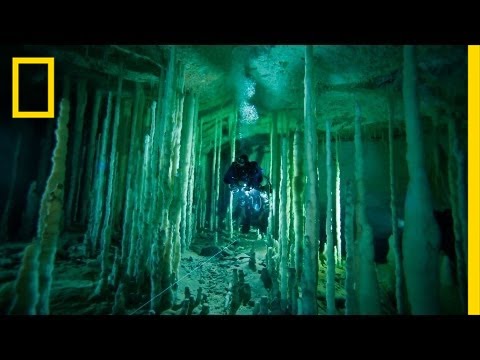
that’s actually what an underwater cave
looks like I take full credit for the
photo as I know our Sadie our photo
editor for the magazine Sadie courrier
she’ll see that’s about as skilled as my
photos are and I’ll show a lot of
beautiful photos and I bet I take no
credit for them that’s what a blue hole
looks like looking up from about a
hundred meters over 300 feet looking at
the entrance as two divers descend down
into the hole and then you get into
these otherworldly sorts of situations
what you really feel like you’re in this
inner space that’s an offshore blue hole
so I’ll talk about two kinds of blue
holes offshore and that’s in Long Island
Bahamas that’s the deepest known blue
hole in the world it’s about 660 feet
deep and there’s inland blue holes that
one’s in the pine yards in Abaco Bahamas
so let me get a little bit into the
anatomy of a Blue Hole if you think
about it hidden I give you the Reader’s
Digest version you have rain coming down
through the atmosphere picks up a little
bit of carbon dioxide becomes slightly
acidic hits limestone which could
think of the calcium carbonate almost
chalk like it can eat away in form
reservoirs of water down beneath our
feet but that’s just how you get the
fresh water down there how you get the
lateral cave formation is where that
fresh water meets the salt water that’s
at the equivalent of where sea level is
that’s come in either through cave
conduits or through the limestone itself
it’s as if we’re standing on a sponge
and there’s many places in the world
that have this kind of geology well
there’s a chemical reaction that occurs
at that interface at the halocline and
that eats away the cave then when sea
level falls or Rises depending on the
ice ages for example 20 thousand years
ago the sea level around the Bahamas in
Florida was about 400 feet lower than
present-day you’ll get cave formation at
that level sea level will rise stop for
a while you get caves for me at that
level and that’s how you can get miles
and miles of lateral cave passageway so
as I mentioned these these caves are
modern-day analogs for what we think
these ancient oceans were like so we
have this freshwater lighter fresh water
and it’s got oxygen in it and then
you’ve got this dense or salt water
beneath it and you’ve got over hundreds
of thousands of years organic matter so
you’ve got plants and trees and animals
falling in and sinking to the bottom
there there’s microbes that actually
feed off this get their energy from
these carbon sources and they combine
with the sulfate that’s found in
seawater and the byproduct is this sword
a sore hydrogen sulfide which we’ve all
smelled the rotten eggs sulfur springs
and kind of very poisonous in gaseous
form and there’s a whole set of life
that lives in that layer as well off
this hydrogen sulfide so we’ve got
different forms of life that we can
study from a genetic perspective as well
as looking at them in context and get a
sense of what life might have been like
billions of years ago let me just show
you some of the forms of life that we
find in there this is the big stuff this
is the recent finds that’s dr. Tom Iliff
who’s catching a loose if you got blind
cave fish most of the creatures are
blind there’s no reason to put your
evolutionary
energy into eyes or optic nerves and
these creatures that probably remain
unchanged for about 200 million years
some of them not only found just in the
Bahamas
not just in underwater caves but only
have seen them in one cave it shows you
how little we know about this very
fragile ecosystem no eyes translucent
that’s a remnant eye with no optic nerve
which tells us that it probably evolved
from originally from the oceans that’s a
new class of crustaceans that was found
in the Bahamas in the 70s and we found
subsequent species remipede iya so that
was a major find out of the blue holes
there’s a close-up they have venomous
fangs but this is about the extent of my
experience with astronomy which is my
screensaver on my Mac so you know I
assume I was brought here to make Adam
look particularly smart but it did when
I did see this it does at least
metaphorically I make the link to what
goes on with potential forms of life in
certain places like Europa and Mars and
that brings us back to the blue holes
and that’s actually a shot of 30 feet
deep 10 meters deep and if you were
diving down descending you would hit
what looks like these rings of Saturn
and that’s the hydrogen sulfide layer
and the pink is actually the
pigmentation in the cells of the
bacteria it’s that voluminous and the
white is sulfur elemental sulfur that’s
broken down and the chemosynthesis or
the metabolic process of the bacteria so
you’re literally descending down into
this noxious layer you start to smell
the rotten egg smell before you can get
to it and obviously you’re wearing a
face mask so you’re not smelling it
through your nose it’s actually
diffusing through the pores and your
skin through your wetsuit or even if
you’re wearing a dry suit you know
you’re staying in it too long once you
stop smelling it because it’s actually
dead and your olfactory nerves and your
sometimes the metal starts to change
color so we try to move quickly through
it but sometimes that’s where we do
quite a bit of our sampling and what
happens physiologically is you have the
hydrogen sulfide stops the
from binding to the red blood cells and
impedes oxygen update you might start to
get tingly lips or whatnot we talked a
lot of physiologist no clear answers on
what long-term exposure made to we did
quite a few we did about 150 dives just
in this one hole there’s some evidence
that’s that’s actually what I look like
before the expedition and there was some
some slight physiological changes
afterwards but we’ve you know we’ve
dealt with them
subsequent right so how am i doing maybe
I should get off the stage but let me
just go on to one of the other quickly
one of the other scientific questions at
the hardly expedition was looking at the
natural history of the Caribbean as it
ends up this anoxic saltwater no oxygen
saltwater is a great place to preserve
fossils including collagen where you can
get DNA out of so we did a lot of work
excavating here’s just some examples
that’s in 90 feet of water it’s probably
about a thirteen thousand year old owl
roost so an owl would go out of the cave
go hunting come back whatever it ate
lizards birds small mammals it would
digest the food but it actually
regurgitate up there the bones so that
whole little meter square excavation pit
we found about twenty-six new species
either unknown to science didn’t know
they lived in that part of the world or
we learned that they had somehow gone
extinct lots of land tortoises species
we didn’t know existed small mammals
birds of prey crocodiles that we didn’t
know existed in this area they’re
related to the highly endangered Cuban
crocodile found in just one small
wetland area Lucayan Indian burial
grounds there’s no surviving descendants
of the Lucayan Indians so there’s a lot
of mystery there’s not a good record on
what happened with human migration when
Paleo Indians came out of the Orinoco
Basin in Venezuela
there’s our expedition really yielded
some interesting answers but many more
questions about why certain species
disappeared and why there was or wasn’t
overlap between human and non-human
species the last can major question one
that we’re really following up
Leon is trying to learn more about the
sensitivity of our climate system so as
it turns out these stalagmites and
stalactites types are the ones that come
from the top
mites come from the bottom they only
grow in the cave as dry as water
percolates through the limestone it
drips down on the floor evaporates and
slowly you start to get these cave
formations accreting well it ends up
there great recorders just like ice
cores or tree rings great recorders of
the environmental history at the time
the temperature and precipitation and
remember they only grow when the cave is
dry so they’re also very precise
recorders of sea-level rise and fall but
in addition to really solidifying some
of the scientific ideas about abrupt
climate change we had some other
interesting findings that’s a hair and
dust there’s no natural source of the
dust in the Bahamas and it’s come over
and it’s come over in such massive
quantities that it really led to
questions of how to get here why in such
quantities why in certain areas of the
cave and as it turns out it ends up that
this dust is trapped in the speleothems
and is exactly in line with these abrupt
cooling and warming periods what are
called Henryk events and we have some
very compelling evidence that dust is a
driver as opposed to a reaction to
climate changes and that has big
implications not just for the
sensitivity of the climate as we add
greenhouse gases but also has
implications for land use and land
change as well this is actually from the
USGS all the water in the world if you
put it together including the oceans is
that big blue marble forget the tiny one
the one little bit bigger that’s visible
that’s all our groundwater that’s if you
take away what’s locked up in ice
95% of world’s freshwater is beneath our
feet in underground reservoirs and it
all came here from space and the
formation of the earth and it’s we’re
not creating it or destroying it we’re
just moving around and changing its
nature and I think it’s something that
it’s hard to get perspective on and I
think you’ll get it in a different way
from the finite nature of what we have
on earth by looking at
what Adam has to say about the infinity
of space so I think it’s Adams up next
and thank you very much
you
before this evening too to talk about
some of the similarities and differences
and between our work and certainly at
the most basic level I think we’re both
interested in exploring the invisible in
the case of Adam it’s exploring the
far-distant gallons that galaxies
light-years away for me it’s what’s
right beneath our feet and the
underground underworld so to speak so I
think will will I’ll give an
introduction to my world
and then hopefully during the discussion
after adam’s talk we’ll get a sense of
what we do
base similarities we both use our heads
in Adams case it’s a kind of complex
mathematics this is actually a seventeen
hundred year old BC what people think is
the first approximation of the square
root of two but kind of fundamental
mathematics I also similarly I use my
head but Moore is a battering ram right
here for getting into the blue holes and
this is you know literally a lot of what
we do is physically search and put
ourselves into these kind of mysterious
invisible beneath our feet worlds and I
think yeah and you just kind of go in
there and you don’t know what you’re
going to find and my mother when she saw
this her comment was you went to school
for how many years to do that but once
you do get into these places you really
are kind of become a physically a
time-traveler you get into these time
capsules and what I used to consider
again before really thinking about the
kind of stuff that that Adam works on is
that some of the things we found in
these holes were taking us back to what
I would call deep time which is very
shallow time by his standards as you’ll
see but really to the the origin of the
earth if we think about the earth about
four-and-a-half billion years old
it’s only in the last two and a half
billion years where we’ve even had
enough oxygen to keep life alive but the
earliest forms of life for microbial
forms of life and as you’ll see blue
holes are kind of a modern-day
analogy for what we think some of this
these early forms of life evolved out of
them and their forms of life that didn’t
leave a fossil record so we look for
these these places on earth where we can
study them at about 2 and 1/2 billion
years before present we had what people
refer to as the oxygen revolution where
certain type of bacteria you probably
heard of cyanobacteria out competed a
lot of the other organisms and microbes
and the byproduct of the cyanobacteria
is the oxygen that that makes our earth
livable and it’s really at the the end
of the timeline where the life as we
know it comes across and as Andrew Knoll
and evolutionary biologist said if you
think that you know humans are the icing
on the cake the cake is really made up
of bacteria and I think that’s a nice
way to think about about this sort of
evolution so I don’t know what it’s hard
to see with a the light on me how many
divers you can yell out how many divers
in the audience Oh quite a few
how many cave divers oh not many good
job security but if you can kill the
light thanks guys for those of you
that’s actually what an underwater cave
looks like I take full credit for the
photo as I know our Sadie our photo
editor for the magazine Sadie courrier
she’ll see that’s about as skilled as my
photos are and I’ll show a lot of
beautiful photos and I bet I take no
credit for them that’s what a blue hole
looks like looking up from about a
hundred meters over 300 feet looking at
the entrance as two divers descend down
into the hole and then you get into
these otherworldly sorts of situations
what you really feel like you’re in this
inner space that’s an offshore blue hole
so I’ll talk about two kinds of blue
holes offshore and that’s in Long Island
Bahamas that’s the deepest known blue
hole in the world it’s about 660 feet
deep and there’s inland blue holes that
one’s in the pine yards in Abaco Bahamas
so let me get a little bit into the
anatomy of a Blue Hole if you think
about it hidden I give you the Reader’s
Digest version you have rain coming down
through the atmosphere picks up a little
bit of carbon dioxide becomes slightly
acidic hits limestone which could
think of the calcium carbonate almost
chalk like it can eat away in form
reservoirs of water down beneath our
feet but that’s just how you get the
fresh water down there how you get the
lateral cave formation is where that
fresh water meets the salt water that’s
at the equivalent of where sea level is
that’s come in either through cave
conduits or through the limestone itself
it’s as if we’re standing on a sponge
and there’s many places in the world
that have this kind of geology well
there’s a chemical reaction that occurs
at that interface at the halocline and
that eats away the cave then when sea
level falls or Rises depending on the
ice ages for example 20 thousand years
ago the sea level around the Bahamas in
Florida was about 400 feet lower than
present-day you’ll get cave formation at
that level sea level will rise stop for
a while you get caves for me at that
level and that’s how you can get miles
and miles of lateral cave passageway so
as I mentioned these these caves are
modern-day analogs for what we think
these ancient oceans were like so we
have this freshwater lighter fresh water
and it’s got oxygen in it and then
you’ve got this dense or salt water
beneath it and you’ve got over hundreds
of thousands of years organic matter so
you’ve got plants and trees and animals
falling in and sinking to the bottom
there there’s microbes that actually
feed off this get their energy from
these carbon sources and they combine
with the sulfate that’s found in
seawater and the byproduct is this sword
a sore hydrogen sulfide which we’ve all
smelled the rotten eggs sulfur springs
and kind of very poisonous in gaseous
form and there’s a whole set of life
that lives in that layer as well off
this hydrogen sulfide so we’ve got
different forms of life that we can
study from a genetic perspective as well
as looking at them in context and get a
sense of what life might have been like
billions of years ago let me just show
you some of the forms of life that we
find in there this is the big stuff this
is the recent finds that’s dr. Tom Iliff
who’s catching a loose if you got blind
cave fish most of the creatures are
blind there’s no reason to put your
evolutionary
energy into eyes or optic nerves and
these creatures that probably remain
unchanged for about 200 million years
some of them not only found just in the
Bahamas
not just in underwater caves but only
have seen them in one cave it shows you
how little we know about this very
fragile ecosystem no eyes translucent
that’s a remnant eye with no optic nerve
which tells us that it probably evolved
from originally from the oceans that’s a
new class of crustaceans that was found
in the Bahamas in the 70s and we found
subsequent species remipede iya so that
was a major find out of the blue holes
there’s a close-up they have venomous
fangs but this is about the extent of my
experience with astronomy which is my
screensaver on my Mac so you know I
assume I was brought here to make Adam
look particularly smart but it did when
I did see this it does at least
metaphorically I make the link to what
goes on with potential forms of life in
certain places like Europa and Mars and
that brings us back to the blue holes
and that’s actually a shot of 30 feet
deep 10 meters deep and if you were
diving down descending you would hit
what looks like these rings of Saturn
and that’s the hydrogen sulfide layer
and the pink is actually the
pigmentation in the cells of the
bacteria it’s that voluminous and the
white is sulfur elemental sulfur that’s
broken down and the chemosynthesis or
the metabolic process of the bacteria so
you’re literally descending down into
this noxious layer you start to smell
the rotten egg smell before you can get
to it and obviously you’re wearing a
face mask so you’re not smelling it
through your nose it’s actually
diffusing through the pores and your
skin through your wetsuit or even if
you’re wearing a dry suit you know
you’re staying in it too long once you
stop smelling it because it’s actually
dead and your olfactory nerves and your
sometimes the metal starts to change
color so we try to move quickly through
it but sometimes that’s where we do
quite a bit of our sampling and what
happens physiologically is you have the
hydrogen sulfide stops the
from binding to the red blood cells and
impedes oxygen update you might start to
get tingly lips or whatnot we talked a
lot of physiologist no clear answers on
what long-term exposure made to we did
quite a few we did about 150 dives just
in this one hole there’s some evidence
that’s that’s actually what I look like
before the expedition and there was some
some slight physiological changes
afterwards but we’ve you know we’ve
dealt with them
subsequent right so how am i doing maybe
I should get off the stage but let me
just go on to one of the other quickly
one of the other scientific questions at
the hardly expedition was looking at the
natural history of the Caribbean as it
ends up this anoxic saltwater no oxygen
saltwater is a great place to preserve
fossils including collagen where you can
get DNA out of so we did a lot of work
excavating here’s just some examples
that’s in 90 feet of water it’s probably
about a thirteen thousand year old owl
roost so an owl would go out of the cave
go hunting come back whatever it ate
lizards birds small mammals it would
digest the food but it actually
regurgitate up there the bones so that
whole little meter square excavation pit
we found about twenty-six new species
either unknown to science didn’t know
they lived in that part of the world or
we learned that they had somehow gone
extinct lots of land tortoises species
we didn’t know existed small mammals
birds of prey crocodiles that we didn’t
know existed in this area they’re
related to the highly endangered Cuban
crocodile found in just one small
wetland area Lucayan Indian burial
grounds there’s no surviving descendants
of the Lucayan Indians so there’s a lot
of mystery there’s not a good record on
what happened with human migration when
Paleo Indians came out of the Orinoco
Basin in Venezuela
there’s our expedition really yielded
some interesting answers but many more
questions about why certain species
disappeared and why there was or wasn’t
overlap between human and non-human
species the last can major question one
that we’re really following up
Leon is trying to learn more about the
sensitivity of our climate system so as
it turns out these stalagmites and
stalactites types are the ones that come
from the top
mites come from the bottom they only
grow in the cave as dry as water
percolates through the limestone it
drips down on the floor evaporates and
slowly you start to get these cave
formations accreting well it ends up
there great recorders just like ice
cores or tree rings great recorders of
the environmental history at the time
the temperature and precipitation and
remember they only grow when the cave is
dry so they’re also very precise
recorders of sea-level rise and fall but
in addition to really solidifying some
of the scientific ideas about abrupt
climate change we had some other
interesting findings that’s a hair and
dust there’s no natural source of the
dust in the Bahamas and it’s come over
and it’s come over in such massive
quantities that it really led to
questions of how to get here why in such
quantities why in certain areas of the
cave and as it turns out it ends up that
this dust is trapped in the speleothems
and is exactly in line with these abrupt
cooling and warming periods what are
called Henryk events and we have some
very compelling evidence that dust is a
driver as opposed to a reaction to
climate changes and that has big
implications not just for the
sensitivity of the climate as we add
greenhouse gases but also has
implications for land use and land
change as well this is actually from the
USGS all the water in the world if you
put it together including the oceans is
that big blue marble forget the tiny one
the one little bit bigger that’s visible
that’s all our groundwater that’s if you
take away what’s locked up in ice
95% of world’s freshwater is beneath our
feet in underground reservoirs and it
all came here from space and the
formation of the earth and it’s we’re
not creating it or destroying it we’re
just moving around and changing its
nature and I think it’s something that
it’s hard to get perspective on and I
think you’ll get it in a different way
from the finite nature of what we have
on earth by looking at
what Adam has to say about the infinity
of space so I think it’s Adams up next
and thank you very much
you
Please follow and like us: