
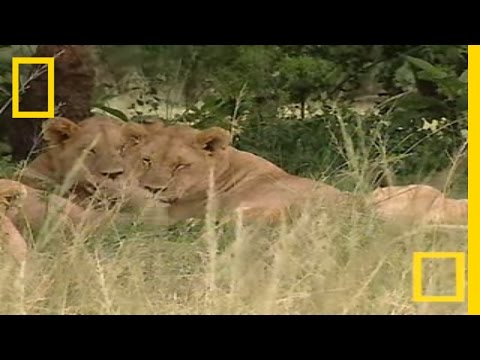
African lions are losing more and more
of their habitat but their problem is
not one of space alone because lions
need lots of room to roam only the
biggest parks have enough space to
support several prized with a variety of
genes lions and smaller reserves have a
very limited gene pool making them much
more susceptible to disease we have a
whole bunch of lion populations that are
isolated within southern Africa so that
presents a problem to us because certain
of these areas cannot can only hold a
certain amount of lions so we’re not
having mixing of genes in the old days
there weren’t the fences there weren’t
the highways so lion populations were
able to roam over vast areas and so you
had gene mixing in those days those
stagnating gene pools are fast becoming
a major concern for conservationists
we think that we need to go in now to to
help the lion population we don’t want
to have inbred lines here in the future
because the more inbred there are the
bigger chance there is of some disease
coming in and wiping out the majority of
them a simple solution would be to move
male lions from one site to another
but lion behavior makes that difficult
to do
usually when you take lines away and you
put them with a new population the new
population tune against them and mostly
end up killing them so the idea is to
try something that seems straightforward
artificial insemination
dr. Paul Bartels runs the wildlife
breeding Resource Center in Pretoria
South Africa he’s discovered a new means
of preserving genetic diversity through
artificial insemination the team
collects viable sperm samples from
unrelated lions in geographically
distant populations what we’ve done is
dot the males and do a vasectomy and of
course that sterilizes him but we at the
same time able to bank down some sperm
from that particular male and now what
is useful because he’s talking of the
pride is an indicator to us which of the
females are coming into season so that
we can then odd fish ly inseminate them
one of the biggest challenges with this
procedure is the fact that they are
operating on wild animals there are a
number of difficulties in doing
artificial insemination with lions
obviously the first is they bite and
they can they can kill you so you have
to develop a technique where you can
work with them with the least amount of
stress because you don’t want stress on
these animals so we developing various
techniques whereby and we can dot the
animal these are very well designed
drugs they go to sleep they wake up we
don’t suspect they even wake up with
much of a hangover feeling although the
lion objects loudly to the dart is not
painful the lion park we can develop the
technology it’s relatively easy because
it’s a small confined area we can find
the lines above quicker develop the
techniques and then transfer it to the
wall blood and tissue samples are
collected from each of the Lions the
genetic material is frozen and stored
for the future
we have sperm and various tissue banked
away so that if there’s a problem with
the population at least in the future
then we have an option where we can
bring this back we are very confident
that that we’re going to get some babies
from artificial insemination and it’s a
case of sticking with it and actually
doing the project and getting the babies
at the end of the day
Please follow and like us: