
[Music]
[Music]
my talk today is not about primates
it’s about marine reptiles and I’m going
to give you a short trip to an island
north of the Norway called Svalbard or
Spitsbergen some of you might know it’s
at 78 degrees north east liked a
northern tip of Greenland and the
archipelago is actually it’s a there’s a
Svalbard Treaty so it means that all
nations can work there and stay there we
were not far away from the main
settlement called long a bein in this
High Arctic landscape it’s easy access
now there’s flights every day there’s
boats there’s everything so I didn’t
discover this areas we are digging in it
was found about a hundred years ago but
nobody did anything about these fossils
for a hundred years
the first that found fossils in the area
was some Swedes in 1914 but then there
were some medical doctors that came to
small barge sponsored by the Rockefeller
Foundation and they overwintered one
winter to see how the common flu spread
through an isolated a mining population
in the islands during one winter it was
one of the first epidemiological studies
these are dr. paul doctor freeze and
there’s also dr. malar that’s not on the
paper i don’t know why but three of them
might be Americans certainly this one
looks like one that’s that’s probably a
Norwegian sailor I don’t know about that
looks like a janitor but might be an
American too but the important thing is
that they went for a trip just outside
the city of long Abin or village or
small settlement at that time and they
discovered a skeleton of a plesiosaur
and actually what they got here
this is the only picture that remains of
this but actually this is what we called
Field Jacket made out of plaster and
burlap so one of these people had the
knowledge from North America the only
place where they were digging dinosaurs
with this kind of knowledge at that time
so one of them had to have some idea on
how to dig dinosaurs to preserve this
specimen so it’s what an enigma at I
tried to trace them back a little bit
some of these guys but I couldn’t find
too much about them but this fossil was
given to the museum in in Oslo in 1931
on its stay there until as we’d describe
it in 1962 but nobody cared about this
area it’s too remote too much work to do
any major days but and we started our
digs in 2004 actually this area of
course this is marine sediments that are
now on land so they have been lifted up
about 200 metres above sea level now
when they were deposited it was about
100 metres below sea level but now we
can actually camp on this Jurassic sea
bottom and collect fossils this area was
high latitude even in the Jurassic it
was a cold water ecosystem also in the
Jurassic so we’re trying to do several
different kinds of studies here it’s now
six field seasons we’re students into
the seventh we only stay up there for a
couple of weeks each time between two
and three weeks because of the weather
conditions we need the permafrost to
melt into the mountains at least one
meter so it’s easier to dig the first
meter before you have to use jackhammers
to get further into the mountainside and
also we have the of course the problem
with snow the snow can be there in July
it usually it melts in July and it
starts to cover the area again in the
middle of August so we have no more than
four weeks really to do this work but in
this 4 weeks the slopes are really nice
there’s nothing growing they’re really
nice no plants no nothing it’s like a
polar desert so you can walk on the
shale and when you find big lumps or
things that do not look like
they order its bones every time so then
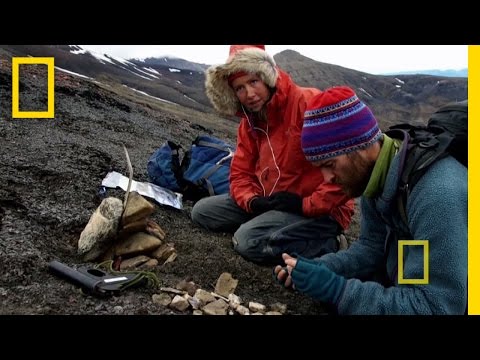
we dig them out this is a typical day in
excavation that’s me we have found this
is a brain case of a huge plus or and
we’re mixing the plaster and encasing it
our main fossil groups are marine
reptiles there are two main groups they
are of course air-breathing they are
land living they have land living
ancestors they are highly evolved to
live in the marine environment at this
time this is 150 million years ago same
time as the long-necked dinosaur ruled
on earth these craters ruled in the
ocean and they’re not dinosaurs we find
articulated skeletons that means that
you can see like here this is finger
boats over huge flipper from a
plesiosaur everything we find is
articulated quite large specimens
there’s no single bones found really if
we find one bone we find a skeleton this
is one we are just prepared now it’s an
extremely oh you can see a model of it
now it’s swimming up here this is the
long-necked plesiosaurs this is the long
neck this is part of the front of the
body – the shoulder girdles this is the
ribs from the stomach here’s the see a
3d scan we just made last week of the
extremely long neck and the front of the
body of this animal unfortunately it’s
missing the head but still it’s a very
complete nice specimen from a very
crucial time in the evolution of
resource so it’s described now as part
of a PhD that will be published next
year and I have several most students on
the project they finish their master
student thesis now in June
so both Neela and Liana they two young
women that finished their masters on
flipper morphology and also on histology
of the bolts it’s really cool to see
inside the bones to see how they grow
these animals as we know this is a cold
watery environment we really like to see
how reptiles survive as big marine
mammal animals in in the cold water and
of course we got some playa source they
are
not as big as blue whales but much
cooler they are like their heads are up
to between two and three meters that
means almost 10 feet and the teeth are
like large cucumbers so very nice
animals but what I’m feeling
finding most interesting at the moment
is really the equal source we found a
really really very complete one last
year they look like fat over eaten
dolphins but they’re not they are
swimming in a different way as you can
see if you study that animation and all
the animations you see here is from this
National Geographic documentary
this is the most remarkable hillside we
got you can see the cap we actually
camped on top of one specimen these are
if your source and place your source and
they’re all in one hillside and for
those of you that know a little bit
about geology you will see that this
looks like a cream cake with the layers
that means that they are not in one
layer like they it was a big meteorite
hitting or whatever and killing all
those animals actually this big time
difference between the lower ones and
upper ones and that’s so cool and we’re
just starting to understand that now
because what we have collected so far
in the sixth the sixth field season
we’re going to collect six more
skeletons this summer so but now we have
five partial amount complete take this
or six portolan to almost complete
please your source and to fragmented
pliosaurus we’re in the process of
submitting all this and it’s for new
species or place the source three to
four new species of accusers are not
splitting up the two if the source but
we have we have actually a lot of
species select your source and we will
wait with the description of some of
them until well it takes two more years
of gluing before we can start to get the
skeleton salt but what we got them in
the lab now we have more than sixty
skeletons mapped in the area we also
worked on the high resolution
stratigraphy of the whole locality and a
cool thing to use them is of course
ammonites because ammonites they evolve
very fast in the Mesozoic so if you find
good ammonites you can actually divide
the Mesozoic into half a million or 1
million year stratigraphic sections and
that’s really good when you’re talking
about this old face so we have mapped
and we are also isotope stratigraphy all
the whole thing and carbon isotopes and
a lot of other things that I’m not going
to talk about but now we know that one
centimeter of shale is about 1,000 years
we got 55 meters of shale here that
means between 5 and 6 million years of
time from from the first skeletons to
the last
and that is really interesting for us
paleontologists because we can probably
tell some stories from that so I will
come back to that when it comes to
future work well the later ethical fall
what is really interesting because we
have the highest concentration of
Mesozoic marine reptiles in the world
probably where I think we have more than
a thousand skeletons weathering out and
this is really what I would like to tell
the story about in two or three years
look at all the active source and you
know from the beginning to the end of
this section it’s five million years
so all this active source seems to be of
the same genus and then we can see more
evolution in one section that’s so cool
to end this we have still a lot of work
to do it’s a lot of unpublished material
we’re going to publish the first big
report on the expedition’s next year as
an expedition volume but description of
a lot of the new species on the
stratigraphy and all this hopefully we
will also be able to say something about
an extinction at some point ologist
believe in and some part ologist don’t
believe in that’s the border between the
Jurassic and the Cretaceous because we
got fossils just crossing that border in
the Arctic part so that was my talk
thank you
[Applause]
[Music]
you
[Music]
my talk today is not about primates
it’s about marine reptiles and I’m going
to give you a short trip to an island
north of the Norway called Svalbard or
Spitsbergen some of you might know it’s
at 78 degrees north east liked a
northern tip of Greenland and the
archipelago is actually it’s a there’s a
Svalbard Treaty so it means that all
nations can work there and stay there we
were not far away from the main
settlement called long a bein in this
High Arctic landscape it’s easy access
now there’s flights every day there’s
boats there’s everything so I didn’t
discover this areas we are digging in it
was found about a hundred years ago but
nobody did anything about these fossils
for a hundred years
the first that found fossils in the area
was some Swedes in 1914 but then there
were some medical doctors that came to
small barge sponsored by the Rockefeller
Foundation and they overwintered one
winter to see how the common flu spread
through an isolated a mining population
in the islands during one winter it was
one of the first epidemiological studies
these are dr. paul doctor freeze and
there’s also dr. malar that’s not on the
paper i don’t know why but three of them
might be Americans certainly this one
looks like one that’s that’s probably a
Norwegian sailor I don’t know about that
looks like a janitor but might be an
American too but the important thing is
that they went for a trip just outside
the city of long Abin or village or
small settlement at that time and they
discovered a skeleton of a plesiosaur
and actually what they got here
this is the only picture that remains of
this but actually this is what we called
Field Jacket made out of plaster and
burlap so one of these people had the
knowledge from North America the only
place where they were digging dinosaurs
with this kind of knowledge at that time
so one of them had to have some idea on
how to dig dinosaurs to preserve this
specimen so it’s what an enigma at I
tried to trace them back a little bit
some of these guys but I couldn’t find
too much about them but this fossil was
given to the museum in in Oslo in 1931
on its stay there until as we’d describe
it in 1962 but nobody cared about this
area it’s too remote too much work to do
any major days but and we started our
digs in 2004 actually this area of
course this is marine sediments that are
now on land so they have been lifted up
about 200 metres above sea level now
when they were deposited it was about
100 metres below sea level but now we
can actually camp on this Jurassic sea
bottom and collect fossils this area was
high latitude even in the Jurassic it
was a cold water ecosystem also in the
Jurassic so we’re trying to do several
different kinds of studies here it’s now
six field seasons we’re students into
the seventh we only stay up there for a
couple of weeks each time between two
and three weeks because of the weather
conditions we need the permafrost to
melt into the mountains at least one
meter so it’s easier to dig the first
meter before you have to use jackhammers
to get further into the mountainside and
also we have the of course the problem
with snow the snow can be there in July
it usually it melts in July and it
starts to cover the area again in the
middle of August so we have no more than
four weeks really to do this work but in
this 4 weeks the slopes are really nice
there’s nothing growing they’re really
nice no plants no nothing it’s like a
polar desert so you can walk on the
shale and when you find big lumps or
things that do not look like
they order its bones every time so then
we dig them out this is a typical day in
excavation that’s me we have found this
is a brain case of a huge plus or and
we’re mixing the plaster and encasing it
our main fossil groups are marine
reptiles there are two main groups they
are of course air-breathing they are
land living they have land living
ancestors they are highly evolved to
live in the marine environment at this
time this is 150 million years ago same
time as the long-necked dinosaur ruled
on earth these craters ruled in the
ocean and they’re not dinosaurs we find
articulated skeletons that means that
you can see like here this is finger
boats over huge flipper from a
plesiosaur everything we find is
articulated quite large specimens
there’s no single bones found really if
we find one bone we find a skeleton this
is one we are just prepared now it’s an
extremely oh you can see a model of it
now it’s swimming up here this is the
long-necked plesiosaurs this is the long
neck this is part of the front of the
body – the shoulder girdles this is the
ribs from the stomach here’s the see a
3d scan we just made last week of the
extremely long neck and the front of the
body of this animal unfortunately it’s
missing the head but still it’s a very
complete nice specimen from a very
crucial time in the evolution of
resource so it’s described now as part
of a PhD that will be published next
year and I have several most students on
the project they finish their master
student thesis now in June
so both Neela and Liana they two young
women that finished their masters on
flipper morphology and also on histology
of the bolts it’s really cool to see
inside the bones to see how they grow
these animals as we know this is a cold
watery environment we really like to see
how reptiles survive as big marine
mammal animals in in the cold water and
of course we got some playa source they
are
not as big as blue whales but much
cooler they are like their heads are up
to between two and three meters that
means almost 10 feet and the teeth are
like large cucumbers so very nice
animals but what I’m feeling
finding most interesting at the moment
is really the equal source we found a
really really very complete one last
year they look like fat over eaten
dolphins but they’re not they are
swimming in a different way as you can
see if you study that animation and all
the animations you see here is from this
National Geographic documentary
this is the most remarkable hillside we
got you can see the cap we actually
camped on top of one specimen these are
if your source and place your source and
they’re all in one hillside and for
those of you that know a little bit
about geology you will see that this
looks like a cream cake with the layers
that means that they are not in one
layer like they it was a big meteorite
hitting or whatever and killing all
those animals actually this big time
difference between the lower ones and
upper ones and that’s so cool and we’re
just starting to understand that now
because what we have collected so far
in the sixth the sixth field season
we’re going to collect six more
skeletons this summer so but now we have
five partial amount complete take this
or six portolan to almost complete
please your source and to fragmented
pliosaurus we’re in the process of
submitting all this and it’s for new
species or place the source three to
four new species of accusers are not
splitting up the two if the source but
we have we have actually a lot of
species select your source and we will
wait with the description of some of
them until well it takes two more years
of gluing before we can start to get the
skeleton salt but what we got them in
the lab now we have more than sixty
skeletons mapped in the area we also
worked on the high resolution
stratigraphy of the whole locality and a
cool thing to use them is of course
ammonites because ammonites they evolve
very fast in the Mesozoic so if you find
good ammonites you can actually divide
the Mesozoic into half a million or 1
million year stratigraphic sections and
that’s really good when you’re talking
about this old face so we have mapped
and we are also isotope stratigraphy all
the whole thing and carbon isotopes and
a lot of other things that I’m not going
to talk about but now we know that one
centimeter of shale is about 1,000 years
we got 55 meters of shale here that
means between 5 and 6 million years of
time from from the first skeletons to
the last
and that is really interesting for us
paleontologists because we can probably
tell some stories from that so I will
come back to that when it comes to
future work well the later ethical fall
what is really interesting because we
have the highest concentration of
Mesozoic marine reptiles in the world
probably where I think we have more than
a thousand skeletons weathering out and
this is really what I would like to tell
the story about in two or three years
look at all the active source and you
know from the beginning to the end of
this section it’s five million years
so all this active source seems to be of
the same genus and then we can see more
evolution in one section that’s so cool
to end this we have still a lot of work
to do it’s a lot of unpublished material
we’re going to publish the first big
report on the expedition’s next year as
an expedition volume but description of
a lot of the new species on the
stratigraphy and all this hopefully we
will also be able to say something about
an extinction at some point ologist
believe in and some part ologist don’t
believe in that’s the border between the
Jurassic and the Cretaceous because we
got fossils just crossing that border in
the Arctic part so that was my talk
thank you
[Applause]
[Music]
you
Please follow and like us: