
imagine a country twice the size of
California but only two million people
no wonder they call it namibia namibian
place of know people it’s the oldest
desert in the world it’s a land of
ancient rock that spilled out of the
earth over the ages hardening to become
the backbone of a country that is the
driest south of the Sahara maybe is
dunes stretch for over a thousand miles
from South Africa all the way north to
Angola the dynamic landscape sculpted by
wind into amazing shapes these are the
famous red dunes of sources Flay the
results of winds that blow from
different directions and some of them
are up to a thousand feet tall these are
the lighter colored dunes found closer
to the sea where they are shaped by
strong coastal winds the reason in the
mid desert exists at all lies offshore
cold water the Benguela current plays a
major role in creating arid conditions
inland and for millions of years that
same current has also transported sand
north along the Mabius coast for strong
winds blow it inland that sand
originated oddly enough from the
Kalahari Desert deep in the interior of
Southern Africa it washes down into the
Orange River which empties it out into
the Atlantic Ocean just south of Namibia
and this is the result a great sand sea
meets the ocean in a magnificent setting
that is as wild as any place we’ve ever
been to it’s called the skeleton coast
for all the shipwrecks that have
occurred there over the years when we
camped here we were the only people in a
wilderness of more than 10 thousand
square miles here’s the big picture
maybe it’s tucked into a corner of South
West Africa surrounded by unstable and
goal in the north prosperous Botswana to
the east and it is heavily influenced by
South Africa it gained political
independence only 20 years ago when the
apartheid regime impulse-buy white South
Africa came to an end in the 19th
century in the maybe it was a
in colony but the Germans have pushed
out by the English after World War one
and South Africa ruled it until 1992
powerful winds rule the climate of
Namibia the strong southwesterly that
prevails for much of the year and the
periodic but dreaded east wind a winter
wind that gathers heat and speed as it
pours off Namibia Central escarpment and
blows with hot fury and hurricane-force
whirling clouds of sand across the land
and far out to sea and that east wind
can literally blow the desert into the
ocean
here’s a space-shuttle view of the
remarkable phenomenon and to give you an
idea the size of those sand plumes
consider that this place here is 5,000
square miles that’s etosha pan and here
is the ground view of a smoking dune hit
by a strong wind the left side is a slip
face and that’s where the sand collects
and piles up the dune gradually moves
over time this is pretty typical weather
along the coast the island in the
background had a great colony of gannets
which our guide said we could easily
reach with an inflatable dinghy we
decided to postpone that idea you know
with fieldwork you always have to
improvise and sometimes you end up with
really interesting meant to you
enthusiastic guides who say that
anything is possible but you know we
were in it for the long run
here’s how the desert sand meets the sea
and vice versa the foam is the result of
these strong offshore winds that whip
the biomass of phytoplankton into a
froth consider it something like marine
egg whites like other major fisheries
the Benguela current marine life has
been plundered involved life populations
like these Cape gannets have declined
seriously but Namibia’s first marine
protected area declared last year is an
important step in the right direction
just like the cold California Current
that runs along America’s west coast the
Benguela currents
ports a rich marine ecosystem and on
shore that results in spectacular
gatherings of fur seals like this one at
Cape crossed where over half a million
seals may haul out for the breeding
season and that attracts predators like
jackals looking for an easy meal here’s
a fur seal pup trying to defend itself
against a hungry jackal but jackals are
not the only ones I want to take
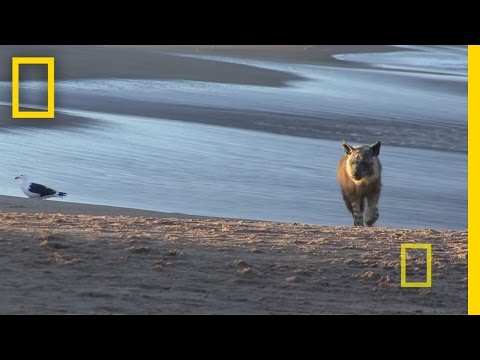
advantage of the seals this is a very
rare image of a very rare animal very
few people ever see it’s a cousin of the
well-known spotted hyenas of Africa
savannas but this one is shaggy solitary
and very shine getting coverage of brown
hyenas was near the top of our wish list
but one hyenas territory can be as large
as 300 square miles it’s not easy to see
wildlife in the interior denominators
eart and most of the time you have to be
content with deciphering tracks like
these of a cape fox making its way up a
dune or the slithers of a snake winding
its way through the sand most of the
desert small creatures may scribble
tracks on the sand surface at night but
they’re forced underground by day to
escape the heat these are oryx’s also
know that as heme spok which are so well
adapted to desert life that they never
have to drink water when it’s hot an
Oryx can raise its body temperature up
to a hundred ten degrees Fahrenheit so
it doesn’t sweat and lose moisture and
its blood passes through special nasal
veins that cool it down before it
overheats the brain this is a herd of
Springbok seen from the air
a century ago these antelopes numbered
in the tens of millions early white
farmers complained that they couldn’t
sleep at night when migrating Springbok
moved across their land in now
unimaginable concentrations if you want
to find animals in the desert what do
you do you look for water because it’s a
magnet the Springbok are coming to drink
at a very small waterhole that we found
and at that same spot these sand grouse
scattered they need to drink water on a
regular basis
they may fly up to 40 miles to a water
source the adults have a unique ability
to gather water in their breast feathers
to take it back to their chicks who
drink it up directly from the parents
soaked breasts plumage it just is in
California where we live
the Mabius coast is blessed by periodic
fog caused by warm moist air from the
open Atlantic Ocean blowing across the
cold Benguela current the air condenses
and it stretches inland as a life
enhancing blanket across the desert and
fog is what keeps these remarkable
plants alive it hardly ever rains where
they occur on the coastal gravel plains
they are well reaches and they look like
alien life-forms from another planet or
plants that had a rough night on the
town they only grow in the Namib Desert
and some individuals are believed to
live for as long as 2,000 years they’re
so unique that botanists have placed
them in their own subfamily there’s
simply no other plant quite like them
their long leathery leaves can’t hold
any moisture but they’ve evolved to
catch fog large well we choose create a
micro habitat in The Naked desert that
gives shelter to other creatures as well
some of these well witches look so
distinctive that we gave them names to
tell them apart something we often do
when we work with wild animals but we
never applied it to plants before this
one with its long curling dreadlocks we
called Bob Marley while Veatch has come
in both sexes and this muscular male
plant look like a real bodybuilder so we
named him Arnold
this voluptuous email we named Marilyn
you can tell female plants by their seed
cones in the center which look a bit
like those of a conifer tree and they
are in fact distantly related to Pines
this is a close-up of maryland’s counts
I guess we could have called a Madonna –
female Valle reaches are pollinated by
bees and wasps and when the cones ripen
they release thousands of papery seeds
that are dispersed by the wind and will
reaches host their own unique array of
life including this sap-sucking beetle
whose nymphs are preyed upon by another
juice loving beetle the Namib Desert is
full of remarkable plants look at these
spectacular succulents the native
Bushman of southern Africa used to
hollow out branches of this tree to hold
their arrows that’s why they’re called
quiver trees and their bark is so smooth
and shiny and that makes them
particularly suitable for photography
and low-light because they reflect
ambient light very well the sensors are
modern digital cameras like the ones I
use have a much higher sensitivity than
I could have ever dreamt of when I was
working with film in the days of film a
typical film speed was a hundred or 200
ISO and I got the 400 ISL things became
problematic but now I can shoot at a
sensitivity of up to 12,000 ISL so I
made this photo by moonlight alone very
few people visited Namibia a century ago
but in 1908 the course of its history
changed forever when diamonds were found
near the coastal town of Lou turrets in
some places they were just lying on the
surface and the miners crawled on their
bellies and collected them by the
handful sometimes they would go out to
search for diamonds at night when they
twinkled in the moonlight it was the
richest deposit ever found one-fifth of
all the world’s gem diamonds come from
the midea and even though they could
only be found right along a coast a huge
security area was established inland as
a buffer
to prevent people from sneaking in and
out illegally with diamonds it was
called asparagus eat German for the
forbidden zone in one way
diamonds were this deserts best friend
the Forbidden Zone stretched along
nearly half the coast of Namibia from
south african border 450 miles north and
60 miles inland and because mining was
done mostly near the coast the sprawling
desert interior has been virtually
untouched since 1908
no human settlements no roads no
livestock it’s a wonderland of walking
dunes exotic animals and rare plants
fast fields of mobile sand dunes these
crescent-shaped dunes that are forever
on the move are called Barkin or walking
dunes they’re formed by powerful winds
that blow from one direction and they
bring planet earth a little bit closer
to Mars because similar dune formations
were recently discovered by a NASA
satellite on the surface of the Red
Planet we receive permission from the
Namibian government to explore dispair
gabite most of which has not yet been
opened officially to tourism of course
we were keen to get to some of these
amazing places including this remarkable
stretch of coastline it’s known as a
long wall for its massive dunes that
come right to the ocean
last year the Namibia government made
another important decision they
announced plans to establish the largest
National Park in Africa the Namid
skeleton coast National Park an area of
60,000 square miles some of the areas in
this new park were already protected but
the spare Givi was added and a few other
coastal areas to create a true super
park that includes the entire coastline
from Angola to South Africa Namibia left
as a park pre-existed to you the
skeleton coast exists up here to the
north this is the spare gabite and then
a couple of other areas were added here
in the middle we went deep into despair
Beach a guide to his one of the most
experienced doom drivers in southern
Africa
and the only one permitted so far to
take people into this fast sensi for a
good reason he understands the ecology
of the desert and he knows how to
navigate his vehicles through the dunes
without causing any damage with our
small team we ventured from the interior
of the sand sea down to the coast
through trackless desert inland from the
coast across the great sand sea you
reach the foot of the jagged mauka lift
mountains and then the Midrand reserve
it’s a place of cinematic beauty with
sinuous lines of vegetated sand dunes
that glow red in the Evening Sun and
from the air strange circles pop the
landscape are called fairy circles and
for a long time there are an unexplained
mystery but a recent study finally
confirms that the fairies are actually
termites which have eaten all the grass
seeds within the circles they like to
keep their place clean the Ninh a brand
reserve was the dream of Alby brückner
a farsighted businessman from Wynne took
who bought a dozen over grazed sheep
farms and turned them into the largest
private nature sanctuary in Africa
covering more than 800 square miles the
reserve is supported by revenues from a
few spectacularly sited eco lodges the
desert terrain of Nemea Brant is really
not that well-suited to commercial sheep
farming but for hem spock and notice the
pronunciation it’s ideal habitat and
large herds now gather here they’ve come
back
and because wild animals are better
grazers on this land and domestic
livestock the land itself has recovered
– this is nothing short of a great
healing with commercial livestock
removed fences are being pulled out and
wildlife canal roam across larger areas
here’s a herd of rare red hartebeest
crossing a road into grassland where
fences once cut them off
bringing predators back is potted at
healing cheetahs are roaming again to
remember
and after they’d been exterminated if
you want to practice conservation in
Africa effectively you’ve got to give
local people a chance to do things their
way here’s a meeting in a Himba village
where a community Conservancy was
established those conservancies are an
innovative way to give people a chance
to find solutions for conflicts between
livestock and wildlife at their own
level it’s easy to proclaim that
elephants need to be protected and they
do but it’s not easy to coexist with
them when they push their weight around
at precious water sources at the
invitation of the World Wildlife Fund
Franz and I visited several
conservancies we went to the far north
the homeland of the Himba people
traditional pastoralists who don’t have
much in the way of material possessions
they’re still semi-nomadic but the trend
is toward small permanent settlements
with humble dwellings and yet the people
from this simple village are co-owners
of this spectacular nearby tourist Lodge
in a unique business partnership with
wilderness safaris a safari company that
does truly innovative things in the
medium we visited a village with
anthropologist Karen knot who has
spearheaded a unique program that takes
the knowledge that him but women have of
a desert plant that they use to beautify
themselves and turns it into an economic
resource here’s how they do it the himbo
women search for a bush they call the
perfume plant it exudes a resin that
smells fresh and aromatic they pluck the
resin from the branches and then use it
to send a moisturizing skin balm the
resin used by the himbo women has
attracted the attention of european
cosmetics companies that are looking for
new natural substances to use in their
own beauty products resin collecting has
been transformed from a traditional
activity into a resource for the whole
village and it’s a revolution for women
who are now earning money for the first
time in their lives through the
Conservancy move
young Namibians have new opportunities
that are better aligned with the
conservation of nature and when you give
people ownership of their natural
resources every elephant and every Rhino
becomes a valuable asset instead of
something to poach away in secret this
mans proudly displaying the inventory of
his conservancies wildlife now keep in
mind that he has no background it means
he has no degree in resource management
this is mostly done from the bottom up
but its support from the government and
long-term significant support from the
World Wildlife Fund here in the US
tourists too are expanding in numbers
and that’s a good thing for Namibia
because it really needs the revenues
from tourism and it reinforces the value
of protected areas but it can also lead
to problems
uncontrolled offer a driving has damaged
certain areas or single tracks have
become multi Lane highways
this is an area that had a low grade
level of protection but it has now been
brought into the super park and
hopefully some of these things can be
resurrected but when it comes to
environmental impacts open pit mines
like this huge uranium mine called
Rossing are of a totally different
magnitude yet you do have to recognize
what the income means for the needs of
Namibia’s developing economy but it also
hurts to look out over this landscape
and know that this is the site of
another future of uranium mine situated
just inside Namid now cleft national
park and it’s led to serious discussions
within the country it wasn’t that long
ago that these people were the only ones
roaming around in the Namib Desert
hunter-gatherers who know themselves as
son or a coon but we know them as
Bushmen they left records of their lives
on the rocks exquisite paintings of
themselves we traveled to a place called
twyfelfontein which features one of the
greatest arrays of rock art in all of
Africa and this is one of the most
remarkable pieces known as the dancing
kudu it shows a pregnant female kudu and
this is the only known rock our
believed to be created by women and done
communally the kudu surrounded by
circles that are believed the
representations of lunar cycles it’s
really quite a magnificent place some
rock faces features great assemblages of
animals this is a famous site but they
only show up faintly by day so yeah we
worked a lot after dark to illuminate
the engravings that special lighting to
make the details stand out better and
when you shine lights right along the
rock face it almost looks like the
animals are leaping off the rock here
what appears to be the paw of a lion has
really been interpreted by
anthropologist as a shame monistic
symbol because it has toes like a human
instead of claws like a cat and this is
the panel known as lion man
notice how the Lions tail ends in the
same shamanistic footprint this is a
unique feature I’ve never seen any other
place that has quite those qualities now
whenever I can I like to bi-level that
the animals I photograph it makes my aim
is it’s much more intimate no matter
whether you’re looking at an ostrich
with its dinosaur feet or a family of
zebras or a wide rhino and a calf we
arranged to spend time in a bunker
constructed by researchers it’s shown
here at the lower left it’s a concrete
cube about 7 feet square sunk into the
ground and with a pillbox slit for us to
look out we slipped inside when no
animals were around and here’s what
happened
heavy iron live it sealed the center and
from inside we had an amazing view of
elephants
but of course they knew we were there
when one who love throws
his truck was in five
I’m so proud that I didn’t cuss on
camera elephants have their ways to let
you know who’s in charge this is a scene
from another day when I was outside the
bunker I was lying across on the other
side of the waterhole and I saw this
elephant approach and scratching his
hind feet with Chris inside so there
scary moments when you do this fieldwork
but if that’s the price of admission you
have to pay to enter their world we
gladly do that there our passion is to
get out there and to bring back images
and stories that convey intimacy like
this female who is definitely aware of
us she is somewhat wary but still not
that concerned and an image like this
that shows majesty and if we can make a
little bit of a difference with what we
do we’ll gladly get shaken up once in a
while thank
you
Please follow and like us: