
it is the largest volcano on earth and
appears relatively quiet today however
looks can be deceiving it is actually
one of Earth’s most active volcanoes and
scientists now feel that the sleeping
giant is on its way to reawakening in
spring of 2002 the volcano began to
inflate began very slightly in 2004 we
began seeing deep earthquakes about 40
kilometers deep so these two signals
very subtle we think may be the
beginning of magma moving into the very
deep part of the volcano we’re not
certain and so we have to wait for
additional science to develop scientists
continue to observe Mon Aloha
closely and since its last eruption in
1984 that work has gotten easier we have
very new tools for measuring deformation
especially we used to use surveying
techniques about getting people out on
the ground shooting distances but with
lasers or using leveling rods now we use
continuous GPS sensors we’re using
satellite signals beam down to a sensor
you can very precisely measure the
change in position of a particular point
to know what the volcano is doing you
have to have a network of several of
them there are 50 GPS stations on Mauna
Loa and Kilauea Kilauea is the more
active volcano
that’s nestled up against Amon Aloha the
movement of these instruments help
scientists detect changes on the
volcano’s surface as the magma reservoir
expands the volcano is part of Hawaii
Volcanoes National Park and rises to
over 13 and a half thousand feet above
sea level
maaan Aloha which means long mountain is
so massive that it amounts to half the
Island of Hawaii it is flanked by
Kilauea which has erupted continuously
since 1983 since records began in 1843
maaan Aloha has erupted 33 times the
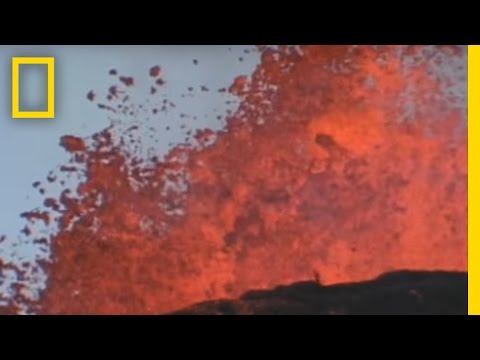
1984 eruption lasted three weeks it
started with a fissure that split across
Mauna LOA’s caldera
it’s crater then streamed fountains of
lava that
seated 2,000 degrees Fahrenheit fissures
broke at lower elevations and lava
flowed down the slopes from these vents
for days coming within four miles of the
outskirts of the island’s main city Hilo
Mauna LOA’s eruptions viewed 220 million
cubic meters of lava that covered more
than 18 square miles Mauna Loa is a
shield volcano made up and almost
entirely of a single lava type of basalt
it erupts time after time and gradually
builds up this huge shape because it’s
an island volcano it also has these two
rift zones that cut through the flanks
of the volcano like tabular bodies magma
can either come up through the summit or
come out along these rifts in the 20
years since its last eruption the
hazards have increased the usgs
estimates that 2.3 billion dollars has
been spent on new construction on Mauna
LOA’s slopes the main hazard at Mauna
LOA’s
is lava inundation there are some
communities living very close to
potential vent areas without a lot of
time to move away we’re working with the
county and state civil defense which are
the primary agencies responsible for
preparing communities and ensuring their
safety we provide some very regular
updates about the status of the volcano
and we also are working to provide them
probabilistic estimates of where the law
is going to flow once the vent area is
known as for now scientists can’t be
sure when the volcano will erupt mana
lower averages in eruption every 4 and
1/2 years so another one would seem to
be imminent phorid erupts we’re likely
to see new signals a large earthquake in
1975 and 1980 for the past two eruptions
were preceded by a magnitude 6
earthquake we haven’t seen that yet and
also seismicity where which is now at
depths of greater than 40 kilometers
will migrate to shallower depths up
higher in the edifice with in the upper
5 kilometers of the surface and then
will start becoming more aware that an
eruption may be coming
appears relatively quiet today however
looks can be deceiving it is actually
one of Earth’s most active volcanoes and
scientists now feel that the sleeping
giant is on its way to reawakening in
spring of 2002 the volcano began to
inflate began very slightly in 2004 we
began seeing deep earthquakes about 40
kilometers deep so these two signals
very subtle we think may be the
beginning of magma moving into the very
deep part of the volcano we’re not
certain and so we have to wait for
additional science to develop scientists
continue to observe Mon Aloha
closely and since its last eruption in
1984 that work has gotten easier we have
very new tools for measuring deformation
especially we used to use surveying
techniques about getting people out on
the ground shooting distances but with
lasers or using leveling rods now we use
continuous GPS sensors we’re using
satellite signals beam down to a sensor
you can very precisely measure the
change in position of a particular point
to know what the volcano is doing you
have to have a network of several of
them there are 50 GPS stations on Mauna
Loa and Kilauea Kilauea is the more
active volcano
that’s nestled up against Amon Aloha the
movement of these instruments help
scientists detect changes on the
volcano’s surface as the magma reservoir
expands the volcano is part of Hawaii
Volcanoes National Park and rises to
over 13 and a half thousand feet above
sea level
maaan Aloha which means long mountain is
so massive that it amounts to half the
Island of Hawaii it is flanked by
Kilauea which has erupted continuously
since 1983 since records began in 1843
maaan Aloha has erupted 33 times the
1984 eruption lasted three weeks it
started with a fissure that split across
Mauna LOA’s caldera
it’s crater then streamed fountains of
lava that
seated 2,000 degrees Fahrenheit fissures
broke at lower elevations and lava
flowed down the slopes from these vents
for days coming within four miles of the
outskirts of the island’s main city Hilo
Mauna LOA’s eruptions viewed 220 million
cubic meters of lava that covered more
than 18 square miles Mauna Loa is a
shield volcano made up and almost
entirely of a single lava type of basalt
it erupts time after time and gradually
builds up this huge shape because it’s
an island volcano it also has these two
rift zones that cut through the flanks
of the volcano like tabular bodies magma
can either come up through the summit or
come out along these rifts in the 20
years since its last eruption the
hazards have increased the usgs
estimates that 2.3 billion dollars has
been spent on new construction on Mauna
LOA’s slopes the main hazard at Mauna
LOA’s
is lava inundation there are some
communities living very close to
potential vent areas without a lot of
time to move away we’re working with the
county and state civil defense which are
the primary agencies responsible for
preparing communities and ensuring their
safety we provide some very regular
updates about the status of the volcano
and we also are working to provide them
probabilistic estimates of where the law
is going to flow once the vent area is
known as for now scientists can’t be
sure when the volcano will erupt mana
lower averages in eruption every 4 and
1/2 years so another one would seem to
be imminent phorid erupts we’re likely
to see new signals a large earthquake in
1975 and 1980 for the past two eruptions
were preceded by a magnitude 6
earthquake we haven’t seen that yet and
also seismicity where which is now at
depths of greater than 40 kilometers
will migrate to shallower depths up
higher in the edifice with in the upper
5 kilometers of the surface and then
will start becoming more aware that an
eruption may be coming
Please follow and like us: