
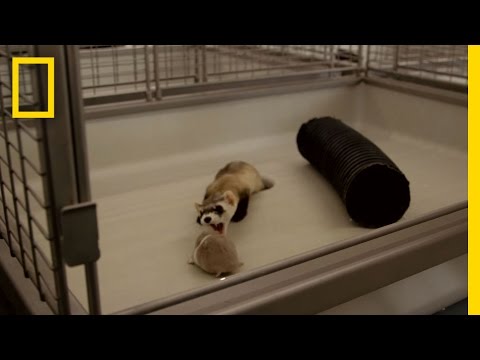
for a carnivore like black-footed
ferrets because we rely so heavily on
captive rearing and we’ve had the animal
in captivity for for so many generations
we do run the risk of inadvertently
domesticating the animal so pre
conditioning is a big part of that is
you know instilling those wild behaviors
when reintroduction started in 1991
ferrets released straight out of a cage
and research showed that the survival of
pre condition kits was 10 times higher
than kits that were released straight
out of a cage
there was a species that had been
initially listed on the endangered
species list declared extinct it’s
significance is that it’s part of an
ecosystem that is highly
underrepresented in the world out here
on the right planes we know that where
its habitat where it lives there’s other
species like prairie dogs and you know
the ferret is obligated to the prairie
dogs for a dog’s constituted anywhere
from 65 to 90 percent of their prey and
you really need to imprint them on that
prey species if you want them to succeed
we precondition animals for a 30-day
period ideally they’d kill for prairie
dogs during that time what a ferret
tries to do is get a prairie dog around
the neck and crush its windpipe and it’s
fixie ate the animal
many times the first prey dog that’s
introduced you know they are actually
quite intimidated by it and prey dog is
a pretty formidable piece of prey we’ve
had ferrets injured during the process
we’ve actually had ferrets killed by
prairie dogs in the preconditioning pens
and it’s it’s a tough thing you know for
a ferret to kill it’s almost like a
whirling dervish or something but you’ll
see a ferret just kind of roll around
with a prairie dog trying to get the
upper hand and get its jaws around its
neck and once it becomes incapacitated
they’ll drag it down a burrow you don’t
want to be hand feeding him I guess you
want some pursuit and there needs to be
a kill in the Burrow and you can hear
what’s going on right now which is good
I mean it’s gruesome but good from our
standpoint but ideally the animal will
go into the Burrow there will be a
pursuit in the Burrow and then ferret
then the ferret will kill it in the
Burrow itself we prefer to feed prairie
dogs to them beforehand just so they get
used to the taste of exactly what
they’re eating however prairie dogs
aren’t something that that are just
readily available so we supplement with
rat because it’s basically the closest
thing that we can get that that’s easily
purchased this is their natural state
killing an animal and eating the animal
that’s what they have to do in the wild
to survive when they’re finished with
the preconditioning process at 30 days
we trap them up bring them into a
holding facility and that’s their last
stop before they’re released at one of
our reintroduction sites it’s a bit of a
leap of faith for us because our animal
caretakers as you might imagine get
quite attached to these animals you know
they have a lot invested in them they
you know see them from the day they’re
born till the day they go out the door
we need to accept some losses and we
need to try to equip them as best we’re
able to survive out in the wild and for
ferrets at least that preconditioning
has been the key to that so for the
folks that work here it’s kind of a case
of letting go
and just hoping you see them again the
next year
Please follow and like us: