
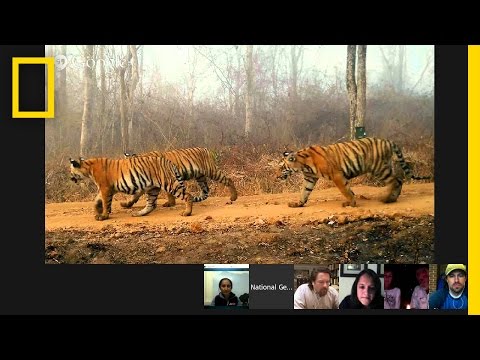
welcome to our Google+ hangout hello
everyone and welcome to our Google+
Hangout celebrating big cat week on nat
geo wild and the big cats initiative for
National Geographic we have with us
today several big cat experts on Luke
dollar I work with the big cats
initiative for National Geographic and
I’m a National Geographic Explorer and
joining us a day today are Boone Smith
expert big cat tracker and host of Nat
Geo Wild’s man vs lion Chrissy current
conservation biologist and big cats
initiative grantee Shivani Bala
conservation biologist and big cats
initiative grantee Boone’s joining us
from Wyoming Chrissy’s joining us from
India and shivani’s joining us from
Kenya also Derek and Beverly zubair
National Geographic explorers and
residents and co-founders of the big
cats initiative are in rural Botswana
attempting to join us via satellite so
we’ll hopefully be hearing from them as
well it’s big cat week at National
Geographic and today we’re talking about
the endangered felines with the people
that are raising awareness to conserve
them and are doing things to protect
them um big cat tracker Boone Smith then
can you say hello hello how are we we’re
doing very well Shivani can you hear as
well joining us via Skype hi can you
hear you excellent Derek and Beverly
zubair are still attempting to join us
from Botswana and krissy current you’re
there are you not yes I am right hi
Kathy and don’t forget everyone at home
we want to hear from you post your
questions on social media for a big cat
experts with hashtag big cats and we’ll
try our best to answer them first let’s
start with a little bit about what the
big cats initiative or the BCI is the
BCI is national Geographics program to
support conservation and protection from
big cat populations worldwide now these
are lions tigers cheetahs leopards Pumas
snow leopards etc and it’s also an
assessment protection and communication
program around
big cats with the goal of protecting
them and stopping their global
population decline it’s currently in its
fifth going on sixth year and the BCI
has provided 65 grants to field
conservationists in 24 countries around
the world a few metrics that may bring
this need to bear our that lions have
disappeared from ninety percent of their
original habitat ninety percent of the
world’s population of lions have
disappeared many of whom in the last
century there are fewer than 3000 tigers
left in the wild africa which is home to
a billion or more people is home to less
than 10,000 cheetahs Jaguars and
leopards for example are hunted for
their fur Derek and Beverly zubair
pushed National Geographic to found the
big cats initiative to not only report
about what’s going on with big cats
around the world but to also do things
to make a difference and everyone we
have here today are fine examples of
exactly what’s going on in the field all
around the world to protect big cats and
that’s what we’re celebrating this week
on big cats week at National Geographic
we do have a question first from one of
our viewers anneliese Fuchs from
Switzerland wants to know how did you
all become big cat conservationists you
guys have a variety of backgrounds and
so Shivani let’s start with you how did
you become a big cat conservationist i
Luke to me it was a childhood dream and
passion I saw my best cat when I was
eight years old and it happened to be in
Samburu I’ve never forgotten that I love
the big cats ever since i was a child i
pursued education in my life
constipation i moved up to samburu 12
years ago to start working with lions so
for me it’s been a dream of mine since I
was a child and I just persevered and
got where I am today well and Chrissy
how about you well I saw my first tiger
and leopard by the time I was too
because my father is a type of
biologists and I got to track tigers and
leopards when I was 8 years old so I
fell in love with big cats as a very
young child and much later on decided
that this
is what I wanted to do with my life as
well that’s fantastic in Boone how about
you how did you come to love big cats
and work to protect them and learn more
about them um my story’s not too
different from the rest I had a
grandfather and a father that had me
outside from the time I could walk and
it was tracks animals mountains hills
you name it they just were passionate
about it and so that love for the
outdoors inspired me to go into work as
a wildlife biologist and that’s evolved
into a wildlife consultant and a capture
expert in tractor now where I help a
variety of different organizations go
out and radio collar and track these
animals for research to to get some
really good data so we can make good
decisions when it comes to these animals
so we’ve got two multi-generational big
cat conservationists and shivani who
came to it as a first generation big cat
conservationist that’s fantastic burn
your a fourth-generation cat tracker I
have to say that the last time you and I
were actually together in one place it
was in South Africa when manvi lion was
being filmed and one of the things that
struck me almost immediately was you
hadn’t been in South Africa for more
than two days trying to work with all
the the game managers there and the
experts who live there year-round this
is their backyard and by the end of day
two you were spotting lion footprints
that they were missing they were asking
you about your thoughts afraid they
might be moving based on the lay of the
landscape and I’ve got to say that that
was that was really impressive what were
your what was going through your mind
when you first stepped onto the man BTW
reserved in South Africa oh you know any
time you’re gonna go a new place um
there’s there’s always something a
little bit of little magical about it
because it is it’s new and it’s
discovery and any adventure and I think
that’s part of that thing that I
probably draws all of us to is there is
some adventure and discovery there and
you know to be able to go there and you
know gain a lot of information really
quickly from the local guys and then be
able to apply some of the other things
learned along the way whether it be from
lions african lions or even mountain
lions or or leopards or things like that
it was fun it was exciting because got
to go out there and kind of put some of
the field skills to work and there’s
some generalities about cats which which
are great because they go across the
board but then there’s those unique
individuals and I think that’s what
attracts us to all of the big cats is
when we get there despite the fact that
we can say yeah cats I’ll do this this
and this we get another circumstances
and they’re so unique and individual and
that’s the fascination about it I think
that’s what draws us in and one sis you
know health want us to get out there and
discover more that’s fantastic Chrissy
what’s the closest you’ve ever been to a
tiger ten feet Mary ten feet yeah that’s
amazing now when you’re when you’re
moving around in India are you ever on
foot in tiger habitat um I walked line
transacts up to pattern elephant country
where yeah the chances of seeing them
are low but can you come across the one
foot yeah and shivani the work that’s
done by the owasso Lions project the
Warriors that are working with you there
on foot almost continuously are they not
absolutely we have 15 warriors working
with us they all work on foot they’re
out in the field every day from dawn to
dusk following tracks of lions keeping
track of livestock to make sure they
stay away from lions and trying to work
with the local communities educating
them talking to them about importance of
lions so they do this on search every
day that’s amazing I believe we may be
connected with Derek and Beverly zubair
from Botswana Derek and Beverly can you
hear us oh I see where they’re trying to
try to do it able to hear um Luke down I
can
there’s the voice of national
Geographics big cats initiative
co-founder and explorer-in-residence
derek zubair along with his wife Beverly
she-bear in Botswana Derek and Beverly
can you hear us yeah we just oh we may
have lost me yes I can hello everybody
hello Derek Botswana hi we can see you
there it’s at night we can hear the
crickets Derek and Beverly are joining
us via satellite so the signal strength
is quite low as you might imagine
Shivani can you tell us a little bit
more about what the lion warriors are
doing in Kenya um so do when we start
the program I worked with one warrior my
assistant generator and he was only
about 21 years of age when he started
working with me after a couple of years
he said you know the Warriors the young
men the young some room n they’re out in
the bush every day they’re the eyes and
ears what’s really going on in this area
and he said let’s bring on let’s bring
them on board let’s track name them that
educate them talk to them about
importance of lions and see if they can
be wildlife ambassadors in this region
so um general staffs this program we
started with five warriors now we have
15 they not only provide security for
people and their livestock but they’re
also providing security for all wildlife
now they reduce conflict they encourage
the communities to protect their
livestock better they educate them they
talk to them about importance appliance
and a real a real champions real heroes
when it comes to conservation just in
the last couple of days we’ve lost so
many let the cows to Lions 12 cows have
been killed by lions just in the last
couple of days and the Warriors are out
there making sure that no one retaliates
no one goes out and tries to kill the
Lions because we really need them we
need them in some room and the warrior
such a key role in that so they have
been very very busy in the last couple
of games in dealing with these issues
and shivani we’ve just got a question
for you via social media speaking of
losing livestock like that is this the
largest threat retaliatory killing for
loss of livestock to Lions in Africa and
what can be done to prevent that in
addition to the warrior speaking with
local communities I’m sure they’re there
too many reasons why why we’re losing
Lions so quickly one is habitat loss
lines are just running out of space and
secondly yes it is retaliatory killing
for the local san bern people livestock
on their libraries who aniline long and
kills their cow or their camel there’s a
lot of anger resentment about this and
often they will go out and kill those
science but now worth you know with the
Warriors going out and working with the
communities they talk to them about how
to better protect the livestock so if
for example the cows are being kept in
in livestock enclosures which are called
bomas they encourage them and talk to
them how to make better bomas make them
reinforce them so it’s much more
difficult but Lions to get in and
difficult furs I’ve stopped this tree
out at night so better husbandry
improved bomas these are really this is
really key to reduce the conflict from
happening in the first place if no live
soccer killed no lines will be killed
December people are amazing they do want
to live with wildlife but it’s when they
lose so much to lions and other
carnivores that’s when they want to go
out and kill them so keeping the
livestock better protected is really key
to their survival so Shivani you were
you were born in Kenya and Derek and
Beverly you are also native Africans can
you can you tell us Derek and Beverly
having spent your entire lives in Africa
and your entire lives dedicated to the
protection of big cats first by filming
them and learning more about them what
drove you what was what was the
inspiration to move
just appreciating big cats in the field
to what the big cats initiative is today
directing Beverly well Luke I don’t know
if you can hear us here better we’ll
give it a try we sitting out in the in
the dark here with lions behind us so
let’s see how this works I think what
originally drove us was was this
appreciation of these these animals out
in the wild these magnificent animals
that are really the iconic creatures of
Africa big melons in particular and then
seeing them disappear unlike in
shivani’s area where there’s no trophy
hunting we grew up in an area in
Botswana where there was trophy hunting
up until this year and we were seeing
these beautiful big male lions being
shot every few days and I think that
turned us into into advocates and
probably fueled our obsession and
fashion for us and through all the time
of Derek and I forming and that’s over a
30 year period you know we’ve had a
chance to actually get to understand
these creatures both leopards and lions
and that they all have individual
personalities there are individual
characters just like us and those in
when you’re you know that we had with a
leopard we just had to be in the
ambassador’s and so I forms of our
ambassadors he creatures in the forms
are ambassadors but we knew that we had
to take action and that’s really why the
big head initiative was founded with the
geograph quick thank yous and they’re
all your motion no we are million miles
away and I know that you bet need to
hear us but I really hope you can hear
us us in the dollars weekend Beverly I’m
noticing the Magnificent shirt that
you’re wearing and Derek I read an
article that you penned
appeared just yesterday about leopards
and leopard prints could you tell us a
little bit about the overlap of leopards
and leopard fashion and what the future
may hold that’s right luke them d
I think we may have lost Derek and
Beverly there but to describe this this
uh this post that Derek had dot and he
and spit not thinking there are article
that in the beginning are really worried
about the fact that people were using
faux leopard skins and it was becoming
so far down to about 50,000 now and when
Beverly and I were born that number was
700,000 so we have to pay attention to
each one of these big cats now but but
we are celebrating right now a leopard
in this area the female is called amber
you know because of her beautiful amber
eyes and her coloring and three weeks
ago she gave birth to an individual
little cub who is absolutely incredible
his visit we’re not sure of the sex
right now but this little thing has been
tucked up in a cage area africana tree
so we really are excited and we’re going
to you know follow um this little Cubs
life hopefully oh yeah I can’t wait to
see more about that um krithi what kind
of leopard protection and leopard
threats do you experience in India
Chrissy oh I think leopards are in
serious trouble in India because most
leopards don’t live in force like our
Tigers do so I think most levels are
found in sugarcane fields we found them
in no paddy fields and so there’s a lot
of conflict now with the leopards living
amidst people but there’s every time a
cow is killed there’s retaliation and
then these mob scenes take place where
the government or the police or the
first apartments really not able to deal
with these moms and their leopards the
Bing end up being horribly injured or
stoned or burned to death and this is
becoming pretty common if you read any
Indian newspaper today as always some
leopard incident being reported across
India it’s a fascinating thing that
leopards are one of the
most geographically widespread of the
big cats going from southern Africa all
the way to Southeast Asia but I’ve yet
to hear a report of anywhere that
leopards appear to be just doing just
fine and people cherish and protect them
universally in any individual area
Shivani how often are leopards the
culprits of livestock theft in some brew
I’m actually your featherbed most better
biggest culprit um leopards and hyenas
cause the most problems they’re the ones
who kill livestock often especially now
in the wet season we will have conflict
incidences with with records almost
every day so definitely leopards and
hyenas cause no problems and the Lions
do now Derek and Beverly I hope you can
still hear us would you agree with with
what we’re hearing here that leopards in
fact maybe the most persecuted of all
the big cats um look which one you say
is the most persecuted would you agree
that leopards may be the most persecuted
even though they may be the most
geographically widespread oh yes great i
think we’re definitely because
specifically because leopards are able
to go further and further and closer
into civilization so you find leopards
now 11 kilometers outside of
Johannesburg and of course they were
then running into all of the things that
that civilized man has mainly dogs and
cats and sheep and goats so very
difficult leopards are living right as I
or in India right up against the the
frontier so to speak of civilization and
so there’s quite a lot of conflict with
leopards refunding certainly much more
than with lions Thank You Derek um speak
the technology like the satellite
technology we’re using to continue to
try and stay connected with Derek and
Beverly in Botswana another piece of
technology that conservationists use our
camera traps and Chrissy you’ve been
using camera traps quite extensively in
in India have you not yeah the WCS India
program now has been camera trapping
Tigers for almost tigers and leopards
for almost 20 years so I think that
Finley is one of the longest-running
science programs focused on big cats in
the world and what we found is that it’s
it’s very easy to identify tigers and
leopards through their striped patterns
making it very cost effective cover very
very large areas where you know wait we
can make a color and track individuals
but really get very accurate estimates
of population sizes of both these cats
across the western ghats and other parts
of India no we have a question for you
Chrissy from dipping John Mitra who
posted on Facebook what is the future of
the Bengal tiger in india with the
forests vanishing so fast um the future
and i think has to be bright has to be
one that we fight for simply because
india has you know forty percent of the
world’s tigers and I think yes Tigers
are in serious trouble they’ve
disappeared from over ninety three
percent of where they were historically
in Asia they’ve disappeared from 70
almost seventy percent of India but
they’re still holding on and i have seen
places where Tigers have come back with
effective protection and monitoring of
trade tiger and it’s basically getting
boots from the ground and making sure
poachers don’t get to them and they have
enough prey to eat and we’ve seen tiger
populations that were completely
decimated 50 years ago recover in parts
of southern India so I am very very
hopeful because India has now the
resources the money and the technology
to save tigers now I think it’s a matter
of will and getting the best people you
know to focus on this rather than
getting get distracted by all the extra
stuff that’s going on I wish they would
do the same for lepers you know we have
600 crores devoted to protecting Tigers
me almost have nothing Shepherd so this
is the this is I’m glad you brought up
the leopard issue because it is a clear
you know every tiger every Tiger gets so
much more attention than leopard and
it’s not like we have a lot of leopards
left I mean we don’t even know how many
lepers we have in India’s is somewhere
between five and ten thousand left and
we lost theatre in nineteen sixty so big
cats are in pretty serious trouble and
lions we have less than four hundred
lines left in India you know but Tigers
get all the attention deservedly so but
we need to talk about all the big cats
right now great as a follow-up to that
Chrissy we have a question from Emily
Earhart from Nepal who has asked
although camera trapping helps to
monitor Tigers what additional steps are
being taken to stop poaching since
that’s one of the biggest threats to the
tiger population I think local efforts
including just include having enough
protection at every wildlife reserve
having boots on the ground having people
being out there in the field every day
monitoring the stuff I mean people have
talked about introducing drones but the
forest cover is so dense it’s really
hard pick up quoting from drones in a
context like India where as in Africa I
think it would work much better so it
still comes down to having people
driving around and walking around
keeping an eye on porches and then
wildlife trade as massive the pressure
from you know particularly China is
still rampant so all the tiger bones and
tins he’s done in the arm not really
domestically consumed this is for a
large commercial markets with that sound
less than three thousand Tigers left
there’s men’s pressure each skin has
huge value in the in global market now
Wow Boone can you tell us a little bit
about the technology that you use to
track Cougars um yeah I’ve been this is
the really cool thing about today’s day
and age is technology changes so fast I
think about 15 years ago when I started
and this was the this was the standard
piece of equipment a VHF radio collar
and emits a signal we have to run we
actually locate that every day but now
with GPS technology and the other
changes um where we just we put a collar
out saturday in fact and this is a color
that is going to get a location every
hour and when we start to think about
how you can piece together the movements
of an animal from where it beds to wear
a harness to the habitat use all of a
sudden we can take such a different
story of things and I look at the things
that we now learn no Cougars have been
really well studied throughout the
United States and we know a lot about
Cougars now we’ve not only got GPS
collars you’ve got incredible camera
technology um the things that I see now
on cameras and we put them upon kills
that the social behaviors and this is
the animal we’re supposed to know the
most about Krugers and I’m seeing things
I’ve never seen before I’ve never heard
of before I’ve never read about in
papers and so technologies made it a
really exciting time I think for for all
of science and research on it gives us a
great opportunity not only to learn more
about it but with the video on camera
technology we had a showcase if data is
becoming visual and I think that’s
exciting because it’s not just dots on a
map anymore we’re able to showcase the
show the social structures and the
intimate moments and I think that does a
great job they’re getting people excited
about the cause because now it’s not
just words on paper we’re seen in people
see that go wow that’s incredible how do
I get involved in so i think we’re at a
time better than ever before to make a
difference in the big gabbro shivani one
of the things that struck me was was how
text messaging is actually helping to
protect lions in kenya can you tell us
about how texting is actually a big cat
conservation tool I’m sure Luke so we
have a program called lion watch and
some of our guides um who are in talk in
the protected area every day every time
they see lions they text us and they
tell us what’s going on with the Lions
who they see they know all the names of
the Lions after they’ve received some
training from us and they all have apps
on their phones so they can actually
record this data and we can be online
and we can see what they’re seeing
so because so much of our efforts are
outside with the community getting this
information daily from these line watch
guides is fantastic we’ve got 20 guides
now all trained sending us text messages
every day and recording date on who they
see and where they see them so it’s
fantastic it’s got you know with we’ve
got this great network that’s really
working well and sunroof everyone
excited and enthusiastic about the lion
population that so we’ve heard about
camera traps we’ve heard about drones
we’ve heard about radio collars we’ve
heard about text messaging Derek and
Beverly you are visionaries in the big
cat conservation world the big cats
initiative exists because of your vision
and thousands of big cats worldwide are
protected because of the implementation
of your visions if you had to reflect
and project on technology in the future
for big cat conservation what would you
like to see oh it’s a good question look
it’s a broad strokes I think that what
we would like to see is a generation of
of kids coming up that start talking
more about how we can co-exist and live
in harmony with big cats I think that
good boundaries will help that but
really and truly it’s the kids that are
going to help us must we at the moment
we’re in the in the bush on here we’ve
got one of our camps that we’ve closed
down and we’ve got a whole lot of kids
in these are the kids that come from a
demographic where their parents are most
likely purchase and we’re running this
Conservation Camp at the moment talking
to these kids and it just is astounding
are when you see them they arrive on the
first day and they get exposed to be
cats be with them with lions this
morning actually and they terrify and
and they hate the bull but Janet’s and
it’s that thing that’s against them but
after three or four days they’re full of
smile
I’ll Sunday that move on more we should
be reaching out to the children and the
children will have that amazing ability
to influence their period and so we’re
going to be spending more and more about
I’m dealing with kids in particular kids
street kids or three or kids in Botswana
narrow or in Africa in general that that
are of the lowest income groups and
probably born in to poaching families
and I think right now we rarely do our
optimism continues purely because we see
we started to see and hear that many of
the other African countries might follow
suit but if then oh not gonna follow
suit then all listening to the condo
cock is karma and so that also gives us
hope it’s really from from the bottom up
which is what we’re doing now with but
still working they’re very closely with
a political leaders of them who
obviously can make sweeping thur 12 and
all the Warriors out there everybody
from India to Kenya and in Botswana and
every single country that we actually
can’t be complacent we do have to
continue the work because whenever use
with I mean whenever any of us you know
sort of hesitate come on I ain’t to open
up hunting vision and more or POTUS or
the AI just wants that we feel we have
to be a lot more aggressive in is
getting that awareness campaign in Asia
so that the children in Asia can make
the conscious decision to change those
ancient cultural beliefs in utilizing
you know all animal products from shafin
to line burns to tiger burns that is
really what we have to
eradicate right now Thank You Derek and
Beverly I have a follow-up question from
you that’s come from Ali case who’s with
us on google+ right now your careers
take a lot of dedication which is much
appreciated what keeps you inspired
because this is a challenge is a
constant lifelong challenge what keeps
you inspired I believe the board has
kept us inspired is truly been able to
have the connection with these
incredible creatures and some you know
it’s it’s it’s the energy of what we
seeing and also not actually knowing
everything out a film that we bring out
with managed to bring something new and
exciting term to the world so I think
that really is what is inspiring us more
than anything else and certainly yeah I
mean
hopeless
and we have faith we have faith in
humanity to do the right thing at this
point faith is a strong factor that’s
for sure Boone how do you stay inspired
um I think Derek and Beverly nailed it i
think the idea of discovering excitement
and something new and need what the
individuals bring to the game and and
it’s you know after is i mean everyone
here has a lot of years of experience
and to know that you can go out tomorrow
and see something that you’ve never seen
before you have a witness that’s
exciting I mean that that’s the whole
part of the adventure and discovery and
and then you have an animal that job is
so dynamic in a species as far as big
cats and they’re so dynamic and they
bring us so I mean we gained so much
from watching them do their thing
they’re majestic their incredible their
inspiring and I think it’s an easy thing
I don’t think it’s hard to be inspired
when you deal with big gaps I think as
soon as you put yourself out there be
involved it just naturally happens and
Chrissy what sort of challenges and
renewals do you experience in India it’s
so hard to see tigers and leopards I I
mean every time I bought that just just
the opportunity to even hopefully get a
glimpse of one of these cats is enough I
I mean that that’s good enough for me
and you know three years ago I took my
four-year-old and I saw her see her
first leopard and she stood up jumping
around saying I saw my first leopard and
to me that moment keeps coming back over
it over and over again my dad my
daughter and I seeing this one female
leopard for about 20 minutes and there
are many many moments like that keep
going Boone have you have your children
been with you on cougar captures they
have um and that’s design is exciting to
pass that on to the next generation from
just the tracking to to being able to be
out of seeing animals and gain an
appreciation and understanding for what
they’re doing and I think I love what
Derek and barely talked about about the
kids in the next generation I think that
is so cute and so
important that we need to you know we’re
all going to play our game and it’s
going to be done at some point if
someone’s got a new place 1,500 one of
us to carry the torching and to have
young people go and be inspired I’ve
been so fortunate to have the
opportunity to be part of that national
Geographics sister school program they
we got a couple schools in this case the
schools in Africa and I’m go to the
stateside and meet these kids and see
just the chaotic excitement of how
contagious it is to get involved with
big cats it causes the awareness and
these kids go nuts for it and it it’s so
cool to see because it’s when you see
from first grade you know senior in high
school and spired and wanting to make a
difference that’s a pretty good thing
and shivani we were we were speaking
just before we went live would this hang
out and you were telling us about what
you were doing yesterday which was
remarkably similar to the kinds of
things that Derek and Beverly are doing
several thousand kilometers to yourself
so Shivani can you tell us what you were
up to yesterday and how that helps keep
you inspired Luke this week has been
incredible we’ve held our lion kids camp
and this is about inspiring children to
become the next conservationists
yesterday and today I got to show
children their first-ever lion their
smiles their faces the excitement that
they had when they saw their first lion
that’s what keeps me going that’s what
inspires me because I know these
children are the next conservationists
there the next wardens tour guides and
leaders in the in this area just seeing
their faces really is what keeps me
going and and secondly my team my
incredible team in Samburu seeing how
they risk their lives to save lines just
seeing how they’ve grown in the last few
years they’re absolutely amazing and
every day they inspire me to keep going
on so I’m very lucky to have a great
team I’m so fortunate to be able to take
out kids should show them their first
ever lion that’s why I do what I do it’s
because of who I’m with that’s fantastic
Shivani thank you for spending time to
join us from Kenya today kirthi thank
you for spending time to join us
India today Boone thank you for spending
time to join us from Wyoming in the USA
today Derick and Beverly as we bring
this hangout to a close are there any
final messages or parting thoughts that
you would like everyone to take with
them as we as we finish up big cats week
later this weekend hmm well you know
look you were saying earlier go on what
keeps us in bed and I have to say that
the people on this call keep us inspired
as well so it’s really you know just so
fantastic that that everybody takes the
time to do these calls and get involved
in the big cats initiative and weakest
is one of those moments in the year
where you can put everything together
and create some sort of event around
McKesson and have people start the
conversation again basically what we do
is we create films let’s start
conversations and we hope that people
pick up that conversation once the film
is finished so we’re very encouraged and
of course want to thank everybody for
supporting the big cats initiative
clearly something that that’s very close
to our hearts and and knowing that some
everybody is going to be watching game
of lions we’ve really just had a very
emotional scene unfold in front of us a
couple of weeks ago and it’s it really
it depicts what lines have to go through
out in the world we you know we think
that it’s all easy easy for that and it
truly am but it took us 30 hours to film
the scene and at the end I had tears
rolling down my cheeks but at least this
time it was tears of joy well when I saw
it when I mentioned just a second ago
that we were going to talk about final
thoughts we were absolutely buried with
questions on social media that all came
in almost at the same time and
and so one of the questions that came in
however came from someone on this
hangout one of the the folks that’s with
us Boone actually asked Shivani Boone
wants to know can he come to your camp
please come and visit us you will love
it the Warriors will love having you it
will be an amazing experience so please
welcome anytime where is incredible
Kenya’s incredible I encourage all of
you to come and see us and see what
we’re doing that’s great um many of the
questions that just came in are from
people asking about what they can do to
get involved but also i’m curious to
know if you guys have any additional
questions for each other so let’s let’s
let’s go through the line up really
quickly about what you think people can
do to get involved and if you have any
questions for one another then um I know
I first of all I just want to say I
think this is such a great thing to be
able to participate this with everybody
because everyone does such unique and
amazing things um you know everyone’s
kind of involved in it in a different
arena to support good cats in there
cause um so maybe I’ll just throw it out
is that a generic question to everybody
because everyone kind of note what’s
going on in their old home arena there
what’s next what is the next thing that
has to happen in your in each individual
area where you’re working to be able for
big cast to take that next step and make
a move in the positive direction Chrissy
what would you say is next for you um I
think we need to come up with
conservation solutions that work and I
see technology playing a big part in
that like Shivani we’re field testing of
Amalur people can call and call into an
800 number four villages in India
reporting conflict and then we have
field teams going to help people file
for compensation and although it’s in
very very early stages we’re getting
overwhelming responses from villagers
who don’t have electricity we don’t have
schools who don’t have health
okay but they have a cell phone and they
can call in and tell us what happened
and I do I think you know sir not urban
Indians take pictures of tigers and get
on social media and say save tigers but
really the people we need to be working
with are the people living next to
tigers and leopards and lions and I
think the solutions have to focus on on
people living with these big cats
Shivani what are your thoughts um
absolutely as crazy says that you know
the future for wildlife is in the hands
of the local people who live with them
we’ve worked out methods and ways of how
people and lions can coexist in in a
small part of some guru and now for us
what’s really important is to take it to
new areas in northern Kenya work with
the people where Lions are being killed
and really just you know use what what’s
worked in our area expanded to new areas
and encourage people to live with lions
we know it’s worked our population is
stable now people have accepted the
presence of lions it’s up to us to take
that to areas where it’s more difficult
and people have not accepted lions so
that’s the next step for us is engage
more warriors and conservation engage
the cemburu community work with more
children work with women we started
working with women this year and if is
absolutely incredible so for us it’s
it’s really important to continue doing
that and that’ll that’ll be the next
steps for us Derek and Beverly what is
the big cat got that what is the big
cats initiative going to look like
moving forward
well you know I think Luke I think that
the the two big problems with big cats
and and their future heir so we have to
fight both of the at-bats and so I think
the big cats initiative is going to be
tackling both of these in the future
certainly I would like people we in
reply to what people can do obviously we
need the funding but I think people have
to ally in forward hats and big care
that would certainly if we help fight
the ignorance that floating around us
all the time obviously dig our heels in
when it comes to greed I don’t think
that there should be a place for trophy
hunting of big cats today in Africa and
everybody’s got a voice and everybody
should should speak out about that but
the other thing is that I think pull
around the world should reach out to
people inside of Africa and just share
the appreciation for big cats very often
people in Africa who lives with lions on
their doorstep don’t appreciate them and
can be held up to appreciate them more
if people around the world children
around the world reached chart and just
let people in Africa and then I believe
we really do have to lobby harder you
know we’ve all been trying to get lines
on site ease to appendix 1 and of course
it’s all hasn’t happened and I did and
that is you know one thing we have to do
we’ve just got to keep the lobbying
going but we also have to be to try and
stop any animal product going into any
country so I mean you can still take you
know safari trophies should be stopped
as well as many of the European
countries and you know if we could do
that loving I believe we’d be able to
stop a huge amount of the killing that
is happening in Africa and then of
course we’ve got a look at some Asia
again Derek and I are we will be working
very hard in
in trying to get some foot in the door
to be able to speak about these problems
and we believe that we have just to
Beijing in a pro to be able to start the
discussion so and I think that’s what it
is Lucas and I think the big cats
initiative for us is going to change
gears and move to a level where we take
on real issues bigger issues and and get
more involved in advocacy and
conservation real odd conservation Derek
and Beverly thank you for that boom
Shivani Chrissy Derek and Beverly again
it’s an honor to share time and hear
from all of you we’re about out of time
everyone at home I’d like to thank you
for joining us and don’t forget you can
continue the conversation with hashtag
big cats and don’t miss the rest of big
cat week on National Geographic wild I’m
Luke dollar thank you very much everyone
for joining us and good bye
Please follow and like us: