
battle brazen 125g visibility hello and
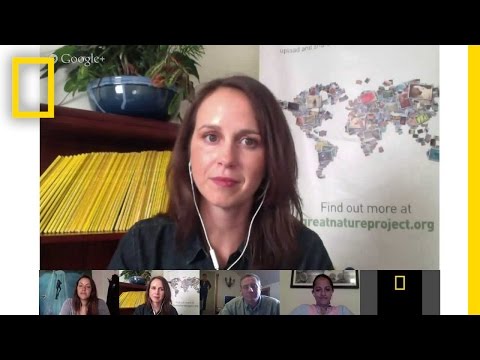
welcome to our live National Geographic
google+ hangout my name is Katherine I
work at National Geographic and today we
are celebrating national Geographics
great nature project and the Earth’s
biodiversity with four incredible
explorers so joining me today is
photographer and National Geographic
Explorer Joel sartori joel has produced
more than 30 stories as a freelance
photographer for the magazine and also
created photo art which documents the
planets vanishing biodiversity we’re
going to hear more about photo arc and
Joel’s work in our conversation we also
have joining us from India or it is
certainly bedtime National Geographic
Explorer pretty current pretty works on
human wildlife conflict particularly
with some of the iconic species that we
find in India like tigers so Christi
welcome thank you for staying up tonight
we also have joining us from Ecuador so
this is truly a global hangout
conservation biologist and National
Geographic Explorer aundrea Marshall
aundrea is down there because she leads
conservation efforts for manta rays and
therefore has earned the name of the
Manta Queen so joining us from Ecuador
thank you and hello Andrea and joining
us in a little bit here we’re going to
get a call from the wildlife naturalist
and host of nat geo wild America the
wild Casey Anderson Casey is up in
Alaska right now up on the Beaufort Sea
and we’re having a little trouble with
our satellite connection so we’ll expect
to hear from kc soon Casey are you there
can you hear us Casey okay
we’ll wait to hear from Casey and just
in just a minute you can see in there in
the thumbnail with the grizzly bear
Brutus who he’ll tell us more about in a
bit and we want to hear from you as well
so please join us by posting and
tweeting your questions on facebook on
Twitter on Google+ using the hashtag
let’s explore so let’s delve into it
explorers and if we could just start out
let’s move the conversation into your
motivations I know people are joining
the hangout and one drain how did you
become passionate about doing what you
do studying this species in the
biodiversity that you focus on so let’s
start there aundrea can you tell us a
little bit about what motivated you to
work with giant manta rays I’ve been in
love with the ocean since I was a little
girl there’s nothing that I ever wanted
to do then be a marine biologist and I
was very influenced by people like
Sylvia Earle who traveled the world you
know exploring the oceans really before
anyone else did and I knew that that’s
what I want to do is passionate about
the ocean environment and therefore you
can’t help but want to actually protect
it and I gravitated toward sharks when I
was younger I found them fascinating a
fascinating group moved over into manta
rays and did a PhD and whatnot and the
more I started working with these iconic
marine animals ones that need protection
that are threatened species the more I
realized that I really needed to as a
researcher to bring more to the table in
with regards to to research to help
protect these animals that often times
are very elusive and no one really knows
much about them so the more science that
we can do the better that we can manage
them and protect them in our oceans
right and we’re going to hear about in a
little bit these are incredible
creatures 3,000 pound manta rays can you
tell some of the weird bizarre
interesting facts about the raise that
you study there’s so much bigger than
people i think realize you know i’m
swimming around with them and ecuador at
the moment and even even you know though
that I spend every single day with them
I’m gobsmacked oftentimes I was swimming
underneath one blowing bubbles on it
just the other day I was almost giving
it like a spa bath and and it Dwarfs you
I mean there there’s six seven meters
across
and these huge diamond shades animals
that just are so gentle and it’s it’s
hard for me to imagine walking up to an
animal on land that’s completely wild
and that size and not having fear but
you never ever experience fear in the
water with these animals just because
that you can see that they’re so gentle
and it’s it’s just it’s awe-inspiring
and it’s a really really neat animal to
be working on they’re very intelligent
so all of the fish they have the very
largest brain to body ratio so they have
the largest brain of any fish they’re
very intelligent animals very
inquisitive and they’re very much like
humans I think that’s what a lot of
people when they start to understand
more about them they feel a connection
these are animals that are slow to
mature they only have one baby at a time
like like us they don’t even have babies
every year so you know this is an animal
that that lives in similar ways to
humans in many cases and because of that
they are facing extreme pressure
worldwide because they don’t have enough
offspring to be able to survive some of
the pressure that that we humans place
on them so the more you learn about them
the more you realize that this isn’t a
really incredible animal that deserves
to be protected excellent yeah and
speaking of iconic large megafauna kriti
you focus on human-wildlife conflict
particularly in a rail protected areas
and the Western Ghats what what drew you
to this and what drew do you
particularly to your focus on can we say
on Tigers and tiger conservation living
in close proximity to humans well I had
a pretty unusual childhood I grew up
from the age of 1 i’ve been running
around in a lot of parks with my dad
watching tigers and elephants and a lot
of iconic species but i think it was and
I mean when I was 8 years old got to
watch my dad father and track Tigers but
i think the real sort of this is what i
want to do with my life moment came when
i was 22 years old and doing field work
in the gods for my own research which
was looking at impact that people were
having on the gods and i realized that
you have this incredible Lansky
that’s home to 20 million people yet has
mmm for twenty percent of the world’s
tigers and a whole lot of other
interesting creatures of one of the
research projects we have looking at you
know frogs and birds right now in
landscapes around the parks actually
emerge we’re rediscovering frog species
that people haven’t seen in 75 years
which is covering new frog species that
people haven’t you know I’m just going
for the first time so I think you know
people think of the big iconic tigers
and elephants but I think there’s a lot
of amazing vitalist still left in a huge
parts of the world waiting to be
discovered good point i mean the western
ghats are one of the world’s
biodiversity hotspots right meaning
incredible CPCs area and also facing
threats so good to remember there’s a
lot left to explore and discover Joel
what about you how did you get your
start or the focus on photo art and why
is this project of particular importance
at this time and in particular sure I’ve
been a contributing photographer for
National Geographic for about four more
than 20 years now and I’ve done about 35
stories I think and I I just see the
world filling up with people or past
seven billion now our way to eight or
nine or ten billion people and the
projections are that if we don’t start
being better stewards the earth we’re
going to lose half of all species by
2100 and the best plan i’ve heard it for
anybody they say well we’ll be dead by
then well that’s not a real plan that’s
not good so so I just figured well I
think that a lot of the stuffs in
trouble all these species are in trouble
because nobody’s ever heard of them they
don’t know they exist we focus a lot on
sporting events on the price at the pump
on what’s on television but we don’t
really think about the natural world so
the photo arc is basically a huge I
don’t know if it’s an online dating
service exactly but it’s certainly an
arch and it’s it’s a way of getting
people engaged and the first step
towards caring is to know something
exists and maybe it’s in trouble and so
we’ve come up with a website called
photo are calm arc spelled with a k
photo art calm and we hope people will
come there and fall in love with some of
these species there’s everything from
the smallest insects to elephants I mean
anything we can we can get the goal is
to get all the species in captivity not
that I having great fondness for
captivity but it is a way of getting a
lot of species quickly and we’ve done
about 3,000 species in the past eight
years on our way to hopefully ten or
twelve thousand I should also say this
about zoos and captive situations that
for many species now they only exist in
sue’s in fact great deal the species
that I’ve photographed over the years
the very rare ones would be extinct by
now if it weren’t for Captain captive
breeding efforts so when people say what
can I do they can support their local
zoo zoos truly are the ark now going
forward they’re going to be more and
more important in terms of preserving
species with good genetic diversity
until we get smart enough to manage the
earth well so these animals can go back
into the wild right and Joel I should
also note that you are the spokesperson
for the great Nature project the theme
of today’s hangout among us and we’re
going to get back to that in just a
second we have Casey Anderson is on the
line Casey can you hear me I can hear
you hear me yes we can welcome so you’re
at the tip top of Alaska and if you
could tell us a little bit about what
you’re doing up there and also in this
picture here we’re seeing you with a
rather large grizzly bear we know his
name is Brutus can you tell us a bit
about your relationship to Brutus and to
the American West and the M American
West wildlife as well absolutely yeah
I’m actually I wish I was in that photo
right now because I’m standing in the
middle of a blizzard it’s too early to
having a blizzard but I’m up here
hanging out with the polar bears there’s
been a whale carcass harvested harvested
by the in Libya people here and a
Beaufort Sea and for 4,500 years his
villages harvested several bowhead
whales usually three a year at the void
lemon of years
during the hungriest I’m the borders of
come and basically picked up the scraps
but something is happening here we’re
seeing with the changing climate that
the grizzly bears are moving north and
also taken advantage of this vlog food
source now we’ve seen us a of an overlap
of two species that haven’t haven’t done
that a long time and we’re seeing them
interact and even a little hybridization
happening so there’s a changing changing
tides up here and of course there’s a
pretty near and dear to my heart
obviously rescuing Fergus 11 years ago
I’ve kind of unique perspective you know
the funny thing is I echo everything
that everybody said so far you know we
do this because we love the wild and you
know before anything every are you see
me sitting there the captive bear but
the truest part of my heart is basically
the other thing needs to be wild and
free we need to have those wild places
what these animals can live like Joel
said it’s like there is an awareness
that isn’t a gift that Buddhist has
given me that I could never get here and
then with the bears in the wild it’s a
gift that glimpse from the soul and the
emotion and the intelligence of an
animal that fortunately for me having to
raise this little orphan bear you give
me the CD perspective maybe I care maybe
it made me give more value in depth to
everything that lives you know just by
having that kind of invisible gift that
Bruce gave me so it’s it makes me fight
harder than ever when I look out at
these wild bears I mean I know that they
could feel it can think they can do the
things that Bruce does I mean it’s
really hard to to uh translate that
without experience I’ve experienced that
so my goal now is to make TV shows to
show people that there is this other
deaths of these animals there’s they are
valuable I mean most people do not know
about most wildlife and if they do big
things like manta rays and grizzly bears
spirit
I protect something that you’re afraid
of and so if i am going to cure the fear
and change it into respect yeah that’s
fantastic demystify a species that the
public might be afraid of I think one of
the real virtues of the great Nature
project is that we can only care about
what we know right and the great Nature
project encourages us to get outside to
explore the incredible biodiversity in
our backyard whether that backyard is
Ecuador Nebraska the Western Ghats are
very far north in Alaska so Joel as as
spokesperson for the great Nature
project can you tell us what is this
project and and what are people supposed
to be doing to contribute to this
project right now absolutely you know um
I think this is a great idea actually
it’s just encouraging people to get up
off the couch get out into the daylight
and see that there’s nature all around
us no matter where you live you don’t
need to be a professional photographer
you could use it you could use a
smartphone to just get out in the
backyard you can photograph insects on
flowers if you like or praying mantis or
spiders or anything we’re trying to
create the world’s largest online photo
album of animals in a one-week period so
that the deadline is sunday night and
we’ve already got about 30,000 pictures
of animals online at great nature
project org that’s where you can go to
to download pictures and it’s very
simple and let’s say let’s say you don’t
have a backyard to go to well then you
go to a go to a city park someplace
where there’s still a semblance of
nature if you stop and look you’ll see
good things to photograph and you could
always go to a local zoo or aquarium
those are really visually loaded places
you can think about it all the animals
are lined up for you to actually view so
no excuse not to participate the prices
sure right it’s free and we might set a
Guinness record we need a hundred
thousand pictures again by Sunday night
and that’s hashtag great nature on the
side right that’s right or hashtag
animal or go to great nature project org
excellent and I think we’re going to cue
up a video here about the great Nature
project
maybe maybe not bargain cross nature all
you have to do is go outside National
Geographic invites you to celebrate
nature join the briefing little snap a
photo of a plant or animal in your womb
upload it to your favorite photo sharing
sites using the hashtag great nature see
it snap it uploaded join national
Geographics great nature project today
and you know there’s some there’s some
really well seen pictures already up
there and very surprising i love the
fact that that people see so differently
it’s really interesting to me and it
gives me a lot of ideas to on how to
shoot things that I see every day that
never it never would have occurred to me
so it’s very fun and it’s interesting
and it only gets people just engaged in
the world around us and and realize you
know it’s it’s it’s there’s not a whole
lot of time to lose in terms of getting
us to care about nature especially for
species that are rare so hopefully this
stirs public interest and will get a
hundred thousand pictures at least by
Sunday night yes and you just step
further yeah aundrea please I just think
it’s a great thing for families to do
together as well you know I’ve been
trying to encourage it in this tiny
little fishing village in Ecuador but I
I’d like families all over the world to
say to their kids hey let’s go do
something you know and and to be a part
of something bigger you know to be able
to take your kids outside you know get
them outside give them walking around
get them you know looking at animals and
taking photos and then doing something
with it you know it’s nice to actually
see it being being used for something
and who wouldn’t want to be involved in
a project that could potentially break a
Guinness Book World Record so um I think
it’d just be a great thing for families
around the world to get together go do
something healthy and fun outside
absolutely and you know just to further
the point that we have nature all around
us we did a walk in downtown DC last
week and snapped tons of pictures of the
insects the plants squirrels Birds
there’s certainly more nature around us
even if or not in pristine area or in
remote corner of the world so it’s
certainly worth getting outside of
participating in the great Nature
project and what might seem ordinary to
you is extraordinary to someone else you
know even the comments twirl to you know
to into someone in Northern America is a
really rare species in other parts of
the world to someone else so don’t
forget that just because you know this
animal may look coming to you and if
it’s in your back yard that it’s still
an important animal it should be
celebrated and someone else on the other
side of the world might find an
incredibly interesting good point and
their people also realize that there’s
your new species so many things yet to
be discovered i think people there’s
particular taxonomic groups where we do
we haven’t even tapped the diversity of
life and i think it’s really really
important that people go explore places
where even 20 million people live the
fact that you can find your 20 new frog
species this year is pretty remarkable
and not just new species to i mean that
you make a valuable point but also range
extensions and i want to explain that
because it’s a scientist that’s
important to someone like me but you
know an animal that may be well known to
occur in one area and no one’s ever seen
it in the area that you’re in and by you
taking that photo and uploading it
online and sharing that that animal
lives in that location to a scientist
that’s incredibly important information
so there’s so many different ways that
your photos can contribute and it’s just
so easy to do and fun really yeah good
point I’m going to bring out a question
now from the internet we have one Casey
Anderson for you up there in Alaska our
question comes from Colby Miguel riff
from the United States who asked on the
Explorers journal blog that he’s a
zoology students studying grizzly bears
in captivity and he’s wondering about
your opinion on the prospect of using a
version learning techniques to keep
bears out of dumpsters
yeah you know the key to a man’s heart
is food and unfortunately going out in
the wild and twenty twenty thousand
calories of berries cups and moms it’s
not easy so somebody made some garbage
hours of cheese but I dumpster to know
Blaine if a fairy’s going to go there
and that’s an easy easy meal I’m gone
there yet it situated to that that’s it
becomes a bit of a habit now TV in it so
they’re being conditioned obviously papa
you know positively and there’s so many
ways you can do the advert adverse
conditioning and the one that’s been
working a lot is just basically they
approve containers proof dumpsters that
bears can get into and once they can’t
get into and don’t get that reward they
stopped going there and start going back
to the natural food sources then you
take you to the next level and one that
works well is electric fences electric
pitchers work really great grizzly bears
brown bears black bears polar bears they
all not like horse corrals here they go
in there very sensitive to get a little
SAP I run away and they don’t ever want
to do that again and you open the Ives
or tourists all kinds of things you know
a part of being well be by the world we
assume itself you know the tools to
coexist and should not just be lazy and
not do anything we can do little things
that can make a big difference and
that’s right there you know that’s
important for them to go back out to the
wild it just do what they can keep the
natural food kriti can you speak to the
spirit of that question a little bit in
areas in your part of the world the
Western Ghats where humans and Wildlife
overlap what are some of the techniques
or methods that you and your team have
employed or our local people are
employing maybe to mitigate some of the
human wildlife complex so we just
finished a two thousand whole household
so in the gods and unfortunately people
are trying you know trenches and ditches
and solar fences
even planting rows of particular crops
but what this study showed was most of
these mitigation measures were really
ineffective and so we were coming out
and saying you know in conservation we
spend some so much money investing in
mitigation measures without really
evaluating stuff so one of the things
we’re coming out very strongly saying is
that you really need to spend a little
more time evaluating things this up
before you know broadly prescribing that
every every farmer go out and fence
their land because in the case of
elephants the fencing doesn’t really
work you know and so there’s I mean
there’s actually like there’s a lot of
conservation money’s going towards this
kind of mitigation without really
thought into whether it should be done
in the first place or not so evaluating
it methods are working before we
prescribe it for you know 200 300 400
thousand people to use yeah I think
people need to step back a little bit
before before doing that yeah Andre what
about the species that you that you
study how do Manas interact with humans
are there any problems in human mant
interactions in the wild it’s
interesting you’re asking me this
question where I’m sitting right now
which is an Ecuadorian Ecuador has
probably been the most involved country
in the entire world and with regards to
Monterey conservation they found this we
found this really huge population of
manta rays dr. the coastline pretty much
the world’s largest known population of
the giant manta Ecuador was quick to
protect them Ecuador’s quick to propose
them on both the convention for
migratory species act and also site ease
earlier this year on both of them
passing successfully helping to protect
mantas internationally and yet in their
own country now despite being protected
we’re seeing so many mantas being
entangled cut up with hooks in them and
swimming around with just giant Nets all
over them and so even in a place where
they’ve theory they definitely aimed to
protect this particular animal we’re
still seeing them coming into conflict
with with humans as they’re trying to
fish the oceans and Ecuador is really
concerned about this now trying to
figure out how they can mitigate those
issues as you are just talking about now
at these other terrestrial animals and
it’s difficult because human
and animals do come in contact and how
do you protect the interest of humans
and also you know maintaining these wild
places where these animals can have
these critical habitats and feel safe in
them and these are really gentle animals
so I especially with regards to bears
and tigers where people feel fear
there’s nothing to fear as regards to
mantis at all and so the fishermen
themselves say hey you don’t want to
catch these animals and they’re they’re
asking scientists what can we do what
tackle can we not use you know can be
fishing in certain areas and not others
to try and protect these animals which
they also feel you know they love these
animals they don’t want to hurt them but
it’s sometimes difficult to understand
how to protect underwater animals if
you’re not actually seeing what the
problems are so it’s you know it’s an
ongoing process but I think what’s
important is as we’re talking about this
great nature project is if people love
animals if you can get people connected
to animals in nature they want to work
through these problems they want to come
up with solutions but the real question
is how to get people to love these
animals and I think a lot of these
projects that arc project or this
particular great nature project are
great ways of getting people connected
to nature well I think this new leads in
nicely with another question we have
coming in from social media this is from
inbal gamble who wrote in from israel on
facebook and said and I’ll just love
this up generally to each of you how do
you have advice to someone who wants to
get involved in the field is it
difficult to find a research subject so
what would you say to a young Explorer
somebody who’s looking to have an impact
on the planet to get involved in
biodiversity conservation how does one
go about getting into the field I mean I
don’t want to I want to talk too much
but I am still very young and I feel
like I just went through this period of
my life myself I don’t know if you guys
were tuning in before when I was talking
about how I fell into this field but I
was always interested in sharks and as I
moved to Africa I saw an opportunity to
study manta rays it’s not as species
that I specifically wanted to study when
I was younger but I saw this great
opportunity to study an animal that had
not been studied before and for people
who think that it’s hard to find an
animal that no one’s
work on before it’s not there are so
many species that as you that’s pretty
pointed out earlier are just being
discovered there’s a lot of things still
left to do you just have to find a niche
and even if the animals can work it on
before find a new perspective of how to
look at that animal or look at that
animal’s habitat or problems related to
that animal I have a lot of students now
doing work on mantis all over the world
we found a new species of map can you
imagine finding a new species of manta
just a couple of years ago in a day and
age where we think we’ve discovered
everything on the planet there’s a lot
left to discover so there’s a lot left
to study still you shouldn’t feel any
fear as a student to be able to just
keep pursuing on your studies keep
pursuing your passion and something will
fall in line you’ll see an opportunity
and grab that opportunity and run with
it great think Casey you wanted to jump
in on this one as well yeah they like to
say dust the books off and get your
boots muddy you mean get one you know
read study and then get out there and
apply it you know I can’t I can’t say it
enough you know kids are always back
beyond abuse are gonna be the next guy
let’s just get out there find you know
find the person whose job you think is
the best job in the world go up to up
say hey okay for free get out their
experience see it you know explore I
mean never be afraid and you know it’s
you get it worst out there the passion
just gets fueled you make that
connection and you got that dream job I
already sell people that you know it’s
uh you literally have one life so what
is it that you want to do don’t worry
about what you’re supposed to do or what
other people are telling you should do
what is it you want to do and then and
then literally go do it I’m just guy
from Nebraska I mean I’m no smarter than
anybody else believe me lot less smart
than a lot of people but what I what I
do have in common with the other
Geographic photographers I know is we’re
all very type A we’re very
self-motivated if your self motivated
there’s no excuse for you not to do
exactly what you want to with your life
truly I mean there are no excuses really
if you’re motivated if you’re
type a type of person you can do
whatever you want pretty much so I’d say
just echo what everybody else is saying
and just go out and do it and find
somebody who is in the case of
photography find somebody who’s doing
the kind of work that you want to do and
then just go live with them camp out
sweep the floors hall lights whatever it
takes and eventually yo you’ll be in but
it takes it takes a lot of work it’s not
for the faint of heart but if you love
what you do you never work a day in your
life right I want to plug out there that
were we’re almost at the limit here of
our google hangout so it’s a last call
for questions if you want to send in any
last minute questions on to google+
facebook or twitter hashtag let’s
explore we’ll try to get to them in our
last few minutes here until actually if
I just can go right back to you you’ve
documented now more than 3,000 species
for photo art um could you just tell us
a favorite what was it what was an
awesome photographic encounter you have
but maybe a species some of us don’t
know as well or wouldn’t or wouldn’t
think about well you know I always say
my favorites the next one because I’m
very excited about everyone I do whether
it’s a moth or it’s a tiger believe it
or not it’s there they’re all good one
of the most poignant was I photographed
an animal that’s still alive it’s at the
atlanta botanical gardens it’s the very
last rabs fringed limped tree frog it’s
about the size of my hand it was
discovered in Panama as kittredge fungus
was sweeping through and this is the
very last one they couldn’t really pull
off captive breeding on and fitted
amphibians are complicated so they’ve
named newest one Tuffy because he’s at
least ten years old now and that hanging
on pretty well for a frog but but it’s
it’s very moving when you’re from the
very last of something and you know that
when it’s gone the species will be
extinct and it’s it’s hard to really
express myself how you feel in front of
an animal like this other than sad and
angry and you really would like the
world to wake up and realize what’s
going on and and pay a little less
attention to the price of the pump and
how this how your favorite team is doing
and care about all these other species I
mean
I tried to try to get the word out as
best I can I photographed a couple other
things that have gone extinct now and
the world isn’t paying nearly enough
attention and its really an outrage so
that’s why I do what I do but how
incredible that you’re documenting it
and again you know you say just get out
there and do it you know people don’t
know how what the impact they can have
with their photos too and people should
really see you as as a great ambassador
for wildlife and they can you know try
their hand at it this week you know they
can go out and try and take a picture of
something that looks very different and
uploaded you never know how you make a
difference that’s right and I you know
I’m under no illusions that the photo
work will save everything but i’m hoping
we’ll save a few things and above all i
hope that the photo work doesn’t just
become a visual history of what we
squandered that’s that’s really what I
want to try to avoid so yeah the great
Nature project is is an excellent way of
reconnecting people you think about
every every generation that comes along
we’re a little at least in north america
we’re less connected to the land that we
were and it’s harder to find a body of
water to to grow up catching tadpoles or
playing in as a kid a lot more fear and
mistrust of our fellow humans we’re
worried about all the things we see on
24 hour day news cycles in terms of you
can’t let your kids go outside anymore
it’s not safe well that’s not that’s
just not right and it’s it’s no way to
survive as a species we I really believe
that we have to reconnect with nature if
we’re going to make it ourselves so this
is a great nation projects a very good
thing and and just and just studying
studying people who’s who are doing
things that you really think are amazing
um my own children watch a lot of
television and I always say why watch
that person do something cool why not be
the person on television you know why
not go out and do that yourself there’s
no excuses really why you shouldn’t when
an excellent sentiment to end on that
we’re all explores and that we can all
join aundrea and joel and kriti and
kasey in documenting and exploring the
Earth’s biodiversity and we invite you
in National Geographic to do that with
us go to great nature project.org and
share your photos or up
them on any photo sharing site with the
hashtag great nature so I want to thank
everyone for joining us today and then
also tell you guys that we have our next
hangout which is not to be missed on
October sixteenth we’ll be talking to a
National Geographic photographer and
photo etter about what we talked about
today in some ways the power of
photography to change the world so thank
you all very much for joining us today
and the fat will say goodbye and
goodnight kriti going to come on okay
Please follow and like us: