
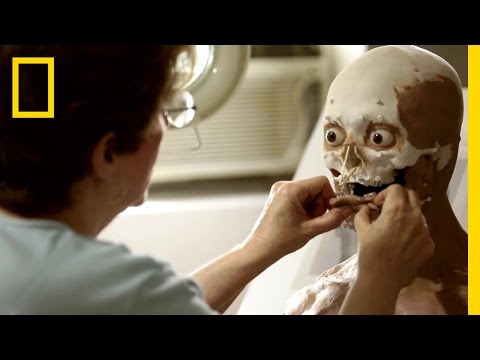
professor Israel Hershkovitz meets with
forensic artist Victoria lywood
to begin reconstructing the Galilean
man’s face Hershkovitz points out the
unique characteristics of a skull look
at the old a tail very small and not not
large square-shaped and not rounded
those are all important of logical
features which again tells you that you
deal with what we call eastern
Mediterranean a population very much
like the people who are living in this
area today Israel could you tell me what
this man would look like as far as hair
color can you suggest something as eye
color skin tone what you need to imagine
is today’s military Nyan people with the
dark hair slightly curly brown eyes
light brown skin lot of wrinkled
probably on the face because they stayed
outside in the Sun for a long period of
time every day oh you didn’t tell me how
old he is determining age just by
looking at the skull is quite different
yes but I would say that roughly that
each individual was around 40 that’s it
well I would get to work
using measurements compiled from CT
scans of living subjects with the same
ethnic origin as our Galilean man she
meticulously glues corresponding tissue
depth markers on the skull well I’m just
putting the marker over here on his
eyebrow these tell her how thick and
thin the tissue needs to be in specific
places across the skull a temporal bone
on your skull you can feel it in your
head and in your jaw now what it’s going
to do when I put in the next muscle on
the mandible the to join up and this is
how you open and close your mouth but I
mean there’s no way that we can put
every muscle on there’s no way that we
can put every fat globule on so what
we’re doing or putting in the main
muscles now what I’m trying to do here
is I’m trying to work around these
tissue depth markers because I want to
keep them there for reference and they
will eventually be covered up then I’m
going to leave most of them show through
right till I get to the last point so
that I know where I am on the face the
most difficult area is the mouth and
it’s gonna be particularly difficult
with this month knowing that there’s an
overbite here that I have to deal with
there’s no lips here yet this opening
for them we reached this particular
stage that I call the Homer Simpson
stage in Boston forensic artist Greg
Mahoney runs a parallel but higher tech
process he’s working with a powerful
computer program
will his man from Galilee looks similar
to Lai woods
Please follow and like us: