
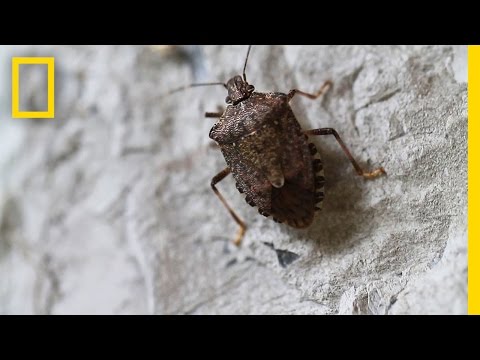
brown marmorated stink bug is not a
native species it’s native to Asia
sometime in the mid 1990s it was
accidentally introduced into the United
States here in the mid-atlantic we have
seen some of the most significant
problems from this invasive species in a
2010 which was the biggest outbreak year
that we’ve seen
we had growers that lost essentially all
of their stone fruit crops these are
things like peaches and nectarines here
in the mid-atlantic and serious losses
in the Apple industry in this region
it’s continued to spread throughout the
country it’s now been detected in 41
states this invasive is both an
agricultural pest but it’s also
incredible nuisance pests so homeowners
in the fall have to deal with large
numbers coming in to their homes seeking
an overwintering site essentially a
place to hibernate until spring you know
you go to brush your teeth in the
morning and there’s a stink bug sitting
on your toothbrush it’s not really
something that people want to see so
it’s been very frustrating for
homeowners as well to deal with these
bugs and the numbers that they can come
in he didn’t find it’s hardly any we’re
back in in July of 2010 we were
contacted by dr. Tracey Leske USDA so is
any chance so we could come up and
survey your orchard for stink bug you
have to really be ready for it because
with that needle mouth part that just
pierces through the skin when you lose
90% of your nectarines because of all
the little Pierce more extinct marks or
eating marks and then apples losing 50%
of the crop you will be in business long
if you let that happen all the time
seeing our damage that we have in years
past I don’t want to see that again on
my farm one of the basic biological
questions and behavioral questions we
had with this bug is their dispersal
capacity essentially how far they can
move and so we know that the stink bugs
are strong fliers but we didn’t
necessarily know how far they could go
so with the flight mill system which is
basically like a treadmill for insects
we can tether them to that system and
then allow them to naturally move and so
they will make a rotation and that
calculates a certain distance on that
flight path that circular flight path if
a bug is flying continuously for 24
hours that translates into about 75
miles in a single day the reason this is
important is the threat they pose to
agriculture how far could they
potentially move from to reach
agricultural production so these have
been going for a number of hours in this
particular bug it doesn’t seem to move
much no though even earlier this morning
ether vision is up travelling software
in that system we’ve measured both
adults and nymphs in terms of their
walking behavior we also can use it as a
mechanism to understand how they respond
when they come in contact with different
stimuli for example we put repellents in
that system and so we see the insects
immediately being stimulated and trying
to essentially escape that arena when
they are put on a repellent or in some
cases insecticides harmonic radar is a
mobile tracking system where we
literally tag the insect with a small
radar tag it has copper wire with a
small diode and then the radar system
itself implements the use of marine
radar and so we’ve been able to use it
with brown marmorated stink bug to
understand retention capacity and
understand how particular host plants or
particular stimuli like the pheromone
how attractive are they in terms of
retaining them at a particular location
we know that insect development is
linked to temperature
they typically to a point develop faster
under warm
temperatures so this year the summer
here in the mid-atlantic it’s been
cooler it’s been wetter than in past
seasons and it’s probably slowed their
activity so we’ve had a smaller
population this year than we’ve seen in
hotter drier years the long term goal is
to try to reduce populations across the
landscape this is an insect that has
come in its disrupted the system and
it’s just caused so many problems and so
for me I want to solve those problems
anything we’ve learned from the
agricultural standpoint is ultimately
going to help the homeowner wear goggles
as well so you know I absolutely believe
we can solve this problem it takes a
team effort and it takes a lot of work
but we’ll get there because um you know
I I never want to see what happened in
2010 again
Please follow and like us: