
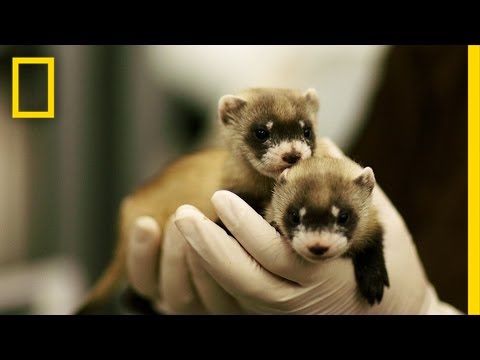
so in 1979 the black-footed ferret was
declared extinct and then in 1981 it was
rediscovered outside of Meeteetse
Wyoming and that really turned the
conservation world upside down so a
captive breeding program was started in
about 1985 because what they found was
that small population of wild ferrets
started to die off they made the
decision to capture up as many as they
could that was a group of 18 individuals
and they started the current captive
breeding program US Fish and Wildlife
Service that’s very successful today the
National black-footed ferret
Conservation Center is the only captive
breeding center like it in the world and
we house three-quarters of the world’s
population and every year we produce
about 250 newborn ferrets
we called them kits and a majority of
those kits are released into the wild if
you were black footed ferret and you
wanted to pick away to survive you would
hit your wagon to prairie dogs they’re
an obligate predator on prairie dogs and
prairie dogs are very very resilient
species but all that changed when we
settled the country because we started
off farming the country which reduced
the habitat available for prairie dogs
later on we decided that we needed to
increase agricultural production from
the standpoint of domestic livestock and
so we poisoned prairie dogs in order to
have more forage for cattle and other
livestock and finally we introduced
inadvertently an exotic disease sylvatic
plague from the old world of the new
world and prairie dogs and ferrets had
not adapted to that disease had not
evolved in the presence of it so they
were very susceptible to
first thing in the morning when I get to
work we do a morning walk through to
make sure that all of our ferrets have
eaten from the night before and just do
a general check on the health of the
colony so we just do a very brief visual
inspection we check their eyes make sure
that they don’t have an infection or
swollen we check to make sure they’ve
been nursing you can see the little milk
corners at the corners of their mouths
and just a quick overall body inspection
and sometimes we’ll double check the sex
so this is a nice fat healthy meal we
find that the ferrets have a high
susceptibility to a lot of diseases
probably stemming from their inbreeding
as a result of their very small founding
population of the captive ferret
population right now so today we’re
going to treat these kits and they’re
down because they have a coccidia
overdose and that’s a very common
disease we see breakout and sure it’s a
lot whole carcass spray is very
nutritious food for the ferrets so the
kits start getting them at day 35 I get
asked a lot of times why do we spend so
much effort saving one species the
black-footed ferret when it appears what
ecosystem seems to be fine and I always
say you have to look at it as not just
that one animal but the impact that it’s
had on the entire ecosystem where the
animal lives what the staff here does
every day I think it’s probably some of
the most important work in the
conservation world today every day we
see hundreds of species disappear on
this planet and it’s it’s an honor to
work in a program where we have an
opportunity to really bring back a
species and the ferret is a perfect
conservation vehicle for the short grass
prairie we know that where its habitat
where it lives there’s other species
like the Swift fox and the burrowing owl
and the Prairie rattlesnake so all these
other species are brought along with the
ferret in saving its habitat
you
you
Please follow and like us: