
what attracted me to Marseille was that
it is a place of immigrants so one of
the things I was trying to capture was
the melange of different people’s this
sort of contrast of traditional and
modern and it literally is a United
Nations Marseille is the oldest city in
in France and what what attracted me to
Marseille was that it is also a place of
immigrants for millennia people have
been coming from other places and so not
just Muslims many other people’s and so
one of the things I was trying to
capture was that that sense of of you
know sort of the melange of different
people’s but it is France make no
mistake about it and there is that
energy and there’s that style in France
and it is also Europe it is not the Arab
world and it is not the Muslim world I
don’t think you’d see something like
this there out of nearly a million
people there are over 200,000 Muslims in
Marseille and it’s not a monolithic
community there are Muslims from North
Africa and also from sub-saharan Africa
and one of the you know you know in 2005
when many of the French cities erupted
in riots mostly out of the sort of poor
Muslim and immigrant neighborhoods
Marseille remained tranquil and that was
also one of the reasons I wanted to go
to this city and I wanted to look at
this issue of immigration you know not
just Muslim immigration in Europe but
immigration in general and one of the
reasons that it’s successful I believe
is this sort of integration so in this
picture you’ve got a groom from the
kamorin islands and you have a bride
from Algeria you know both Muslims
and this is a group of kamorin women by
the way this is the largest population
of commands outside of the island the
kymaro islands I think there’s about
40,000 commands just in Marseille alone
and there I had never been exposed to
this to these folks and you know I would
say you know I’m used to dealing with
some pretty harsh communities and
environments and these folks were so
gentle and so graceful and also quite
welcoming of the camera which I can’t
say was always the case in Marseille
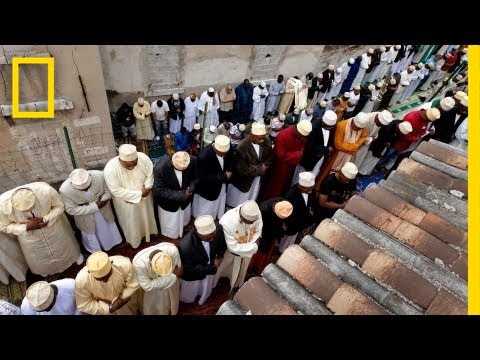
this is a lovely man this Imam with his
daughters the day before Eid and this is
during eat so because we’re in France
and you know France is a secular state
during Eid which is the probably the
most the holiest day of the Islamic year
and it’s the end of Ramadan the
thousands of people were funneled into
this basically into a convention centre
you know one of the things that that the
fathers of Marseilles are trying to do
is to maintain this kind of control and
it’s a very interesting balance where
you’re in a very and a validly secular
society yet you have this these huge
immigrant populations that tend to be
more traditional and you know also are
looking to maintain their culture and so
there’s this interesting mix this was
during Eid at the sort of a Muslim
community center in the city centre and
that’s another reason why it’s
successful in Marseille is that in the
city centre you literally feel like
you’re in Algiers or Tunis that that
it’s not that the immigrant communities
are not just banished to the suburbs and
the poor neighborhoods surrounding the
city they actually inhabit the city
centre and and now from all the people
that we interviewed and you know from
what I read that really is one of the
reasons that Marseille did not explode
in riots in 2005 because the the
immigrants feel a stake in the community
this is during Eid al-adha this is forty
days after
after the end of Ramadan and it’s it’s
sort of this feast it’s it’s a two-day
killing spree is what it is quite
frankly I’ve photographed it in many
different Muslim countries and what was
different about this is that I think
literally 5000 animals were killed over
a two-day period and and it’s actually a
beautiful ritual and that the idea is
that you you you would slaughter an
animal and then you’d provide the meat
for your family and then you would give
the extra meat to the poor and less you
know and the disadvantaged in your
community but again because we’re in
France they do not allow people to kill
the animals in their homes in their
backyards in parks in the public sphere
which is what would be more typical in a
place like Pakistan or you know in in
you know Muslim countries and so they
would they would bring their animals to
these slaughterhouses and it was sort of
this you know mechanised killing what
was interesting though like in this
scene is that there were some some men
who wanted to still kill their own
animals they still wanted to hold on to
that tradition during the Arab Spring
last year I was there and there were
many immigrants from Tunisia who were
coming and they had no place to live and
they had no food so the community came
out to give them food and shelter
Marseille also has an extremely large
Jewish community and they’ve been there
for hundreds of years
I think there’s 70,000 Jews in Marseille
alona I believe it’s the third largest
population in all of Europe and it was
interesting I one thing I wanted to tell
you was one of the reasons this became
so hard is with all my years of
experience I made a huge tactical
mistake when I began this project I
thought I needed someone who spoke
Arabic obviously I needed someone who
spoke French because I don’t speak
French and English and I thought I’d
need someone who’d speak Arabic and I
ended up hiring this Tunisian man who
was a pretty hardcore like leftist
socialist dude and he essentially looked
at me and National Geographic like we
were McDonald’s and that I was actually
part of the sort of you know
neo-colonial conspiracy of America to
take
of the world and and his English was not
very good either so you know you can
always learn but so I bring it up now
because so you know my family my family
is from Iraq I’m actually my family’s
Jewish but my family is from Baghdad so
this Tunisian guy in this Araki guy show
up at the main synagogue and we wondered
why they the armed guards turned us away
you know so after my first trip and this
is classic me I continued to work with
him when I returned a two months later
and it lasted two days and we had this
terrible fight throwing things and
yelling in the car and he looked at me
and he said I think we need to divorce
and and he was right and then it was
magical because what happened was
thankfully he hadn’t introduced me to
this lovely young French woman 36 year
old single mom speaks great English
names Valery and it was my fortunes just
turned around and what had what was
becoming this very dark depressing and a
story where I thought is this going to
be my first time where I actually fail
on a geographic assignment everything
turned around and you know just my mood
the pictures and it really taught me a
lesson about how important it is I mean
again you’d think I would know this by
now but how important it is that your
liaison your representative is someone
who represents you in a good way and
then subsequently we went to other women
when I revisited some subjects Valerie
would say to me yeah they were just
telling me that when you know the first
time you came with Omiya
they that he was telling them how much
he didn’t like you and what a bad guy
you were and I’m thinking so no wonder
it was such a struggle there’s also a
very large Roma
community or gypsies as we sometimes
think of them and you know they’re
mostly coming from Romania what was
interesting about this community though
and it sort of goes against the
stereotype of the Roma is that many of
the people we met and interviewed that
like this family they wanted stable
housing
they want to send their kids to school
they wanted to take advantage of the you
know great health care system in France
you know they wanted to pay rent they
wanted a stable life and I thought that
way it’s always interesting as a
journalist and a reporter when you learn
things that fly against the grain of
what you normally see in the media and
you know I’m always especially at this
point in my career I’m always trying to
avoid you know sort of you know
repeating stereotypes and cliches I’m
always looking for sort of new ways of
telling stories but there are still Roma
in Marseilles who are there do do what
we typically think of which is is beg on
the streets you don’t see this in this
picture but what was interesting is that
many of the women would dress as Muslims
and beg because they figured they would
be more likely to get donations
Marseille is also the seat of the
national front sort of the almost the
sort of would you consider like the
neo-nazi party that’s maybe a little too
harsh but the National Front marine
lepen very right-wing very
anti-immigrant so that’s also
fascinating that in a city that that
maybe of all of Europe represents
immigrants it is also the seat of the
National Front in France and this was at
the opening these are members of the
National Front showing up at a at the
opening of a movie that was sort of a
Pro Algerian movie so you have this very
interesting mix in this city but somehow
it all sort of moves along peacefully
Marseille is a city of small communities
and neighborhoods and this is in the no
wheel district again this is one of the
central districts of the city which is
predominantly Algerian Moroccan Tunisian
and this is a petanque which is a I
think it was like a religion but it’s
sort of an international sport or at
least it’s a sport of Marseille and you
know I love this as an American so it’s
it’s about 4 o’clock in the afternoon
you can’t see this but off to the side
this couple their baby is in the
stroller sleeping
so they’re drinking beer smoking
cigarettes playing this game and y’all
for me in the afternoon and Huff’s just
thinking I said to Valerie I said we
would never do this in America and it’s
a shame no because they were totally
chill and happy and so was the kid so so
this you know big youth culture there
and which is in a sense universal this
made me feel like I was back in San
Francisco this is in the city center by
this famous old carousel and this young
woman is 32 years old Algerian descent a
Muslim woman she but she works at a bank
she’s totally Western and middle-class
and she was out with her mates basically
partying in the streets all dressed up
in funny costumes because she was
getting married two weeks later and then
there are certain places in the city
that are kind of a leveling ground you
know where where when you go there
you’re not you know Muslim Christian
Jewish you’re not you know Algerian or
French or Italian or course again
there’s a very big Corsican population
there too and that is at the olympic
marseille stadium and they absolutely
express how they feel I went to three
matches and seriously at every one by
the end of it the players had to be had
to be had to leave and the refs in
particular had to leave with armed
escorts because the crowd was so angry
but you know this is a place where were
you know all the different communities
of the city come together and this truly
is a religion like so much of Europe and
the world you know football is a
religion the beach is another place and
there are many different beaches in
Marseille and there’s some very urban
beaches and then there’s sort of long
white white sandy beaches these were a
bunch of Maghrebi boy guys actually I
think one of them is an Egyptian as well
and they were getting all ready to I
sort of make the moves on some women
this is a group of high school students
who had come to the beach for the day
and it literally is a United Nations I
mean you have Asia Africa there’s an
Italian
Spaniard you know Algerian it’s really
quite amazing and it’s beautiful to see
a scene like this you know and this sort
of contrast of sort of traditional and
modern this is one of the more urban
beaches people would say to me Marseille
Wow south of France it must have been
great and all I could say was no it was
actually horrible and because people I
don’t know if this is prevalent in all
of France because I have to tell you I
don’t work very much in Europe I mostly
work in the developing world and so I
was actually really surprised at the
level of negativity towards my camera
also Marseille is the largest port in
France and there used to be over 7,000
port workers now there are under 700
because of mechanization and also sort
of a slumping caught world economy this
was at a rally you know French left to
protest this was it a protest against
the raising of the retirement age
there’s also this sort of night life
sort of sort of darkened you know seedy
side of Marseille I was convinced that
half the men on the streets of Marseille
were hitmen you have you have the
Corsican mafia you have the Italian
mafia you have the French mafia then
you’ve got the maghreb Ian mafia you
know the Algerians Moroccans and
Tunisians and then you have the
Islamists but I probably wouldn’t have
known about them because they don’t want
to be seen but but you know it was just
it was baffling to me I again as I said
I thought this was going to be a piece
of cake but the allure of this city to
immigrants continues this is a Tunisian
man who is just arriving in the central
train station he had just arrived to
come and visit relatives there so that’s
Marseille thank you
you
you
Please follow and like us: