
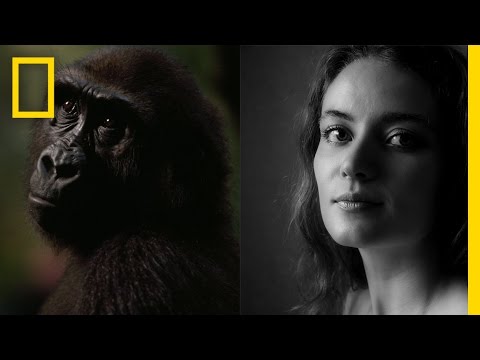
as we like to say at these evenings no
special expertise is needed only a
curious mind and tonight should be no
less inspiring because of very
outstanding guests dr. Roger Myerson
Nobel Prize winner in Economic Sciences
and dr. Jill proofs primatologist
biological anthropologists and National
Geographic emerging Explorer National
Geographic grantee the genius of these
evenings goes beyond just the guests the
experts that we bring here and in the
topics they’re talking about it’s the
fact that we’ve got different fields and
when you bring these different fields
together we try to find a common threads
difference of expertise and hopefully
they will spark new insight and new
discoveries by bringing these diverse
backgrounds together and frankly on
hearing some of our past lineups before
the evening began I thought how are we
ever gonna connect those two things how
are we gonna make it work but it always
does tonight on the other hand Roger
Myerson who among other things looks at
models for understanding political
institutions and jhope roots looks at
behavior and group dynamics and wild
chimpanzees and I thought finally we are
on the same page so if you will welcome
them both this evening and we will begin
the project let me thank you let me try
to introduce myself a little bit I am a
game theorist I work on models of
conflict and cooperation that have
applications in economics political
science and elsewhere in life I think
it’s important to start by saying game
theory gives us a mathematical language
to describe and to analyze people’s
incentives when they interact in in
almost any kind of situation a game
theory is that is a language for
describing our social interactions in a
language that could be described to a
computer or to somebody from another
world or to somebody from an alien
species perhaps
game theoretic models are used to help
understand how changing the rules of any
kind of social institution could affect
individuals behavior but as I say
tonight I want to bring a passion for
using our respective methodologies to
understand fundamental questions of
social science in particular as the
title the evening suggests I am very
interested in understanding what are the
essential elements of a successful
society I should show you at least one
game so here’s a slide with a game each
of the players has two alternatives a
can choose to claim or yield whatever
that means and B has two options that
I’m calling claim or yield so here for
each of the four row cells here that
corresponds to a combination of what the
players could do their payoff numbers
and each player wants to maximize his or
her own payoff that’s their goal so if
you look at these numbers you see that
the combination of actions were eight
where they both claimed is the worst
outcome for both of them it gives them
both a payoff that I’m calling negative
one if a chooses to yield then he gets a
payoff of zero no matter what if B
chooses to yield she gets a payoff of
zero no matter what so that’s it because
the only thing that’s left to say is
there’s some number that I’ve called
abstract levy but maybe we could call it
a hundred it’s a positive number and
that’s if if you claim and I yield then
you get a payoff of a V you get to keep
the prize you’ve some territory or
whatever it is the work I think we’re
this is a model of our disputing some
possession and if one claims the other
yields the person called the individual
claims it gets the prize so let me stop
there and pass on thank you good evening
I’m gonna talk to you about a different
type of society and as you heard I’m a
biological anthropologist and a
primatologist and I do study chimpanzees
because I love chimpanzees and I think
they’re very interested interesting in
their own right but as an anthropologist
I also study them because I do think
that they
can give us some insight into her own
species much of what we know and think
about chimpanzees is based on Jane
Goodall’s work and it’s largely based on
chimps that live in forests my study
side is in West Africa and Senegal
fungally here on the map and it’s in a
very very different type of habitat and
I specifically chose that habitat
because it is so different and because
it is a mini ways similar to what we
think our own species evolved in savanna
woodland habitat and chimps at my side
do hunt but what is so different at my
site is that males chase monkeys down
females and young individuals use tools
to hunt and that’s something we thought
was pretty much a human trait what’s
interesting is that socially there are
differences in this society that allow
that to happen with vongola you have
most of the chimps together all the time
and this stronger degree of social
cohesion translates into behaviors like
more tolerant individuals and more
sharing behaviors what you’re not going
to see is sharing in this particular
clip but what you do see is tolerance so
that male is Bilbo
he’s a mid to low ranking male he’s got
his rabbit monkey see those guys sitting
there right in his face those are high
ranking individuals in fact the guy on
the right the second highest ranking
individuals in community but he doesn’t
take that monkey from Bilbo Bobo’s a
little annoyed he’s gonna move off a
little bit from those guys oh if they’re
just gonna follow him right in his face
but that is interesting in itself
because he’s allowed they we would say
with humans respect his ownership of
that monkey and males share with females
here and they also share tools so that’s
something that we’re focusing on now you
have tolerance by males and asserted
assertiveness by females in it’s quite a
complex situation but I will stop there
now and hopefully we will discuss some
of this thank you
Rogers will come up I don’t know about
you but I have a lot of questions after
hearing this talk you’re looking at
these chimps because of their the
environment in the Savannah is being
perhaps representative of the develop of
the early hominids that in the same
environment right and so would this be
the first signs of compassion in humans
is that what began to separate us or
this banding together that we’ve got to
work together we can’t all be
individuals if we’re going to survive as
a species did that take us to the next
level well I mean I I think definitely
you would argue that there was
compassion and other apes and and
primates but I do think the what you see
is a different level of social cohesion
in these Savannah chimps that has
affected their sharing and I guess
sharing cooperation is where I’m focused
right now and the more I learn about it
I always learn about it first in
chimpanzees and then I go to the human
literature and learn a little bit about
myself I guess or at least my species
but that seems to me something that I
think is incredibly important and it’s
it’s overlooked because we tend to may
be not humans but in the term the chimp
literature we tend to look at things
like aggression it’s it’s a sexy topic
and we tend to focus on how how
aggressive chimps can be and they
definitely can be as can humans but I
think that sharing cooperation is
something that is is key to our own
species and I do think these Savannah
chimps show how it might have developed
I thought it was very unusual to see Jim
sit there and let one Eden and the
others not just grab a piece of it right
and tear off something they can’t not
think what am I gonna get out of this
even if I’m gonna sit there and not get
a piece of meat immediately there’s
something that they’re getting for
exhibiting that kind of thing well and
what well what you see also is there’s a
degree of policing behavior by other
individuals so if for example one of
those males would have taken the monkey
from Bilbo you’d have had five other
males come up and reprimand him for it
which in chimpanzees would be chasing
him down and trying to beat him up so
that’s what he’s getting out of it is
safety and he’s not getting any part
it’s it’s it’s the way that their
society is supposed to behave I guess
you might say it’s it’s not the norm for
their society is to be tolerant but at
other sites the leader in other
chimpanzees
alpha-male as far as they know it almost
every other site will go up and just
take take that prey item away but but
not not here where does how does
ownership fit into your your
mathematical models because in the end
people want to own stuff and where did
that begin in society when you think
within the stories we’ve heard about the
the chimpanzee community when when when
ownership rights when the ability to to
retain control of one’s own kill by
virtue of having achieved the kill
becomes a part of the culture you would
then have more animals owning so one of
things we can say is when we distribute
secure protected property rights to more
people we expect more investment and
more and more prosperity that’s that a
nutshell is one of the most important
lessons of development of how I think of
how humanity has has achieved such
enormous success and how I hope we’ll
enjoy even greater material prosperity
in the future it is very important to
say that changing the rules of property
rights in the long run can change
economic dynamics in ways that are of
the most important in the world I was at
a National Geographic site where we had
our funding some research archeology
Neolithic village and they’d been
digging back and they discovered that
there was a time in this village they
kept building
centuries later on top of it that there
was no ownership people to know anything
they discovered this but then they get
to a port where they see that people
were starting to hide a few things in
their little room that the rest of the
village didn’t know about so they had
secret ownership do you see that in the
chimpanzees do they go off and hide
things from the rest of the Greek name
do they have on earth they do I’ve seen
that specifically meat is a very prized
possession and even though those males
respected you know Bilbo’s rights they
were in his face and oftentimes females
will be even more in your face and the
males tend to be a little bit harassed
and and will move about and I’ve seen
the low ranking males separate the most
successful one once he gets a monkey
will eat it quite quickly and then once
he’s you know somewhat satiated I say
he’ll go and find that other individuals
but he’s very quiet about it when he
first finds gets the monkey doesn’t
advertise it and then he goes on and he
does share he shares with his buddies
who support him and coalition airy ways
etcetera but yeah I’ve seen what you
would call deception I’ve seen it it’s
it’s more obvious with captive chimps
where they hide possessions that you’ve
given them usually food but I I do see
it with with meat specifically and even
with us sometimes they’re a little
nervous about us watching too closely
because I tend to watch the meat-eating
quite close and they don’t seem to like
me doing that very much so well do they
have other possessions besides food that
would be the most basic instinct that
you need but because you mentioned they
they’re one chimp that
tools tools there’s a few instances of
tools sharing but do they find others
possessions that they just have to have
do they have is there anything that they
do they start collecting do they become
a consumer society in any way no
necessarily there are a few instances
and they’re somewhat morbid and so
usually young individuals will catch
certain animals that they don’t eat like
Jeanette’s I can’t like animal mongooses
and they won’t eat them but they’ll play
with them and it doesn’t turn out well
for that little animal so it’s somewhat
like a doll for the rest of the day and
they do exhibit ownership of that
plaything is what it becomes and I’ve
seen that maybe yes and then I mean
there’s there’s definitely what I would
call jealousy in terms of male female
behavior when females are in estrus and
that sort of thing but yeah as far as
objects not not to any extent like you
see in humans but other than food but
every once in while a Yosi position is
well there was something that came up in
what you were showing us and talking
about that got me interested in Rogers
take on this and that is that a lot of
the trouble began with the females
so the guy comes into the cave he’s
fighting because he wants the woman or
they’re fighting over a tool or they
have to let the woman have her meal so
Roger in your formulas do you figure in
mathematically the gender of the group
well obviously I would assume that that
that mating rights are important the
thing that chimpanzees and humans can
quarrel over one of the things we had
the question of the evolution of
monogamy in the world is again something
which tends to make the monogamous
societies have been able to expand
better in the world it’s a because it
reduces a source of tension when each
male is limited to one female that the
the facts of males being able to
impregnate multiple females I’m sure I
believe I understand to be an important
source of possible friction in in
chimpanzee ork to human societies we
establish rules within within rules and
how are those rules enforced again by
loss of social status if you if you
violate the rules and so shows social
status which we’ve also heard a lot
about the ability if I’m higher status
than you there sometimes I can take some
things from you perhaps but if I obey
the rules then I rise in status and and
the rules can be functional for society
one of these either but it’s very
striking to me in looking at some of the
earliest writing that comes out of
ancient Babylon that one of the first
things they’re writing about is debt and
so compassion is giving to someone else
but a sense that I owe you something
that’s something that it’s been inhuman
among humans as long as we’ve been
writing and that’s one first as we chose
to write about but the chimpanzees show
a set of sense of specific debt I did
this for you so therefore there’s
definitely a sense of debt a reciprocal
altruism some call it so I do this for
you I share meat with you you share meat
with me and there’s actually reaction
when you see an unfair response so I
shared my monkey with you two months ago
and chimps are long live so you also
have very long term relationships and
there can be punishment for something
that is you know sort of against the
grain of how the behavior works in terms
of supporting
individuals and social interactions
that’s definitely important so support
for you on this day means you should
support me the the following week or
month and and that sort of thing so it’s
definitely the case in chimpanzees
they’ve seen it in other primates as
well but especially among among males
where coalition’s are so important in
dominance rarely can a male chimp stay
very long at the at the top of the
hierarchy without support so in your
analyzing of what makes systems most
effective in society’s most effective
you’re constantly saying we need to
tweak here and tweak there and make some
changes and this is leads me to the look
at chimpanzees do they ever do you see
any progression or is this generation of
chimpanzees the same as the one before
the one before did they ever build on
and modify well interaction yeah it’s a
good question
since chimps are so long-lived we for
example I think I followed so far maybe
one generation I’ve been studying them
for 11 years not quite a generation so
it’s it’s hard to look right now and
understand what’s going on but it’s in
baboons for example they’ve they’ve got
a wonderful example of there’s an
unfortunate situation for some
individuals but most of the the dominant
males died off from tuberculosis and
what happened was these subordinate
males were then the guys running the
group well it was a much more Pacific
situation the group was less aggressive
and even when those males died off the
other individuals kept that social
system didn’t allow more aggressive
individuals to rise up the dominance
hierarchy so you saw a complete change
and the culture of those baboons even
though we normally don’t think of
baboons is having culture at least chimp
folks or others but it’s it’s it was a
great example and so we do see changes
and I think a lot of it has to do with
leadership and so the leader right now
of the fungally group is a pretty
aggressive young guy but he’s he’s quite
intelligent as well I’d say he’s
different from the previous male who was
less aggressive it’s it’s sort of just
feel like I know just a tiny bit of
what’s going on right now and even the
Jane Goodall site we’ve you
fifty years so it could be the lifespan
of one chimpanzee you do have evidence
in the animal world of society is
morphing and changed what we would say
improving or at least making life better
for that generation mm-hmm
one quick this is just totally aside but
I was just wondering if the hot tub yes
gems do they have wine or drinks fruits
fruits don’t take fruits of a hot tub
right yeah uh-huh so they do understand
pleasure and they find ways to satisfy
hey that that are out of the norm for
chimpanzee behavior
definitely so societies can more for not
just monetary reasons or food reasons
right yeah Comfort it’s a very different
type of society in fact we now that we
know more and more about chimps we used
to think of you know a chimpanzee and
how a chimp behaves and we know that
they’re diverse across the the
geographic range and in fact some just
minor behaviors and the example like to
give is leaf clipping is a very simple
behavior so at my site before males
start to display they’ll just take a
leaf off of a tree and they’ll just chip
kind of pull away pieces of the leaf
with their their mouth and then they’ll
start their display and that to me and
to other individuals especially females
a signal to get ready to get out of the
way of that guy he’s about to display
but in Tanzania that is a signal that
the male wants the female to come and
mate with him so very simple behavior
completely different signal and so I
think that’s a you know simple but
elegant an example of how you know you
have they do the grooming the chimps
here where they will pick termites or
bugs off of the other one and so right
yeah just you’re like I’m here not as
though right and now do we see this in
your human dynamics in which sometimes
we are motivated not just by the the
bottom line or the dollar that it’s a
purely pleasure and the hot tub we want
our time in the hot tub obviously we are
we’re social animals when one’s trying
to understand the nature of competition
one wants to focus on the the the the
the the possibility of divergent
interests
I think Madison talking about the
construction you know the the designing
of a constitution for this country who
said that if everyone was angels if
people were angels we wouldn’t need a
constitution so so I the reason why I
think we we technique UNAM us tend to
focus on the selfish aspects which are
only a part of what of our motivation is
in some sense because we’re trying to
understand how to build better societies
and for that if you assume that people
are already socially motivated then in
some sense the social problem is easy
everyone will try to make our society
better to the extent that people are
individually motivated and then then the
design of our society makes a difference
with the chimps we’re seeing that it’s
really the leader that’s setting the
rules makes the big difference so is it
the Constitution or the leader that
makes the most difference for society
for human question as I said I think
this is my somewhat radical position
within the profession I think we’ve all
gone too far in thinking that writing
down rules is the point it’s I think
leadership which in which is a
continuous phenomenon from from
chimpanzees to humans it’s not notice
it’s qualitative it’s different in some
ways but this clearly the same
phenomenon is what comes first and and I
tried to indicate before in a very
profound sense I believe the efficacy of
written laws depends at some level on
our having individuals who are prominent
and prestigious or leaders in our
society who have a reputation for
enforcing laws for example I I think as
I as I read history and try to
understand how does it all work the fact
that it is as as people have said
possible for someone to love the law and
you know senior jurists or are like that
the fact that it’s possible for to love
the law means that some people who don’t
actually love the law would like to
pretend to love the law because you know
it’s possible and then you can become a
prominent jurist that way but then what
do you do when you love the law or are
pretending the answer is you enforce it
the way it’s written and now we have a
possible we have a cadre of people who
we can rely on in society to do their
bit to make sure
that laws are applied appropriately
there’s been a most interesting
conversation most revealing the fact
that we have really not moved that far
beyond where we were I’m convinced to
understand ourselves that she’s on the
right path it’s important though I don’t
know where we should look Mart or should
we look to Senegal or should we look to
the boardrooms to find out how we’re
gonna form the best society or to
Congress it’s just it’s a flip of the
coin thank you for being here this
evening
you
special expertise is needed only a
curious mind and tonight should be no
less inspiring because of very
outstanding guests dr. Roger Myerson
Nobel Prize winner in Economic Sciences
and dr. Jill proofs primatologist
biological anthropologists and National
Geographic emerging Explorer National
Geographic grantee the genius of these
evenings goes beyond just the guests the
experts that we bring here and in the
topics they’re talking about it’s the
fact that we’ve got different fields and
when you bring these different fields
together we try to find a common threads
difference of expertise and hopefully
they will spark new insight and new
discoveries by bringing these diverse
backgrounds together and frankly on
hearing some of our past lineups before
the evening began I thought how are we
ever gonna connect those two things how
are we gonna make it work but it always
does tonight on the other hand Roger
Myerson who among other things looks at
models for understanding political
institutions and jhope roots looks at
behavior and group dynamics and wild
chimpanzees and I thought finally we are
on the same page so if you will welcome
them both this evening and we will begin
the project let me thank you let me try
to introduce myself a little bit I am a
game theorist I work on models of
conflict and cooperation that have
applications in economics political
science and elsewhere in life I think
it’s important to start by saying game
theory gives us a mathematical language
to describe and to analyze people’s
incentives when they interact in in
almost any kind of situation a game
theory is that is a language for
describing our social interactions in a
language that could be described to a
computer or to somebody from another
world or to somebody from an alien
species perhaps
game theoretic models are used to help
understand how changing the rules of any
kind of social institution could affect
individuals behavior but as I say
tonight I want to bring a passion for
using our respective methodologies to
understand fundamental questions of
social science in particular as the
title the evening suggests I am very
interested in understanding what are the
essential elements of a successful
society I should show you at least one
game so here’s a slide with a game each
of the players has two alternatives a
can choose to claim or yield whatever
that means and B has two options that
I’m calling claim or yield so here for
each of the four row cells here that
corresponds to a combination of what the
players could do their payoff numbers
and each player wants to maximize his or
her own payoff that’s their goal so if
you look at these numbers you see that
the combination of actions were eight
where they both claimed is the worst
outcome for both of them it gives them
both a payoff that I’m calling negative
one if a chooses to yield then he gets a
payoff of zero no matter what if B
chooses to yield she gets a payoff of
zero no matter what so that’s it because
the only thing that’s left to say is
there’s some number that I’ve called
abstract levy but maybe we could call it
a hundred it’s a positive number and
that’s if if you claim and I yield then
you get a payoff of a V you get to keep
the prize you’ve some territory or
whatever it is the work I think we’re
this is a model of our disputing some
possession and if one claims the other
yields the person called the individual
claims it gets the prize so let me stop
there and pass on thank you good evening
I’m gonna talk to you about a different
type of society and as you heard I’m a
biological anthropologist and a
primatologist and I do study chimpanzees
because I love chimpanzees and I think
they’re very interested interesting in
their own right but as an anthropologist
I also study them because I do think
that they
can give us some insight into her own
species much of what we know and think
about chimpanzees is based on Jane
Goodall’s work and it’s largely based on
chimps that live in forests my study
side is in West Africa and Senegal
fungally here on the map and it’s in a
very very different type of habitat and
I specifically chose that habitat
because it is so different and because
it is a mini ways similar to what we
think our own species evolved in savanna
woodland habitat and chimps at my side
do hunt but what is so different at my
site is that males chase monkeys down
females and young individuals use tools
to hunt and that’s something we thought
was pretty much a human trait what’s
interesting is that socially there are
differences in this society that allow
that to happen with vongola you have
most of the chimps together all the time
and this stronger degree of social
cohesion translates into behaviors like
more tolerant individuals and more
sharing behaviors what you’re not going
to see is sharing in this particular
clip but what you do see is tolerance so
that male is Bilbo
he’s a mid to low ranking male he’s got
his rabbit monkey see those guys sitting
there right in his face those are high
ranking individuals in fact the guy on
the right the second highest ranking
individuals in community but he doesn’t
take that monkey from Bilbo Bobo’s a
little annoyed he’s gonna move off a
little bit from those guys oh if they’re
just gonna follow him right in his face
but that is interesting in itself
because he’s allowed they we would say
with humans respect his ownership of
that monkey and males share with females
here and they also share tools so that’s
something that we’re focusing on now you
have tolerance by males and asserted
assertiveness by females in it’s quite a
complex situation but I will stop there
now and hopefully we will discuss some
of this thank you
Rogers will come up I don’t know about
you but I have a lot of questions after
hearing this talk you’re looking at
these chimps because of their the
environment in the Savannah is being
perhaps representative of the develop of
the early hominids that in the same
environment right and so would this be
the first signs of compassion in humans
is that what began to separate us or
this banding together that we’ve got to
work together we can’t all be
individuals if we’re going to survive as
a species did that take us to the next
level well I mean I I think definitely
you would argue that there was
compassion and other apes and and
primates but I do think the what you see
is a different level of social cohesion
in these Savannah chimps that has
affected their sharing and I guess
sharing cooperation is where I’m focused
right now and the more I learn about it
I always learn about it first in
chimpanzees and then I go to the human
literature and learn a little bit about
myself I guess or at least my species
but that seems to me something that I
think is incredibly important and it’s
it’s overlooked because we tend to may
be not humans but in the term the chimp
literature we tend to look at things
like aggression it’s it’s a sexy topic
and we tend to focus on how how
aggressive chimps can be and they
definitely can be as can humans but I
think that sharing cooperation is
something that is is key to our own
species and I do think these Savannah
chimps show how it might have developed
I thought it was very unusual to see Jim
sit there and let one Eden and the
others not just grab a piece of it right
and tear off something they can’t not
think what am I gonna get out of this
even if I’m gonna sit there and not get
a piece of meat immediately there’s
something that they’re getting for
exhibiting that kind of thing well and
what well what you see also is there’s a
degree of policing behavior by other
individuals so if for example one of
those males would have taken the monkey
from Bilbo you’d have had five other
males come up and reprimand him for it
which in chimpanzees would be chasing
him down and trying to beat him up so
that’s what he’s getting out of it is
safety and he’s not getting any part
it’s it’s it’s the way that their
society is supposed to behave I guess
you might say it’s it’s not the norm for
their society is to be tolerant but at
other sites the leader in other
chimpanzees
alpha-male as far as they know it almost
every other site will go up and just
take take that prey item away but but
not not here where does how does
ownership fit into your your
mathematical models because in the end
people want to own stuff and where did
that begin in society when you think
within the stories we’ve heard about the
the chimpanzee community when when when
ownership rights when the ability to to
retain control of one’s own kill by
virtue of having achieved the kill
becomes a part of the culture you would
then have more animals owning so one of
things we can say is when we distribute
secure protected property rights to more
people we expect more investment and
more and more prosperity that’s that a
nutshell is one of the most important
lessons of development of how I think of
how humanity has has achieved such
enormous success and how I hope we’ll
enjoy even greater material prosperity
in the future it is very important to
say that changing the rules of property
rights in the long run can change
economic dynamics in ways that are of
the most important in the world I was at
a National Geographic site where we had
our funding some research archeology
Neolithic village and they’d been
digging back and they discovered that
there was a time in this village they
kept building
centuries later on top of it that there
was no ownership people to know anything
they discovered this but then they get
to a port where they see that people
were starting to hide a few things in
their little room that the rest of the
village didn’t know about so they had
secret ownership do you see that in the
chimpanzees do they go off and hide
things from the rest of the Greek name
do they have on earth they do I’ve seen
that specifically meat is a very prized
possession and even though those males
respected you know Bilbo’s rights they
were in his face and oftentimes females
will be even more in your face and the
males tend to be a little bit harassed
and and will move about and I’ve seen
the low ranking males separate the most
successful one once he gets a monkey
will eat it quite quickly and then once
he’s you know somewhat satiated I say
he’ll go and find that other individuals
but he’s very quiet about it when he
first finds gets the monkey doesn’t
advertise it and then he goes on and he
does share he shares with his buddies
who support him and coalition airy ways
etcetera but yeah I’ve seen what you
would call deception I’ve seen it it’s
it’s more obvious with captive chimps
where they hide possessions that you’ve
given them usually food but I I do see
it with with meat specifically and even
with us sometimes they’re a little
nervous about us watching too closely
because I tend to watch the meat-eating
quite close and they don’t seem to like
me doing that very much so well do they
have other possessions besides food that
would be the most basic instinct that
you need but because you mentioned they
they’re one chimp that
tools tools there’s a few instances of
tools sharing but do they find others
possessions that they just have to have
do they have is there anything that they
do they start collecting do they become
a consumer society in any way no
necessarily there are a few instances
and they’re somewhat morbid and so
usually young individuals will catch
certain animals that they don’t eat like
Jeanette’s I can’t like animal mongooses
and they won’t eat them but they’ll play
with them and it doesn’t turn out well
for that little animal so it’s somewhat
like a doll for the rest of the day and
they do exhibit ownership of that
plaything is what it becomes and I’ve
seen that maybe yes and then I mean
there’s there’s definitely what I would
call jealousy in terms of male female
behavior when females are in estrus and
that sort of thing but yeah as far as
objects not not to any extent like you
see in humans but other than food but
every once in while a Yosi position is
well there was something that came up in
what you were showing us and talking
about that got me interested in Rogers
take on this and that is that a lot of
the trouble began with the females
so the guy comes into the cave he’s
fighting because he wants the woman or
they’re fighting over a tool or they
have to let the woman have her meal so
Roger in your formulas do you figure in
mathematically the gender of the group
well obviously I would assume that that
that mating rights are important the
thing that chimpanzees and humans can
quarrel over one of the things we had
the question of the evolution of
monogamy in the world is again something
which tends to make the monogamous
societies have been able to expand
better in the world it’s a because it
reduces a source of tension when each
male is limited to one female that the
the facts of males being able to
impregnate multiple females I’m sure I
believe I understand to be an important
source of possible friction in in
chimpanzee ork to human societies we
establish rules within within rules and
how are those rules enforced again by
loss of social status if you if you
violate the rules and so shows social
status which we’ve also heard a lot
about the ability if I’m higher status
than you there sometimes I can take some
things from you perhaps but if I obey
the rules then I rise in status and and
the rules can be functional for society
one of these either but it’s very
striking to me in looking at some of the
earliest writing that comes out of
ancient Babylon that one of the first
things they’re writing about is debt and
so compassion is giving to someone else
but a sense that I owe you something
that’s something that it’s been inhuman
among humans as long as we’ve been
writing and that’s one first as we chose
to write about but the chimpanzees show
a set of sense of specific debt I did
this for you so therefore there’s
definitely a sense of debt a reciprocal
altruism some call it so I do this for
you I share meat with you you share meat
with me and there’s actually reaction
when you see an unfair response so I
shared my monkey with you two months ago
and chimps are long live so you also
have very long term relationships and
there can be punishment for something
that is you know sort of against the
grain of how the behavior works in terms
of supporting
individuals and social interactions
that’s definitely important so support
for you on this day means you should
support me the the following week or
month and and that sort of thing so it’s
definitely the case in chimpanzees
they’ve seen it in other primates as
well but especially among among males
where coalition’s are so important in
dominance rarely can a male chimp stay
very long at the at the top of the
hierarchy without support so in your
analyzing of what makes systems most
effective in society’s most effective
you’re constantly saying we need to
tweak here and tweak there and make some
changes and this is leads me to the look
at chimpanzees do they ever do you see
any progression or is this generation of
chimpanzees the same as the one before
the one before did they ever build on
and modify well interaction yeah it’s a
good question
since chimps are so long-lived we for
example I think I followed so far maybe
one generation I’ve been studying them
for 11 years not quite a generation so
it’s it’s hard to look right now and
understand what’s going on but it’s in
baboons for example they’ve they’ve got
a wonderful example of there’s an
unfortunate situation for some
individuals but most of the the dominant
males died off from tuberculosis and
what happened was these subordinate
males were then the guys running the
group well it was a much more Pacific
situation the group was less aggressive
and even when those males died off the
other individuals kept that social
system didn’t allow more aggressive
individuals to rise up the dominance
hierarchy so you saw a complete change
and the culture of those baboons even
though we normally don’t think of
baboons is having culture at least chimp
folks or others but it’s it’s it was a
great example and so we do see changes
and I think a lot of it has to do with
leadership and so the leader right now
of the fungally group is a pretty
aggressive young guy but he’s he’s quite
intelligent as well I’d say he’s
different from the previous male who was
less aggressive it’s it’s sort of just
feel like I know just a tiny bit of
what’s going on right now and even the
Jane Goodall site we’ve you
fifty years so it could be the lifespan
of one chimpanzee you do have evidence
in the animal world of society is
morphing and changed what we would say
improving or at least making life better
for that generation mm-hmm
one quick this is just totally aside but
I was just wondering if the hot tub yes
gems do they have wine or drinks fruits
fruits don’t take fruits of a hot tub
right yeah uh-huh so they do understand
pleasure and they find ways to satisfy
hey that that are out of the norm for
chimpanzee behavior
definitely so societies can more for not
just monetary reasons or food reasons
right yeah Comfort it’s a very different
type of society in fact we now that we
know more and more about chimps we used
to think of you know a chimpanzee and
how a chimp behaves and we know that
they’re diverse across the the
geographic range and in fact some just
minor behaviors and the example like to
give is leaf clipping is a very simple
behavior so at my site before males
start to display they’ll just take a
leaf off of a tree and they’ll just chip
kind of pull away pieces of the leaf
with their their mouth and then they’ll
start their display and that to me and
to other individuals especially females
a signal to get ready to get out of the
way of that guy he’s about to display
but in Tanzania that is a signal that
the male wants the female to come and
mate with him so very simple behavior
completely different signal and so I
think that’s a you know simple but
elegant an example of how you know you
have they do the grooming the chimps
here where they will pick termites or
bugs off of the other one and so right
yeah just you’re like I’m here not as
though right and now do we see this in
your human dynamics in which sometimes
we are motivated not just by the the
bottom line or the dollar that it’s a
purely pleasure and the hot tub we want
our time in the hot tub obviously we are
we’re social animals when one’s trying
to understand the nature of competition
one wants to focus on the the the the
the the possibility of divergent
interests
I think Madison talking about the
construction you know the the designing
of a constitution for this country who
said that if everyone was angels if
people were angels we wouldn’t need a
constitution so so I the reason why I
think we we technique UNAM us tend to
focus on the selfish aspects which are
only a part of what of our motivation is
in some sense because we’re trying to
understand how to build better societies
and for that if you assume that people
are already socially motivated then in
some sense the social problem is easy
everyone will try to make our society
better to the extent that people are
individually motivated and then then the
design of our society makes a difference
with the chimps we’re seeing that it’s
really the leader that’s setting the
rules makes the big difference so is it
the Constitution or the leader that
makes the most difference for society
for human question as I said I think
this is my somewhat radical position
within the profession I think we’ve all
gone too far in thinking that writing
down rules is the point it’s I think
leadership which in which is a
continuous phenomenon from from
chimpanzees to humans it’s not notice
it’s qualitative it’s different in some
ways but this clearly the same
phenomenon is what comes first and and I
tried to indicate before in a very
profound sense I believe the efficacy of
written laws depends at some level on
our having individuals who are prominent
and prestigious or leaders in our
society who have a reputation for
enforcing laws for example I I think as
I as I read history and try to
understand how does it all work the fact
that it is as as people have said
possible for someone to love the law and
you know senior jurists or are like that
the fact that it’s possible for to love
the law means that some people who don’t
actually love the law would like to
pretend to love the law because you know
it’s possible and then you can become a
prominent jurist that way but then what
do you do when you love the law or are
pretending the answer is you enforce it
the way it’s written and now we have a
possible we have a cadre of people who
we can rely on in society to do their
bit to make sure
that laws are applied appropriately
there’s been a most interesting
conversation most revealing the fact
that we have really not moved that far
beyond where we were I’m convinced to
understand ourselves that she’s on the
right path it’s important though I don’t
know where we should look Mart or should
we look to Senegal or should we look to
the boardrooms to find out how we’re
gonna form the best society or to
Congress it’s just it’s a flip of the
coin thank you for being here this
evening
you
Please follow and like us: