
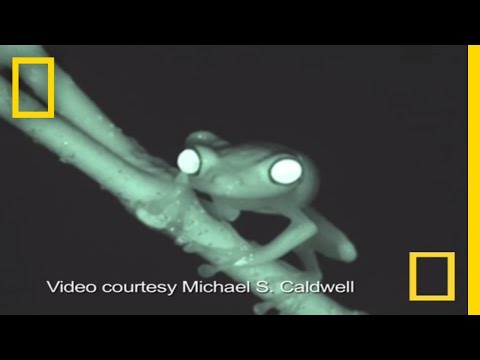
no they’re not shivering and no they’re
not getting shocked these red-eyed tree
frogs in Panama have been recorded
shaking their behinds to send a message
this shaking known as tribulation is a
form of communication between male tree
frogs the males are trim you lating to
establish which is the dominant male
they’re claiming territory for their
calling area where they spend the night
calling for female mate sometimes the
shaking leads to wrestling among males
and maybe even more shaking until the
loser retreats researcher Michael
Caldwell of Boston University and his
colleagues used infrared cameras at the
Smithsonian Tropical Research Institute
in Panama to record the tribulation they
even used Robo frogs seen in the lower
right here for part of the experiment
Caldwell suggests the shaking behavior
had not been previously observed
probably because the tree frogs behaved
differently under white light which
researchers usually use to record these
nocturnal creatures the red-eyed tree
frogs live in the rain forests from
southern Mexico to northern South
America many scientists believe it
developed it’s vivid scarlet eyes to
shock predators into at least briefly
questioning their meal choice and their
neon green bodies coupled with the red
eyes may play havoc with their nocturnal
predators visual senses the tree frogs
sleep by day
stuck to leaf bottoms with their eyes
closed and body markings covered the
scientists believe the vibrations
created by the shaking are an important
part of the communication because in
many instances the shaking frog was not
even in view of the intended recipient
of the message and even if he had his
back turned it seemed the receiving frog
knew what the message was Caldwell and
his colleagues published their findings
in a recent online issue of Current
Biology
though their discoveries are believed to
be new the researchers don’t think the
shake
behavior is isolated to the red-eye tree
frogs they suggest that vibrational
signaling might in fact be common in
other vertebrates that spend most of
their time in the foliage of the
rainforests perhaps because they do this
in the cover of darkness and camera
lights change their behavior scientists
just haven’t witnessed the shaking yet
you
not getting shocked these red-eyed tree
frogs in Panama have been recorded
shaking their behinds to send a message
this shaking known as tribulation is a
form of communication between male tree
frogs the males are trim you lating to
establish which is the dominant male
they’re claiming territory for their
calling area where they spend the night
calling for female mate sometimes the
shaking leads to wrestling among males
and maybe even more shaking until the
loser retreats researcher Michael
Caldwell of Boston University and his
colleagues used infrared cameras at the
Smithsonian Tropical Research Institute
in Panama to record the tribulation they
even used Robo frogs seen in the lower
right here for part of the experiment
Caldwell suggests the shaking behavior
had not been previously observed
probably because the tree frogs behaved
differently under white light which
researchers usually use to record these
nocturnal creatures the red-eyed tree
frogs live in the rain forests from
southern Mexico to northern South
America many scientists believe it
developed it’s vivid scarlet eyes to
shock predators into at least briefly
questioning their meal choice and their
neon green bodies coupled with the red
eyes may play havoc with their nocturnal
predators visual senses the tree frogs
sleep by day
stuck to leaf bottoms with their eyes
closed and body markings covered the
scientists believe the vibrations
created by the shaking are an important
part of the communication because in
many instances the shaking frog was not
even in view of the intended recipient
of the message and even if he had his
back turned it seemed the receiving frog
knew what the message was Caldwell and
his colleagues published their findings
in a recent online issue of Current
Biology
though their discoveries are believed to
be new the researchers don’t think the
shake
behavior is isolated to the red-eye tree
frogs they suggest that vibrational
signaling might in fact be common in
other vertebrates that spend most of
their time in the foliage of the
rainforests perhaps because they do this
in the cover of darkness and camera
lights change their behavior scientists
just haven’t witnessed the shaking yet
you
Please follow and like us: