
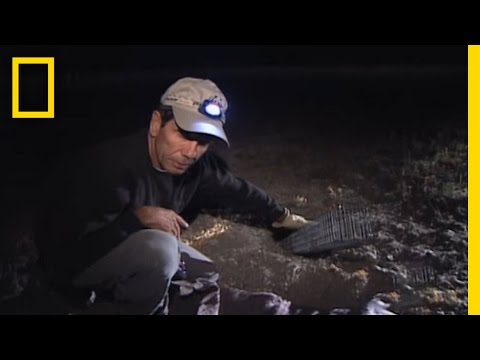
a team from the World Wildlife Fund
works the night shift to ensure a future
for one of the rarest mammals in North
America at the end of this bumpy ride
across the Dakota Plains is a colony of
mammals still struggling back from the
brink of extinction
and our job tonight is to catch ferrets
from previous years and also pick up a
few juveniles young of this year who
haven’t been marked yet see the bright
green eyes shine by the light of the
moon and headlamps the team captures the
small animals close to a dozen each
night for a ferret physical we just set
them in the hole
so it’s triggered by we try to make this
a natural extension of the burrow system
impossible and then it’s triggered by
when the third comes up and steps on
this treadle because they’re very
curious animals and they won’t be able
to abide staying down there very long
without coming up to see what’s going on
okay this is a juvenile any of that you
know this is a young one probably a
young female just bite-sized how you
doing good the black tubes too clicks
her into the darkness of the two and if
she were transponder diff she had a chip
in her you can’t read it in the metal
trap so you have to transfer them anyway
yeah Travis I ended up with female KITT
okay gas is on inside the trailer the
team puts technology and pharmaceuticals
to work we’re going to put a microchip
in do the vaccine we’ll get a little
hair sample so they can do DNA tracking
on it we’ll get a swab of the inside of
the cheek so they can do DNA on it too
he’s gonna do some prevent
it doesn’t know plague vaccine this is
like liquid gold almost this is an
experimental vaccine that as we’ve
gotten ahold of in the ferret program we
know that in lab trials it works very
well on black-footed ferrets and this is
good old Clary all nice and easy natural
black number 122 we can put a little bit
a little bit black dye on his neck and
then you know it’s somebody we already
trapped up we don’t have to deal with
them okay his head’s here here we go we
we put them back in the same burrow from
where we trap them especially the kits
especially the young of the year because
they’re still potentially tied to their
to their mother
you got you got lucky they usually go
right down the hole that’s cool there’s
no textbook a lot of captive breeding
reintroduce black-footed ferrets so a
lot of this was learned by trial and
error during 85 87 they were able to
trap the last 18 bifida fertile existed
Meeteetse Wyoming those animals went to
a captive breeding center in Wyoming and
that’s when the captive breeding effort
started big male just take a look at it
here we’ve got a little boy all the
blood sweat and tears that myselfin
other individuals in this program are
really paying off we have wild black
food ferrets reproducing on the ground a
fully fledged self-sustaining population
here in South Dakota
it’s just four most satisfying feelings
I’ve had my career so far
the team has worked the night shift on
this Prairie for five years to ensure
these black footed creatures their
historic plan
[Music]
works the night shift to ensure a future
for one of the rarest mammals in North
America at the end of this bumpy ride
across the Dakota Plains is a colony of
mammals still struggling back from the
brink of extinction
and our job tonight is to catch ferrets
from previous years and also pick up a
few juveniles young of this year who
haven’t been marked yet see the bright
green eyes shine by the light of the
moon and headlamps the team captures the
small animals close to a dozen each
night for a ferret physical we just set
them in the hole
so it’s triggered by we try to make this
a natural extension of the burrow system
impossible and then it’s triggered by
when the third comes up and steps on
this treadle because they’re very
curious animals and they won’t be able
to abide staying down there very long
without coming up to see what’s going on
okay this is a juvenile any of that you
know this is a young one probably a
young female just bite-sized how you
doing good the black tubes too clicks
her into the darkness of the two and if
she were transponder diff she had a chip
in her you can’t read it in the metal
trap so you have to transfer them anyway
yeah Travis I ended up with female KITT
okay gas is on inside the trailer the
team puts technology and pharmaceuticals
to work we’re going to put a microchip
in do the vaccine we’ll get a little
hair sample so they can do DNA tracking
on it we’ll get a swab of the inside of
the cheek so they can do DNA on it too
he’s gonna do some prevent
it doesn’t know plague vaccine this is
like liquid gold almost this is an
experimental vaccine that as we’ve
gotten ahold of in the ferret program we
know that in lab trials it works very
well on black-footed ferrets and this is
good old Clary all nice and easy natural
black number 122 we can put a little bit
a little bit black dye on his neck and
then you know it’s somebody we already
trapped up we don’t have to deal with
them okay his head’s here here we go we
we put them back in the same burrow from
where we trap them especially the kits
especially the young of the year because
they’re still potentially tied to their
to their mother
you got you got lucky they usually go
right down the hole that’s cool there’s
no textbook a lot of captive breeding
reintroduce black-footed ferrets so a
lot of this was learned by trial and
error during 85 87 they were able to
trap the last 18 bifida fertile existed
Meeteetse Wyoming those animals went to
a captive breeding center in Wyoming and
that’s when the captive breeding effort
started big male just take a look at it
here we’ve got a little boy all the
blood sweat and tears that myselfin
other individuals in this program are
really paying off we have wild black
food ferrets reproducing on the ground a
fully fledged self-sustaining population
here in South Dakota
it’s just four most satisfying feelings
I’ve had my career so far
the team has worked the night shift on
this Prairie for five years to ensure
these black footed creatures their
historic plan
[Music]
Please follow and like us: