
[Music]
follow any muscle to its base through a
bundle of strong flexible fibers called
tendons down to the very point where
it’s anchored and you’ll find one of the
world’s most remarkable materials bone
some 206 of these engineering Marvel’s
are strewn throughout the body strong
enough to support up to 20 times our
body weight light enough to defy gravity
however briefly flexible enough to
absorb unfathomable impacts and connect
it in such a way so as to provide a
seemingly endless range of movement
accounting for some 15% of our body mass
bones are what give us our shape without
them we would all look like this
but despite the amazing strength and
support our inner frameworks provide
they’ve had a pretty bad rap
[Music]
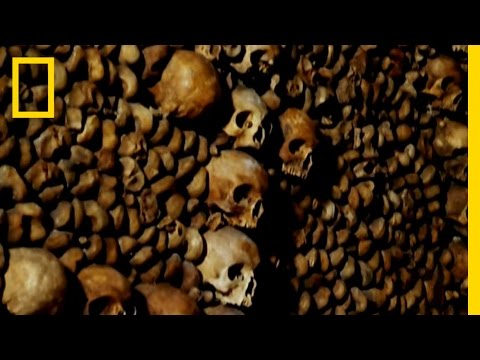
to send sixty feet under the streets of
Paris into its catacombs hundreds of
years old and we get the stereotypical
image of bone dry sterile white dead
that’s not exactly surprising this is
the only way most of us ever get to see
bones
[Music]
and not to be too morbid but these are
the only bits of us that are going to be
left this was the world’s first glimpse
of bone inside a living human body the
left hand of Roberta Rankin has imaged
in 1895 by her husband Wilhelm Rudkin
Discoverer of the x-ray we’ve come a
long way since then and it turns out
bones are anything but dry deep in the
center of many bones in this tissue
called the marrow some 120 million
oxygen-carrying red blood cells and 7
million microbe fighting white blood
cells are born every minute and shipped
off to the rest of the body toward the
surface specialized cells continually
lay down no bone while others do the
opposite and whisk old layers away this
is how bone grows with us throughout our
youth and keeps itself strong long after
we’re growing
if we suck away all that marrow we see
bone is mainly a blend of two substances
the mineral calcium phosphate and the
protein collagen is a match made in
heaven without flexible collagen bone
would be as brittle as glass without
calcium phosphate it would be as
unstructured as rubber together they’re
light enough to maneuver strong enough
to shelter our most delicate inner
organs and resilient enough to last a
lifetime no champion gymnast like Joey
Haggerty routinely pushed the limits of
bone they trained them to grow and adapt
to extremes Sports physiologist Bill
Sands tries to ensure this isn’t past
the breaking point bones a living tissue
like all other living tissues so the
function the things we ask the tissue to
do as long as we provide that those
stimuli carefully slowly progressively
we can usually get tissues to withstand
astonishing things it is this adaptive
property at home that allows a martial
arts expert to punch straight through
concrete you don’t do that the first day
of course I mean you have to fill them
up more and more and more over probably
multiple years the same goes for gymnast
whose bones absorb a tremendous amount
of shock
yeah don’t hook your toes Sanz uses a
variety of apparatuses to measure this
like these inserts that measure the
forces on Joey’s feet and high-speed
cameras to record the impact
well here right here he’s over 150
pounds per square inch trust me that’s a
big force the force is generally seen in
gymnastics are the biggest forces I
think we’ve had recorded so far in the
14 to 20 inch times body weight
[Music]
Please follow and like us: