
the story of ancient Rome is a story of
evolution of how a civilizations ability
to adapt and dominate can lead to its
survival for over a thousand years Rome
began as a small village on Central
Italy’s Tiber River in the coming
centuries it grew into an empire that
stretched from the North Atlantic all
the way to the Persian Gulf during this
transformation Rome displayed a
political military and cultural prowess
that enabled it to become a superpower
and helped shape what would become known
as Western civilization the life span of
ancient Rome can be divided into three
major periods the Regal the Republican
and the Imperial during the Regal period
Rome was minar kacal and ruled by a
succession of about seven kings Rome’s
first King according to legend was a man
named Romulus he and his twin brother
Remus are said to have founded Rome in
753 BC in 509 BC Rome adopted a
Republican system of governance in which
the state was primarily ruled by to
annually elected representatives called
praetor’s who were later called consuls
one of them became a famous general and
dictator Julius Caesar
[Music]
the Imperial period followed it was
characterized by the rise of the Roman
Empire and notorious leaders such as
Octavian Rome’s first emperor who
ushered in an era of peace and Nero who
some scholars believe was Rome’s
cruelest emperor Rome’s focus and pride
in its military was vital to the
civilizations growth and this ethos was
evident as early as the regal period
when Rome was only a small village still
Rome slowly conquered and annexed
neighbouring people’s the slow and
steady expansion eventually led to the
Romans domination of the Italian
peninsula and the entire Mediterranean
Sea where they conquered the Greeks
Egyptians and Carthaginians military
conquests would later help Rome conquer
lands as far away as Britain and Iraq
this massive scale and growing populous
necessitated advancements in Roman
engineering aqueducts were constructed
which increased the public’s access to
water helped improve public health and
paved the way for Rome’s famed bath
houses a 50,000 mile long road system
was built as well while made originally
for the military it facilitated the
movement of people and ideas throughout
the empire
this transmission of ideas and increased
contact with diverse cultures also
enabled other aspects of Roman culture
to evolve
a key to Rome’s success in the longevity
was the Empire’s inclusion of cultures
from the lands they conquered from the
nearby land of Latium Rome acquired the
Latin language which became the Empire’s
official language and the ancestor to
Europe’s Romance languages Romans also
adopted cultural aspects from the
ancient state of Etruria including their
religion alphabet and the spectacle of
gladiator combat however no other
civilization influenced the Romans as
much as the ancient Greeks their
influence is probably most apparent in
Rome’s art and architecture upper-class
Romans commissioned paintings and
sculptures to imitate Greek art Greek
architectural styles such as columns
were implemented in Roman structures
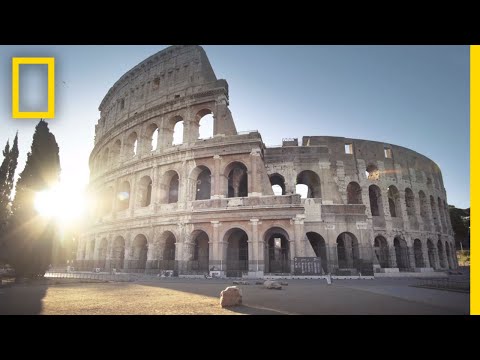
such as the Pantheon and Colosseum one
cultural shift in particular that
resonated throughout the Empire was the
rise of Christianity originating in the
Middle East the religion found a strong
advocate in Constantine the first the
first Roman Emperor to convert to
Christianity he enabled Rome’s
transition into a Christian state and
encouraged the religion to spread across
Europe by the 4th century after a
lifespan of over a millennium the Roman
Empire declined factors including
political corruption economic crises and
class conflict led to the Empire’s decay
from within
while invasions and other military
threats caused it to break down from
outside Rome’s ability to incorporate
diverse cultures dominate rivals and
adapt political systems to the needs of
its people are all lessons to be learned
for time eternal
[Music]
[Music]
Please follow and like us: