
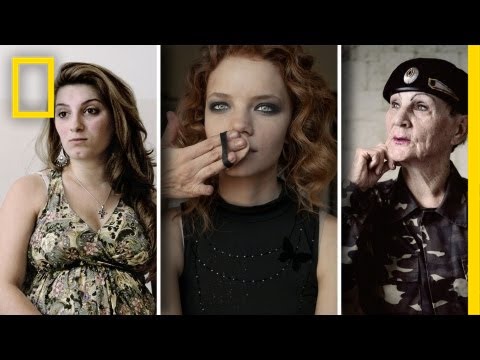
most of my personal work focuses almost
exclusively on the lives of women who
are living in gender segregated
environments in different places around
the world and it’s such a privilege
because as a photographer you get to
experience in some small way what life
might have been like if you were
somebody else
thank you hi I grew up traveling in the
summers in a horse-drawn wagon in the
southwest of the UK and over wintering
in a caravan in a trailer in this field
in Devon my parents made their living
through odd jobs this picture was taken
in 1985 and it’s me and my mom and our
horse Shadowfax and my little brother on
my mum’s back so we traveled and we had
adventures but we were always broke and
life was really difficult being broke
and I remember thinking that I really
didn’t want to be broke when I grew up
so eventually I learned about this
wonderful job called photojournalism and
I thought well maybe that’s for me
because I could travel and I could get
paid for it I would like to share with
you some earlier work now the work that
brought me here actually most of my
personal work focuses almost exclusively
on the lives of women who are living in
gender segregated environments in
different places around the world and I
love being a photographer and I didn’t
have to sacrifice so much to be one
except for horses and this has made me
so sad I’m not able to have my own I’ve
spent maybe a few nights if I’m lucky at
home in London a month and really not
having those animals as part of my life
made me sad and the wonderful thing
about being a photographer is that you
can go anywhere you want and you can
meet anybody that you want for no reason
other than that you just want to so one
night I was sitting around complaining
about how unhappy I words that I didn’t
have horses in my life was my friend
Camila and she had grown up in the
circus and she said you know I metco sex
in the circus I can’t go
because I have a job but you should go
and I thought why not
and this was really the start of my work
in Russia and the caucuses why I’ve been
working for the last couple of years I
stayed at Bella kill it for the Cossack
cadet school and the girls dormitories
actually for a week and from there
traveled around southern Russia and also
into Crimea Ukraine this is the
dormitory so my fixer Masha and I each
got a bed in the dorm and and we stayed
with the girls there again it’s such a
privilege because as a photographer you
get to experience in some small way what
life might have been like if you were
somebody else of course it’s not the
same as experience but I at least have a
sense of what it might have been like to
to be a teenager in this school hard if
you want to date boys I can tell you
that much this is the only chance they
get to interact in the corridors between
lessons and so of course there are men
in the Cossacks as well but continue
with the theme of where my interest
lives of groups of women and living or
working in segregated environments
I focus mainly on the women while I was
there and I continued working in this
region nagorno-karabakh is an
unrecognized Republic that lies between
Azerbaijan and Armenia it’s a 1700
square miles very small and in 2008 the
de facto government they’re introduced
the birth encouragement program and
their aim was to repopulate the region
and increase the birth rate and also the
population to pre-war figures the war
started in 1991 and ran 294 just as the
Soviet Union collapsed and the ethnic
Armenians the majority in
nagorno-karabakh waged war against the
ethnic as Ares Muslims each backed by
neighboring countries so it also became
a war between Armenia and Azerbaijan and
this conflict left 45,000 ethnikos Ares
displaced and 65,000 ethnic Armenians
but in the region a total of 1 million
became refugees the de facto government
see increasing the population to pre-war
figures before the Azzurri is left as a
way of legitimizing and their country
internationally and as is always the
case with photography this isn’t the
whole story I’d like to say it’s even
half the story but but it’s not the
majority ethnic Armenians remain in
nagorno-karabakh and in 2011 they
celebrated 20 years of independence from
Azerbaijan so the birth encouragement
program gives cash payments to couples
on their wedding day and I’m just going
to read the figures here
and surprisingly none of my friends are
ever asked me to photograph their own
weddings so the first payment that the
government administer is for seven
hundred and forty dollars to help with
the wedding of any young couple in
nagorno-karabakh then it’s two hundred
and forty dollars approximately for the
first baby five hundred dollars for the
second one thousand two hundred and
twenty dollars for the third child and
one thousand seven hundred and thirty
dollars for the fourth baby once you
have six children under the age of 18
you’re given a free house to keep and
it’s working so the figures that I had
access to were between 2007 and 2010 and
during that time the birth rate had
spiked by twenty five point five percent
actually nagorno-karabakh has many
repopulation programs in fact this might
be something you guys are interested in
sushi was them one of the considered to
be the cultural capital of
nagorno-karabakh the city of artists
poets you know bohemian types and if you
are a creative person and you have a
creative job photography does count by
the way because I did check and you want
to move to sushi regardless of your
nationality you will be given a free
house so there are also programs to
resettle poor Armenians and other things
so this is just one part of a huge
repopulation program that the de facto
government are running and here an insta
panic at Maternity Hospital is really
the front line of the baby boom about
six or seven children are born a day
here and the maternity hospital it’s a
one of only two maternity hospitals in
Kara back this is the grandmother and
grandfather Kara back it’s the national
symbol of nagorno-karabakh and when
couples get married they always drive
past the monument to have their wedding
pictures taken there
so I shot this story in 2011 and that
was the year as I said that
nagorno-karabakh celebrated 20 years of
independence from Azerbaijan yet remains
unrecognized by the rest of the world if
you look at a map it’s not there in 2011
the world population also reached 7
billion and I thought it was interesting
that there might be this small country
in the world who were actively trying to
increase the bursary of their population
where when there are so many programs to
decrease it and most well-known are of
course in China and India and also in
2011 I turned 30 and some of you might
know this but when you turn 30 and
you’re a woman almost to the hour people
start asking you when are you going to
have children and if they know you
better they might say are you ever going
to have children but in any case I
realized that for all of the time that
I’d been a photographer I had always and
while I’ve been photographing young
women i had never photographed mothers
and again the wonderful thing about
photography is that it’s a way to
explore your own life as well as others
so i decided well maybe now is the time
since everybody’s bloody asking me to go
and history about babies so this is
mariana and sevak and i met mariana
while she was giving birth to her
daughter na rahe and insta panic at
Maternity Hospital and the picture will
come later Saavik is in the Armenian
army and actually they were married in
2008 in a private mass wedding of almost
700 couples this was funded by wealthy
Armenian diaspora businessmen and was
actually the event that sparked the
government program for the baby boom so
actually they were given higher payments
and with the birth of their daughter
naari I think it’s almost five thousand
dollars they’ve been paid and so these
payments are quite significant in a
region where the the average monthly
income is 35 euros
so I hang out in churches and hospitals
and photographed people getting married
and children being christened and women
giving birth this is marina she’s 19 I
went to stay with her and her tiny
village Cole attack her husband serves
also in the Armenian army and he’s based
on the Israeli border although there is
relative peace between a Kara back and
Azerbaijan a piece a peace agreement has
never been reached so there are still
simmering tensions on the border and
there’s a DMZ set up in that area this
is the records department Stepanek at
Maternity Hospital each file represents
one woman who is currently a patient and
her children
so I learned that having kids is really
really hard again I focused on the women
in this story because although men are
present they actually play a very small
role in child rearing and domestic life
you know they showed up at weddings and
for supper but um no that’s a little bit
me but of as it was also the case that i
have noticed in russia and male and
female gender roles are very very
clearly defined so men must be manly and
provide their family and go out and work
and women are homemakers and caregivers
and and both are respected equally
within society so this is Marianna
giving birth actually it was the first
birth that I had ever witnessed I
thought yeah when I was thinking about
doing the project I thought that’s kind
of crazy I’m a photographer I can go
anywhere do anything I’ve lived 30 years
on this planet and I’ve never seen a
baby being born so this was this was the
first time and actually and the birthing
systems quite interesting here in
nagorno-karabakh men aren’t allowed into
the wards and the wards are locked so
only women are allowed inside so it
means that all of the women I met were
giving birth alone I’m not even their
relatives are allowed inside its kind of
quite Soviet and the nurses are like
shut up and get on with it so Mariana
was quite glad to have me there and and
as of my fixer and we sort of acted as
unofficial birthing partners although we
didn’t have a clue what we were doing
except from what we’d seen on the telly
so we were like I hate breathe please
Ben and then occasionally I’d have to
say two hours to get out the way I need
to take a photo
this is Rosa she was 35 when I
photographed her and she has six
children under the age of 18 so this is
one of the three houses that are given
out and Stepanek yet an area called not
a rush they’re all and prefab houses so
they’re cheap but you you get to keep
them it’s not like social housing in the
UK for example so I continued working
still in this region and the last story
i will show you is is also from russia
i’ll start by showing usual multimedia
piece and then tell you a little bit
about what interests me and what made me
want to go there nice to meet you in
italia my name’s andrew
I detailed Chanel Christian Dior
Givenchy martin margiela and Rhydian and
I did christian dior five times you
swore and eli’s your logic is one RF Lao
si muy I’m strong I am
who you with and on Milan mother
japanese like yeah
not on normal now you can smile
yeah but listen you soon and he likes
your logic is one not a flower team oily
and I’m strong I can t do I ever go back
yes the wall good hold this good hi
what’s your name my name nice to meet
you violet how old are you yeah you’re
13
I’ll speculator the guy that is you
might show you is there in socially
scarce kia kaha the money is our money
he’s only that idea so did she try in
any shape or form to do that there’s no
matter what you’re the bad guy
I had never really intended to do a
story about the fashion industry it
wasn’t something that necessarily
interested me but when I heard about
these tens of thousands of young women
migrating from Siberia I’m trying to get
to the west to work as supermodels it
struck a chord with me because no matter
where you go in the world young women
usually have this drive to get the hell
out of where they come from and although
Devon isn’t as remote as Siberia it sure
as hell felt like it when I was 15 and
photography was my ticket so I kind of I
admired them and actually what interest
these girls mostly wasn’t modeling at
all it was just the opportunity to see
the world and experience life outside of
the small towns where they had come from
so I spent seven weeks traveling along
with trans-siberian railway stopping off
at major cities along the way and
visiting modeling schools where girls
are taught to walk apply makeup how to
be demure actually I found that a lot of
these schools weren’t only designed to
prepare women for a modeling career but
they were being used in a way as a kind
of finishing school so again with gender
roles being very clearly defined men
being expected to be masculine and women
being expected to be feminine this was
almost a rite of passage in the way that
where I come from young girls do ballet
and what boys play rugby it was kind of
expected that girls would go to these
sorts of schools and I was also very
aware that i didn’t want to necessarily
make a comment about the modeling
industry and the size zero issues and
eating disorders and all these things
that are associated with the industry
particularly when it comes to social
documentary that wasn’t so much what I
was interested in focusing on
but I found while I was in Russia
although I have clearly never had any
aspirations of becoming a model myself
spending weeks and days and hours in
rooms where I was surrounded by mirrors
kind of make me feel about the way
I looked as well and even I was only
looking at myself to try and avoid my
reflection in the picture but still I
realized that it did it did eat away at
these girls self-esteem they’re being
you know they’re constantly being
measured and prodded and that’s not a
criticism necessarily at the end of the
industry in many ways it’s a necessity
for the industry that they work in as
with all my stories I didn’t want to
pass judgment on on anybody particularly
within the story and lastly Nastya
Nastya is short in Russian for Anastasia
and nastya made it big and she came to
London I photographed her during London
Fashion Week she travels all over the
world and the whole time she’s traveling
or she says is that she’s gaining as
many experiences as she can and she’s
earning it as much money as she can so
that she can go home and have a normal
life and again that spoke to me because
I think the further photography takes me
away from that field in Devon perhaps
the closer I am to coming back to it at
some point so thank you very much for
listening to me
you
Please follow and like us: