
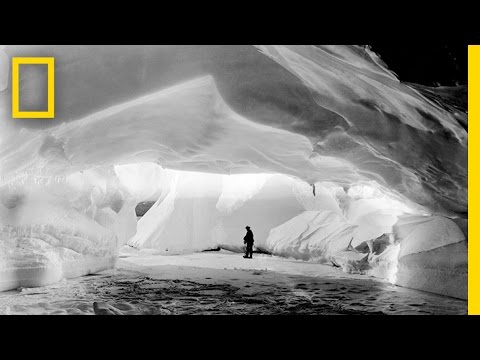
Douglas Mawson chose for his expedition
a 2,000 mile swath of Antarctica all of
it unknown he actually says in his diary
I have no hope of making it back
amazingly a verse came into his head
just have one more try it’s dead easy to
die it’s the keeping on living that’s
hard here’s one of the great stories in
exploration history that deserves to be
better known
in January 1915 Douglas Mawson spoke to
the National Geographic Society 98 years
ago so it’s a wonderful tradition that
the society has of speakers who were
still celebrating a century later who
actually came spoke to the Society
Mawson was the contemporary of Scot
Shackleton an Amundsen and has been
eclipsed ever since by those three great
figures and I think there’s three
reasons for it the first is that he was
Australian and sadly we in the Western
Hemisphere and in Europe have always
looked at Australia and Australian deeds
as way out there on the periphery the
second reason is that unlike those other
three greats Mawson was totally
uninterested in going to the South Pole
he saw that as completely arbitrary and
and pointless he was interested in
science and science to him meant
collecting everything in sight and
exploring unknown land so Mawson chose
for his expedition not a quest for the
pole the South Pole but a survey as
complete as possible of a 2,000 mile
swath of the continents directly south
of Australia completely unknown land so
unknown that it was a flip of the coin
whether it was actually land at all as
opposed to a series of little rocky
islands surrounded by sea ice and
finally the reason he’s neglected or not
so well known today is that he returned
to Australia with the greatest survival
story ever at the same time as the news
about Amundsen and Scott’s race to the
pole was circling the globe and the
tragic story if Scott reaching the pole
a month after Amundsen but dying with
his four companions on the return
March this so captured not just the
British audience but the the attention
of the public world over worldwide that
Mawson was sort of eclipsed by this and
has been ever since the famous studio
portrait of him taken when he was 28
there the quote from Washington Post his
mind impossibly handsome he was 6 feet 3
with sparkling blue eyes and but he was
also a great he was as great a leader of
men as Shackleton
the photos from here on or her lease and
Hurley was a young up-and-coming
Australian photographer who attracted
boss’s attention but almost didn’t go on
the expedition because Mom because his
Hurley’s mother wrote Mawson a letter
saying for God’s sake don’t take my son
on the expedition he’ll never survive
he’s in very poor health and without
Hurley knowing mom had written this
letter so Moss and grilled and examined
and questioned Hurley at length and
finally decided to let him come along
and history is that much the richer for
it most of the other members were so
green they’ve never been on expeditions
before they averaged an age only about
24 a lot of them were University
graduate students of Mawson’s and others
something like a third of them had never
seen snow there’s a lot of snow in
Australia and they say things like on
their diaries on the first first days on
shore my first day in his sleeping bag
when they got to Cape Denison they had a
snowball fight
they were like kids they were like frat
boys you know running wild one of their
first favorite occupations was to push
penguins off the cliffs into the water
so he set out with 38 men 31 men in late
nineteen eleven with a completely
radical new plan for how to approach
Antarctica the plan was to use as a way
station halfway between Antarctica
Australia Antarctica Macquarie Island a
long time sealing station fairly
desolate place in its own right but
where he hoped to drop off five men to
erect radio masts and transmitting
equipment
Mawson hoped to be the first expedition
ever to have radio contact with the
outside and yeah it was a brilliant plan
that that was wrecked by some very
strange factors I’ll get into later the
the ship having dropped off the 5-minute
Macquarie what went straight south
hoping to find a good Anchorage on the
continent itself and all they found was
ice cliffs so they kept skirting west
and west and west looking for any kind
of an inlet and meanwhile the ship got
terribly iced up every day finally they
came to a plausible Inlet which they
named Commonwealth Bay unwittingly it
turns out to be the windiest place in
the world at sea level
the summit of k2 may be windier but
scientists 70 years later proved that
the the winds here are literally the
fiercest and most continuous anywhere in
the world any other part of Antarctica
any other place in the world and this
created tremendous stress and hampered
all of the research efforts of the team
to give you an idea what that means that
in the month of May 1912 which is one of
the coldest and darkest months in
Antarctica the average wind velocity day
and night
hours a day for a month was sixty point
seven miles an hour I mean some of you
have been in sixty mile an hour winds
for a few hours it’s rough I love this
photo of a bunch of penguins right after
a blasting sleet storm
the poor guy on the Left doesn’t know
what hit a many others the others are
wondering what hit him too
all they can do this winging summer an
early autumn of 1912 is make
reconnaissance ‘as the big expeditions
are going to happen next summer so they
have to win her over
then the autumn wanes and winter sets in
but inside the hut you could have a
certain coziness and camaraderie they
they always centered around the
gramophone and Mawson was very collegial
he would share messes with it with his
man always and was one of the guys and
you get a sense of how beleaguered the
snowpack made living in the hut you
couldn’t get in the doorways after walls
he had to climb out these escape hatches
in the roof that’s the actual doorway
which has turned into a tunnel of snow
this illustrates the difficulty of
working in the wind
Hurley called this wind walking he said
that you could wind walk in an 80 mile
an hour wind this is maybe 80 miles an
hour but a hundred miles an hour at not
g-flat
Hurley shot a lot of these this is a guy
who’s just gone out for an hour to check
the wind gauge and other scientific
instruments and by the time he gets back
into the hut that’s what his hood and
face look like most of the work was man
hauling sledges with makeshift sails to
help and moss had divided all his 18 men
into three-man parties that would go out
every which way the simple point was
just discovered new land go every
direction possible finally the next
summer came six parties set out in six
different directions three-man parties
all of the man’s
man hauling except the three-man team
that was the most ambitious that by
maussan his two teammates were Savior
merge pictured here a 28-year old lawyer
from Switzerland and also the Swiss
national ski jump champion he was a
great athlete they all said he was the
best athlete on the expedition he was
the only guy who knew how to ski and the
third member was a 26 year old British
soldier in the Royal Fusiliers named
Belgrave ninnis who was nicknamed cherub
for his youthful complexion but he was a
great favorite of the whole team so
these three set out on the far eastern
journey which aimed at going 350 miles
to the southeast to try to link up with
the land that Scott had discovered in
Ross in the Ross Sea the year before all
of it unknown these pictures are not
actually from the expedition itself
because as I explained in a minute no
photographs survived from the three-man
party but these are Hurley photos of the
very kinds of obstacles they had to
overcome a nice fall like this is tough
enough to just climb through with an ice
axe let alone try to get sledges and
dogs through and the big threat was
crevasses an open crevasse like this is
no problem except you have to find a way
around it but the really fiendish thing
was a hidden crevasse one covered by a
snow bridge so it’s almost invisible but
which you can plunge into if you break
through the snow bridge the set out in
the early November from the main base
Hut they’re having all kinds of problems
here lots of crevasses scores of
crevasses they cross successfully they
get out here they’re five weeks out
December 14th they’re going across what
looks like an absolute ordinary crevasse
and Mertz in the lead Scouts they had
waves back there’s a little crevasse
here Mawson makes a signal back to Nana
to Dennis
Mawson took the dirty job he took a
second sledge with all the less valuable
equipment on it figuring that if anybody
broke through would be he and his sledge
and his dogs that were six dogs and that
the really precious stuff with minused
we would be safe for coming second but
they costed this ordinary crevasse Murch
looks back an alarm
Mawson looks back and there’s no sign of
menace they go right back to the edge
and here’s a sudden hole punched in the
eleven feet across punched in the snow
bridge and they look down into this
gigantic chasm and all they can see a
hundred and fifty feet down is a single
dog groaning its back broken resting on
a snow ledge another dog dead a few
pieces of broken parts of the sledge no
sign of meanness no sign of the sledge
to the rest of the gear the they shout
for three hours they don’t have a rope
to get down in there they string
together all their cord just to figure
out that it’s 150 feet down they
suddenly realize what a predicament
they’re in because on that sledge was
all the dogs food and all but one and a
half weeks of men’s food so they’re five
weeks out three hundred miles to get
back they take a route farther south
hoping to avoid the worst of these
glaciers they’ve got six dogs the six
weakest dogs they’re each playing out
they pull as hard as they can and then
moss and emerge has to shoot the dog
feed part of it to themselves part of it
to the other dogs by the time they get
to here there are no dogs left there man
hauling they only have a scraps of food
a little bit of chocolate raisins tea
and there’s still more than 100 miles
out Mertz
at this point cannot cannot sledge any
more he just lies in the tenses I can go
today we’ll try it tomorrow
and destroys Mawson mad he says I think
I could make it back myself but but I
can’t abandon my comrade finally on
January 8th Mertz goes into a delusion
he starts hysterically swinging his arms
around breaks a tentpole Mawson sits on
his chest to hold him down
Mertz is screaming in German
unintelligible words and then he he dies
in the night Mawson waits till morning
and buries him on the cache of snow
blocks and now realizes that he has a
hundred miles to go with almost nothing
left and he means to cut the sledge in
half he was able to get his supplies
onto this and man haul it but he
actually says in his diary I have no
hope of making it back alive but what
drives him on is the idea that if I can
only get my my diary and merchants diary
to somewhere and cash it and some some
time later searchers will find the
Diaries and learn what happened to us
that’s worth the struggle in its own
right
I can’t illustrate this because as I say
Mawson had to throw away his camera and
his film packs so sadly there are no
pictures of this ultimate survival story
his hair was coming out in clumps his
skin was festering boils forming all
over his face he about three days out he
takes off his socks which he hasn’t
taken off for days and discovers to his
horror that his soles have detached from
his feet they turned into these hard and
almost leather like skins that are no
longer attached to the fleshy the flesh
underneath or up above well On January
17th only about 20 miles of the hundred
bet on the way back he falls into a
crevasse and a really bad one and he
plunges through a snow bridge he’s taxed
to his to his sledge by a 14-foot robe
and he anticipates the end and the
sledge is pulled towards the edge of the
crevasse if it goes in with him he’s
suffering the same fate as notice it’s
gone and nobody will ever find him
miraculously the sledge catches in the
snow and acts like an anchor and holds
him but Nissen Mawson is hanging
dangling free can’t his feet can’t even
touch the edges of the crevasse he’s 14
feet down he actually thinks about
slipping out of the harness and ending
his life rather than dangling and
suffocating his first thought is a great
regret that he didn’t have a chance to
eat the very last of the food and but he
finally decides to summon up enough at
the extreme effort so he pulls he tied
knots thank God he tied knots in the
harness rope she grabs a knot tries to
go hand over hand
he’s completely debilitated he gets no
purchase from the sides of the walls and
after this tremendous effort he pulls up
onto the surface only to have the lip
break back again he plunges all the way
down to the fourteen feet and this time
in true despair anticipates the antis
so this is the end he says to himself
what pulled him out he says is two
things his trust in Providence and
whether by that he meant God is unclear
but he talks about Providence over and
over again
Providence always helping him but
amazingly averse from Roberts service
came into his head which is
and he quote it just have one more try
it’s dead easy to die it’s the keeping
on living that’s hard that’s what made
the difference for him keeping on living
that’s hard
he made this second effort tried to pull
himself out and completely exhausted did
what we climbers call up a heel hook he
put his feet up onto this surface before
the rest of his body and used his heels
to yank the rest of his body up and
crawled up onto the shelf passed out
because he woke up two hours later it
covered with new snow anyway he still
took him another twenty some days to get
back the last eighty miles to the hut
and at the end he’s stuck in an
eight-day storm at Aladdin’s cave only
five miles from the hut and he’s
thinking about that January 15th
deadline it’s long past he thinks will
there be anybody at the hut or will be
gone and on February 8th he comes back
to the hut the men there six men who
have been left to search for him and the
man seemed and run up the slope and
embrace him and they can’t even tell
which one he is he so emaciated and
wasted Mawson missed the ship through
leave ship by five hours so those seven
men are condemned to a second winter in
Antarctica but they have the radio they
brought a new radio operator the mast
never worked the first year because it
got blown down by the winds they got
sturdier now at least they’re going to
have contact with Australia they get two
or three weeks of blissful contact they
learn about moss and actually is able to
exchange telegrams with his fiancee they
they learn about Scott’s demise they
learn about cricket matches in Australia
and horse races and then the radio
operator Sydney Jefferies goes insane
and he ends up completely refusing to
broaden his the only guy knows how to
work the radio he ends up vacillating
through the whole winter between the
conviction that the others are going to
murder him and the attempt to murder
them can you imagine the second winter
with the constant tension of a crazy man
who is your only hope of radioing to the
outside world it gets so tensed they
have to keep a day-and-night watch on
Jeffrey’s finally in November early
summer late spring comes again the men
are just frantic for the return of the
ship they write things like a hundred to
only a hundred days till the ship comes
finally the Aurora does come and pick
them up they go back to Australia and
Mawson is immediately greeted as
tremendous hero he’s knighted by George
v Sidney Jeffries sadly spends the rest
of his life he lived in 1942 and insane
asylum but all in all what an incredible
story what a great survival story what
an amazing expedition well I hope you
become as enthralled this amazing trip
as I did and emerge as I began with the
greatest admiration for one of the great
exploratory heroes of all time Douglas
Mawson
thank you
you
Please follow and like us: