
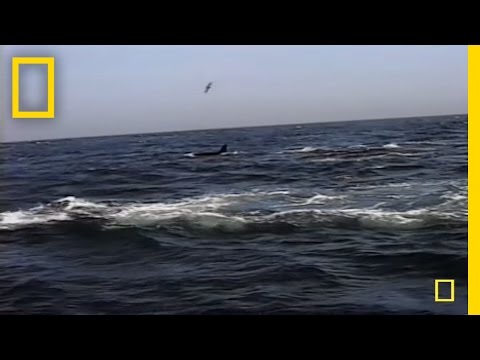
this is the season of the gray whale
California gray whales make one of the
longest migrations on the planet often
traveling up to 6,000 miles between
Mexico and the Arctic the first wave is
made up of adults more than 30 tons of
seagoing force killer whales have been
known to attack these leviathans but
they do so very rarely it’s the next
wave they’re waiting for coming up the
coast of Mexico are the mothers and
their newborn calves the Grays ever
weary of their only predator tend to hug
the coastline but there is one stretch
in their epic migration where the gray
whales cannot hide the broad expanse of
Monterey Bay to get across the Grays
must pass above an underwater chasm the
size of the Grand Canyon now they are
swimming across open water a mile deep
the killer whales can hear every sound
they make it’s a dangerous passage for
mother and calf marine biologist Nancy
Black has seen what can happen
a few years ago we found killer whales
closing in on a grey well female and
calf I was really excited because it was
one of the few times I’ve had an
opportunity to see killer whales hunting
together as a team it’s very rare
because Monterey is one of the few
places in the world we have an
opportunity to see something like this
as the attack began Nancy recognized the
members of a transient pod joined by
other transient groups they encircled
the gray whales blocking their escape
then they began to rammed a calf to
separate it from the female the calf
struggled to climb on its mother’s back
desperate to get out of the water
but it couldn’t stay on for long to help
her calf the mother turned belly-up but
the killer’s renew their attack the
killer will spent a lot of time bashing
and they rammed and hit the gray whale
calf they look like they were causing a
lots of internal injury to the calf when
they did that as the prey tired one
female transient made a dangerous
maneuver moving him alone against an
animal six times her size she tried to
separate the calf from its 30-ton mother
the rest of the pack joined in to shove
the calf away from its mother
then they began to push it below the
surface
if they could keep it down its lungs
would fill with water but the mother
would not give up on her path the cap
spent a lot of time rolling on top of
its mother and alongside of its mother
too and that rolling behavior seemed to
prevent the killer whales from getting
in the middle between the mother and
calf in the end it was the killer whales
that gave up two hours after the attack
began mother and calf escaped and the
killer whales went hungry
California gray whales make one of the
longest migrations on the planet often
traveling up to 6,000 miles between
Mexico and the Arctic the first wave is
made up of adults more than 30 tons of
seagoing force killer whales have been
known to attack these leviathans but
they do so very rarely it’s the next
wave they’re waiting for coming up the
coast of Mexico are the mothers and
their newborn calves the Grays ever
weary of their only predator tend to hug
the coastline but there is one stretch
in their epic migration where the gray
whales cannot hide the broad expanse of
Monterey Bay to get across the Grays
must pass above an underwater chasm the
size of the Grand Canyon now they are
swimming across open water a mile deep
the killer whales can hear every sound
they make it’s a dangerous passage for
mother and calf marine biologist Nancy
Black has seen what can happen
a few years ago we found killer whales
closing in on a grey well female and
calf I was really excited because it was
one of the few times I’ve had an
opportunity to see killer whales hunting
together as a team it’s very rare
because Monterey is one of the few
places in the world we have an
opportunity to see something like this
as the attack began Nancy recognized the
members of a transient pod joined by
other transient groups they encircled
the gray whales blocking their escape
then they began to rammed a calf to
separate it from the female the calf
struggled to climb on its mother’s back
desperate to get out of the water
but it couldn’t stay on for long to help
her calf the mother turned belly-up but
the killer’s renew their attack the
killer will spent a lot of time bashing
and they rammed and hit the gray whale
calf they look like they were causing a
lots of internal injury to the calf when
they did that as the prey tired one
female transient made a dangerous
maneuver moving him alone against an
animal six times her size she tried to
separate the calf from its 30-ton mother
the rest of the pack joined in to shove
the calf away from its mother
then they began to push it below the
surface
if they could keep it down its lungs
would fill with water but the mother
would not give up on her path the cap
spent a lot of time rolling on top of
its mother and alongside of its mother
too and that rolling behavior seemed to
prevent the killer whales from getting
in the middle between the mother and
calf in the end it was the killer whales
that gave up two hours after the attack
began mother and calf escaped and the
killer whales went hungry
Please follow and like us: