
the story really starts when we started
going to Peru so there were these
incredible fossils we first discovered
them in 2006 that started changing our
ideas about penguin evolution so 36
million years ago Peru is a very
different place they’re no Andes there’s
sort of proto Mountains we have a series
of what appear to be islands and lagoons
and now we have evidence of multiple
species of very sizable penguins this
animal would have had a swimming length
of approximately 1.5 meters and the
giant penguin schoo is like this long
and it was actually a student an
undergraduate student Ally Altamirano
who found the fossil and noted that
unusually there seemed to be scale
impressions on the foot and immediately
this sort of prompted kind of incredible
excitement because no one’s ever seen
the scales preserved in any or any kind
of evidence of soft tissue in a fossil
penguin and then we took the fossil back
to the lab and meticulously removing
flakes of rock from around the specimen
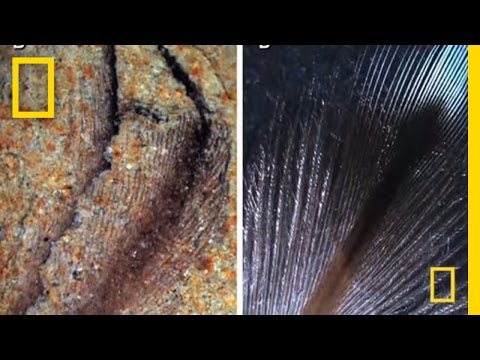
I was lucky enough right near one of the
wings to uncover what was clearly the
tip of a feather
it’s our first insight into what are the
series of early modifications in the
feathering closer to this transition to
basically flying underwater in the
origin of penguins what the new fossil
shows us is that modifications occurred
in the shape of these feathers really
early on and these tiny tiny feathers
that have been described as scale like
or scale shaped create a very
streamlined contour to the front of the
wing the primary feathers are densely
packed
they’ve lost this distinctive
asymmetrical organization we see here
and kind of more dramatically we see a
dense packing of primary feathers
whereas living birds have give or take
10 primary feathers in the wing penguins
have more like 20 and they’re stacked
one on top of the other to create a
stiffened flipper so that all of these
change
have happened really early in penguin
evolution by the divergence the
branching off of our giant penguin so
coincidentally around the same time we
are finding the first evidence of
feathers in this giant penguin other
colleagues are making the discovery that
fossil feathers can preserve evidence of
their color what the feathers contain
are imprints of color imparting
organelles in the feather and what they
in fact record is the shape and size and
packing of these organelles called
mallanna’s ohms that contain melanin all
living penguins have this distinct black
and white tuxedo like appearance and the
fossil is in gray tone and reddish brown
this is only the second color map of an
extinct vertebrate that is mammal or
bird though only the second time we’ve
been able to reconstruct color in an
extinct organism penguins are quite
different from what we imagine them to
be sort of in movies or what we see
today that there’s this really rich
history in penguins that we are just
beginning to understand
you
going to Peru so there were these
incredible fossils we first discovered
them in 2006 that started changing our
ideas about penguin evolution so 36
million years ago Peru is a very
different place they’re no Andes there’s
sort of proto Mountains we have a series
of what appear to be islands and lagoons
and now we have evidence of multiple
species of very sizable penguins this
animal would have had a swimming length
of approximately 1.5 meters and the
giant penguin schoo is like this long
and it was actually a student an
undergraduate student Ally Altamirano
who found the fossil and noted that
unusually there seemed to be scale
impressions on the foot and immediately
this sort of prompted kind of incredible
excitement because no one’s ever seen
the scales preserved in any or any kind
of evidence of soft tissue in a fossil
penguin and then we took the fossil back
to the lab and meticulously removing
flakes of rock from around the specimen
I was lucky enough right near one of the
wings to uncover what was clearly the
tip of a feather
it’s our first insight into what are the
series of early modifications in the
feathering closer to this transition to
basically flying underwater in the
origin of penguins what the new fossil
shows us is that modifications occurred
in the shape of these feathers really
early on and these tiny tiny feathers
that have been described as scale like
or scale shaped create a very
streamlined contour to the front of the
wing the primary feathers are densely
packed
they’ve lost this distinctive
asymmetrical organization we see here
and kind of more dramatically we see a
dense packing of primary feathers
whereas living birds have give or take
10 primary feathers in the wing penguins
have more like 20 and they’re stacked
one on top of the other to create a
stiffened flipper so that all of these
change
have happened really early in penguin
evolution by the divergence the
branching off of our giant penguin so
coincidentally around the same time we
are finding the first evidence of
feathers in this giant penguin other
colleagues are making the discovery that
fossil feathers can preserve evidence of
their color what the feathers contain
are imprints of color imparting
organelles in the feather and what they
in fact record is the shape and size and
packing of these organelles called
mallanna’s ohms that contain melanin all
living penguins have this distinct black
and white tuxedo like appearance and the
fossil is in gray tone and reddish brown
this is only the second color map of an
extinct vertebrate that is mammal or
bird though only the second time we’ve
been able to reconstruct color in an
extinct organism penguins are quite
different from what we imagine them to
be sort of in movies or what we see
today that there’s this really rich
history in penguins that we are just
beginning to understand
you
Please follow and like us: